
Following our adventures in the Amazon, we spend one more night in gritty Lago Agrio before heading back to Quito. Rather than taking the night bus, we’ve decided to travel by day and break the journey in Papallacta, which we’ve heard is one of the best natural spas in the country – just what we need after a few sweaty, grubby days! The bus climbs, climbs, climbs from 200m altitude in the jungle (its amazing that the rivers take about 8,000km to drop just 200m to reach sea level at the Atlantic Coast) up to 3,300m in Papallacta. We go from the edges of the rainforest, through cloud forest and up into the cool mountains, with deep valleys and incredibly sharp, green ridges.
Apparently, lots of people stay at the (expensive) Hotel Termas de Papallacta, but we opt for the much more affordable Hostería Pampallacta Termales. Our room is great, with an open fire and a huge bathtub that we can get filled with incredibly hot thermal water (it takes at least half an hour to cool down before we can get into it). The hotel has three thermal pools, 2 indoor and one outdoor, all at different temperatures and with a different feel. The children are in and out of the various pools constantly throughout our stay – Fi and I are happy to do very little after our trip into the jungle and are happy to let the children get on and enjoy themselves. We’ve been warned that as this is a bank holiday weekend, it would be extremely busy, but in fact it’s surprisingly quiet, which is a bonus. The main shortcoming of the hotel is that the restaurant is permanently like a fridge, so much so that the proprietor always seems to wear a thick outdoor coat while she’s working there! Even when it’s warm outside, if I don’t wear socks in the restaurant, my feet are like blocks of ice within minutes!
While we are relaxing in the outdoor pool, we are amused/horrified to see an Ecuadorian family with a ridiculously preened chihuahua dog. Not only is it wearing a coat but it’s toenails are painted bright red! When Jemima first points this out to me, I can’t quite believe what I’m seeing! Needless to say, it yaps a lot and appears to spend most of its life in its owners’ arms. Surprisingly, the husband, who otherwise appears completely normal, seems to be completely at ease having this ridiculous creature in his arms!
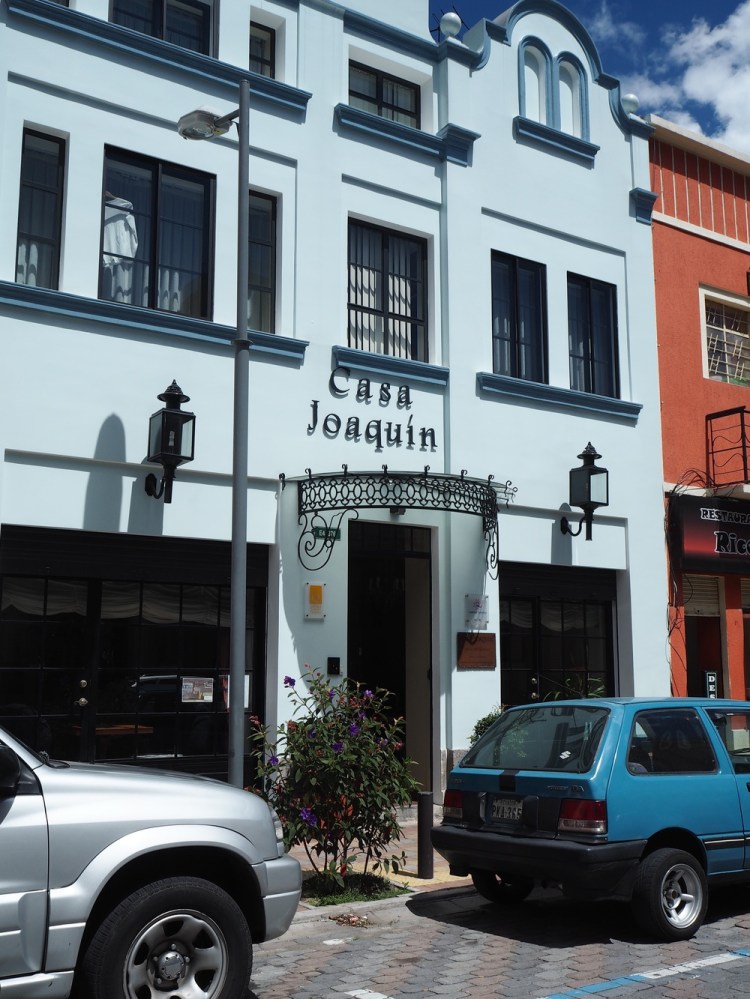
Our hotel in Quito – very nice, despite the occasional hooker and drug dealer hanging around!
There are buses back to Quito, but again we benefit from the fact that for five of us, it’s not that much more expensive to take a taxi. It shaves a chunk of time off the journey and means we don’t have to worry about changing buses with all our luggage. As the crow flies, the distance back to Quito is amazingly short; it makes us appreciate how short the distances are from the coast to Quito in the sierra and from Quito to the Amazon rainforest – and how quickly the terrain and climate change.
We have a warm feeling of familiarity as we drive back into Quito and to our hotel with its little apartment. This is a really vibrant city that I would have no problem living in. We’ve got a final week here to catch up with Adela and her family once more, and to see some of the sites that we didn’t get to see last time we were here.
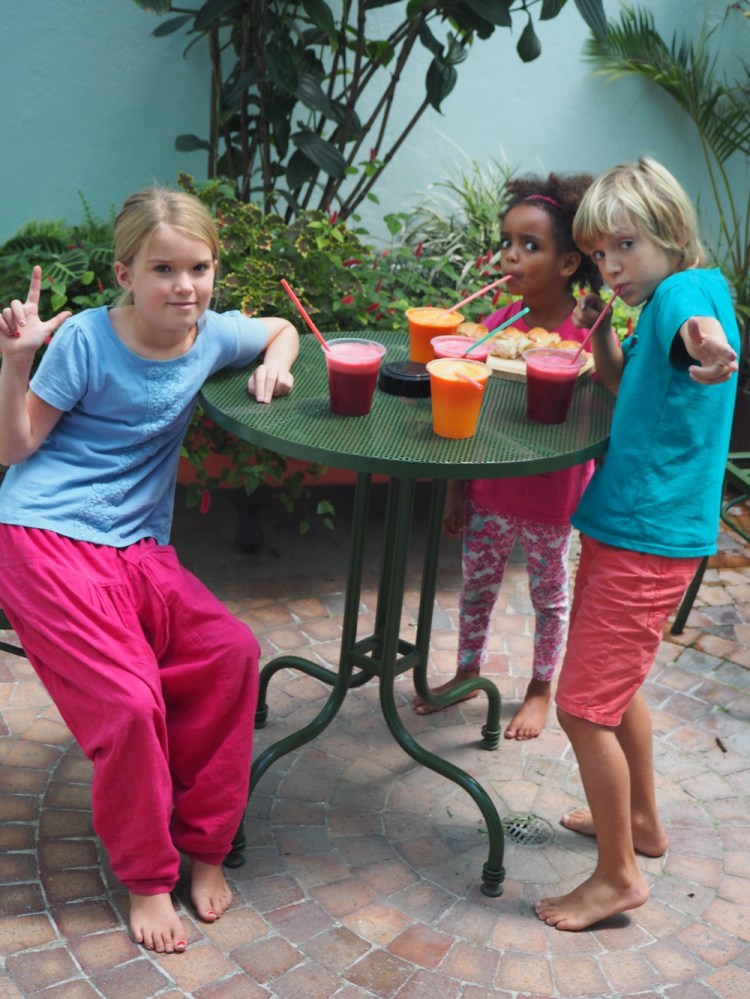
Amazing juice!
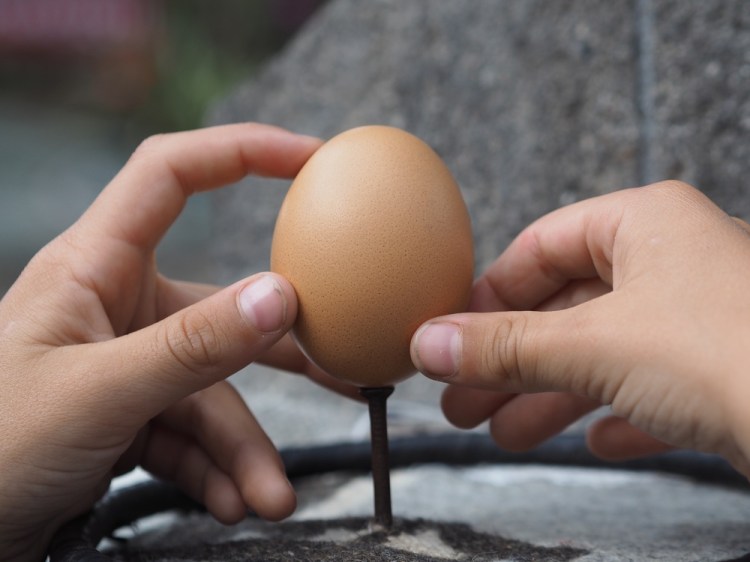
Balancing an egg on a nail is tricky, even on the equator!
We visit the museum that is actually on the Equator (as recently measured by GPS), rather than the one we visited previously, on the line that the French determined as the equator however long ago, that is a couple of hundred metres away. It’s a fascinating museum: not only does the tour include exhibits on the different regions and tribes (including a shrunken head); but also various ‘scientific’ exhibits that explain the Coriolis effect and the effect of being exactly on the equator. (It’s the effect of the centrifugal force of the spinning earth, which at the equator goes absolutely vertically through an object). The obvious experiment is to illustrate the fact that a natural vortex (weather system, water, etc) spins anti-clockwise in the northern hemisphere and clockwise in the south. Our guide has a sink that she fills and repeatedly empties into a bucket, with a few leaves to make it easier to see the water spinning. Sure enough, as she moves the sink first to the north of the line and then to the South, the direction of spin reverses. On the line itself, the water runs straight through the plug hole without spinning at all. It’s quite extraordinary, given she’s only moved it a couple of metres in either direction. Another exhibit involves balancing an egg on the end of a nail – we’re told it’s easier to do on the equator as anywhere else the force of the Coriolis effect moves the yolk (which is of different density) off-centre. To say I’m sceptical of the effect of the changes of these small forces resulting from moving just a couple of metres is an understatement, but it’s all great fun (and does it really make balancing an egg more difficult if its centre of gravity is marginally off centre?). But I do manage to explain to the children (and Fi!) why we weigh less on the equator than we do at home (on reflection, I only explained the easy part of it, but never mind – that’s another maths lesson for the children, for the future).
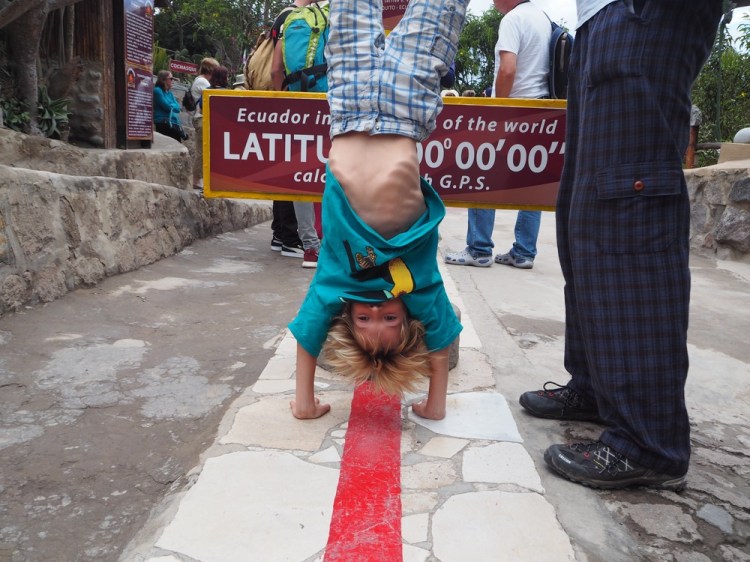
Put your right hand in (the south), your left hand in (the North)…
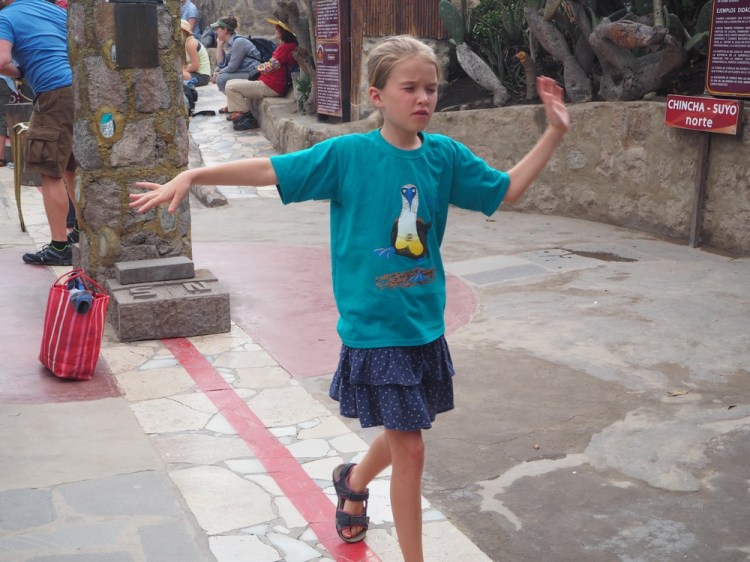
Walking in a straight line on the equator is supposedly more difficult that off it, but I’m pretty sure moving a couple of metres doesn’t make much difference.
We go to visit Fi’s old nanny Adela and her family. She lives on the outskirts of Quito – unfortunately she’s had a bad water leak in her house and so is currently living with her daughter Lupe and family, who live directly across the street. We’ve brought a DVD of Paddington with us, so our three settle down quickly to watch it with Lupe’s two older children, Ariana and Joshua. Once again, it’s a privilege to witness this emotional meeting between Fi and Adela. There are lots of hugs, holding of hands while talking and of course, tears when we leave. Before this trip to Ecuador it’s been 20 years since they last met and I’ve no doubt the thought that this might be the last time they see each other passes through both their minds. It’s so obvious how close this relationship is – how important Adela has been in Fi’s life and vice versa. It’s great that Edison (Lupe’s husband) comes home from work for lunch, so we get to see him to. It’s not so fortunate that Adela’s husband Jorge works as a lorry driver and is currently away. We have a delicious lunch of roast chicken – they insist that I sit at the head of the table and every time I try to clear things away, plates are quickly snatched out of my hands. I’m not sure how much of this is because we’re special guests and how much it’s just that it’s not a man’s role in Ecuadorian culture? This is a great opportunity to practice my Spanish, but during our trips to Vilacabamba, Galapagos and the jungle I obviously haven’t had Spanish lessons and haven’t had the chance to practice too much – sadly it all seems incredibly rusty!
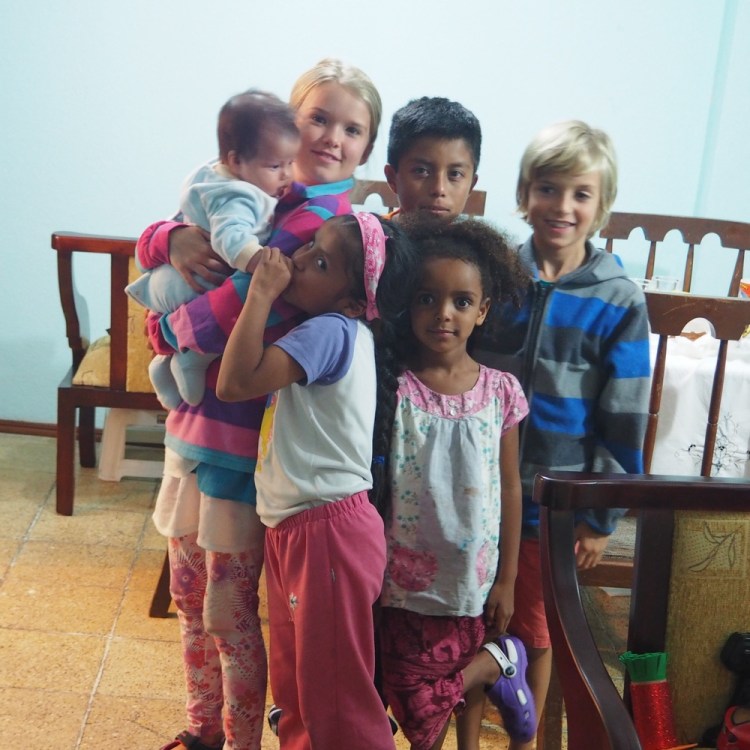
Our guys with Joseph, Ariana and one of the twins (I can’t tell which one)
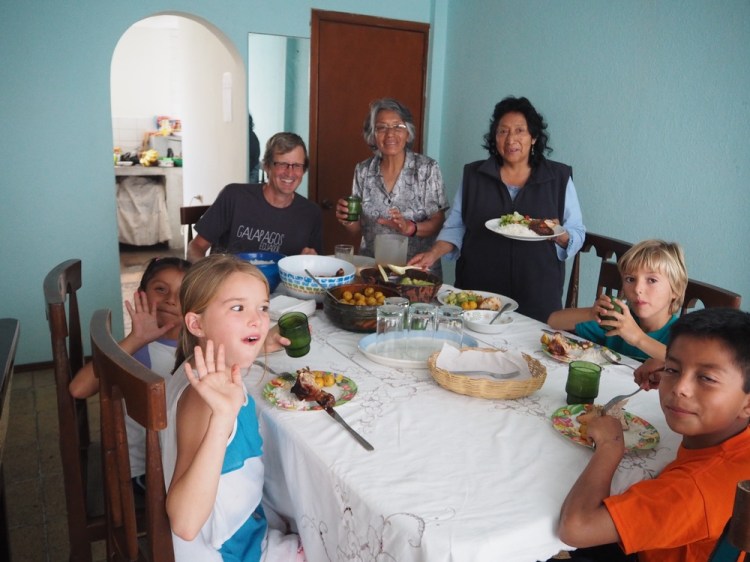
Adela with her cousin, who is more like a sister
Another highlight is our trip to the Guayasamin museum / gallery. I know very little of his work when we arrive but we have a volunteer guide and there’s an introductory film that is very good. He dedicated his life and work to highlighting the suffering of (and his desire for peace and justice for) the oppressed and down trodden, including victims of racism, war and slavery. It’s incredibly powerful work – the canvases are huge, with eyes, hands and body language communicating anguish and oppression so effectively. Jemima and Gabriel are quite interested – they get it and we manage to keep them engaged throughout. Millie, on the other hand, is bored from the moment we walk in and is a real challenge! As with all galleries, the exit route is via the shop; there’s a rack of very large limited edition prints, each which cost more than $2,000 – at one point Gabriel accidentally bumps into it and the whole lot go sliding across the floor! I tell him it’s by far the most valuable things he’s ever knocked over – in total it must have been worth over $100,000!! Still, they were all well protected and no harm was done – Gabriel looked pretty shocked, though!

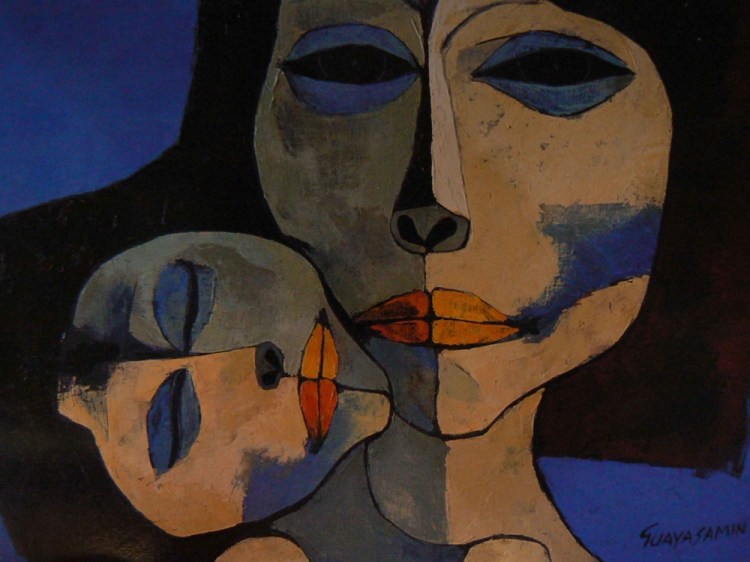
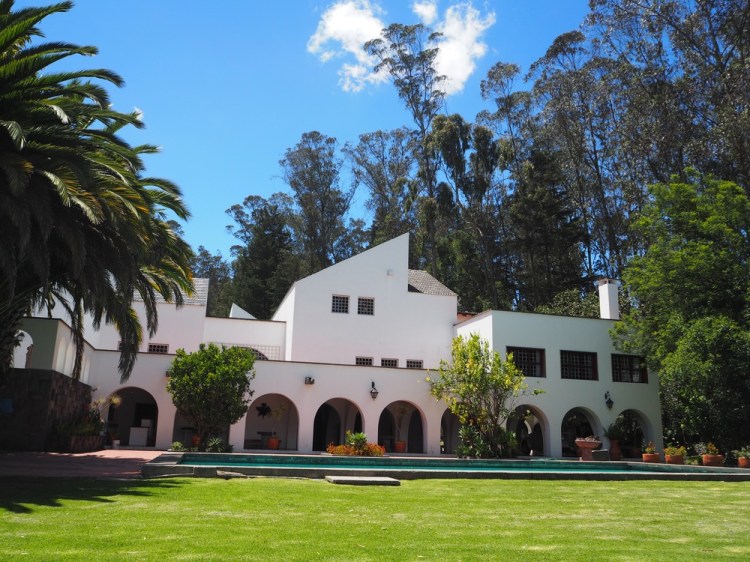
Guayasamin’s house – really beautiful
So after 3 months, it’s time to say adios to Ecuador, Fiona’s birthplace. I’ve really loved it here – I’ve been to Costa Rica and Bolivia before and have very fond memories if both – there’s something about Latin America that’s got under my skin and this trip has reinforced that. For a relatively small country, Ecuador is incredibly varied – the sierra varies markedly from north to south and then there’s the Amazon and the Galápagos Islands. There’s also the coast, the cloud forest and the chain of volcanoes down its spine that we didn’t get to visit this time – we’ll just have to come back!
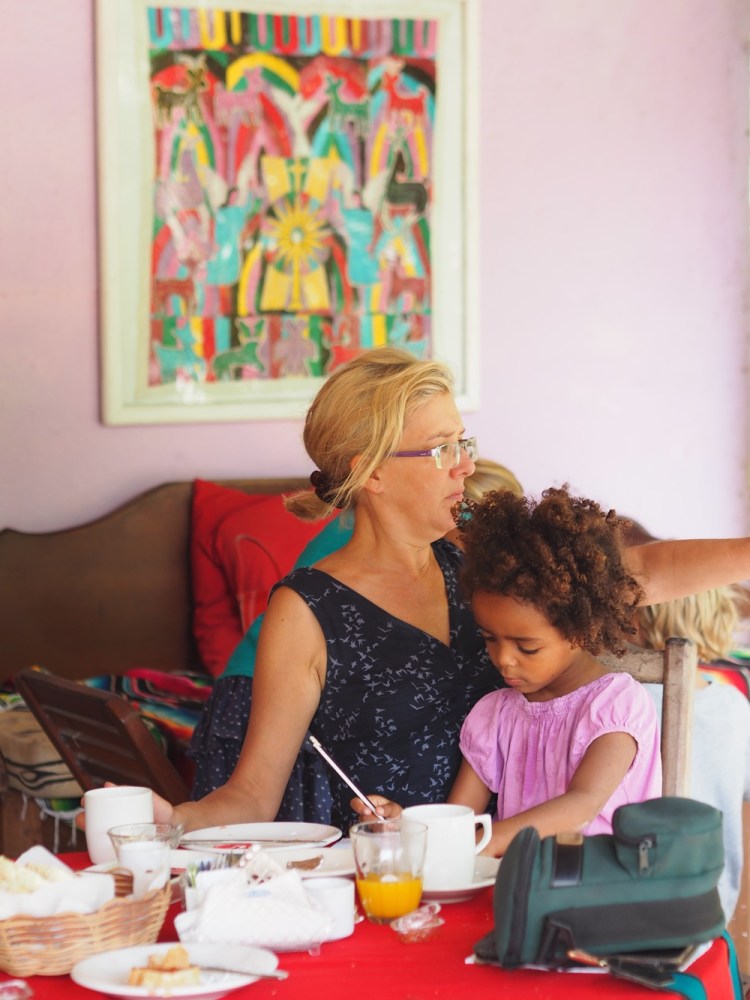
A typical moment in a restaurant, with children drawing.

The change of pace Since we left New Zealand has also been fantastic. In the first 6 months of this adventure we visited 6 countries – in the second 6 months we’ll visit two. We’ve been debating at length whether or not to visit Colombia, which so many people rave about, but in the end we’ve decided to go straight to Mexico. Firstly, flights to and within Colombia would be expensive and distances are bigger, meaning bus journeys would be very long, especially with children. But secondly, we don’t want to try to cram too much in. We’ve really enjoyed immersing ourselves in fewer places, settling into a routine, taking Spanish lessons, etc. Not only has it allowed us to see a different side of places – when we’re not running from place to place, we seem to stumble across special and memorable opportunities (like horse riding in Quenca and Vilcabamba) that we would not otherwise have experienced – but it also takes the pressure off: the children are more settled; Fi and I are not endlessly packing and unpacking; and it’s easier to to find at least a bit of space for ourselves.
Whenever we leave a country I myself asking whether I could live there. So let’s see…. Quito: definitely yes. It’s a vibrant city with just enough ‘edge’ to it; there’s lots going on and it would certainly be possible to get most of the creature comforts that we can’t do without. And it feels like you could get things done here – of course there are problems with the Government but at least they seem to be investing for the future and the infrastructure has obviously improved markedly in the last few years. Otavalo: beautiful surrounding countryside and fascinating to visit, with the very strong indigenas population there, but perhaps not enough going on to live there. Cuenca: I really enjoyed this city and could probably live here, although for 4 months of the year it’s chilly and wet (sound familiar?!). Vilcabamba: stunning surrounding countryside and wonderful for an outdoor life of hiking, cycling, horseback riding, etc. But the town is very small and there are just too many retired Americans hanging and for me, so no. And the Galapagos? Incredible to visit but definitely too remote and too limiting to live here (even if we were allowed to).
So we leave with some very special memories and markedly improved Spanish (although there’s still a LONG way to go!). And now we embark on another long journey, from Fi’s country of birth to the country in which she spent much of her childhood – Mexico. I can’t wait!
 Five Go Round The World
A lovely farewell to Ecuador !
LikeLike
Estoy muy feliz que les haya gustado mi pais ,mi tierra aunque con muchas falencias de las cuales dia con dia tratamos de mejorarlas y creo q vamos por un buen camino …. Espero q vuelvan q los abrazos siempre estaran abiertos para todos ustedes
LikeLike