
After a couple of incredible weeks in the Galapagos, we’re now off for another week that I’ve been looking forward to for a long time. My Dad has always been into natural history and we watched all the wildlife programmes at home as children. But one ecosystem has always intrigued me more than any other for some reason or another – tropical rainforest. I’ve visited primary rain forest before in Costa Rica but the Amazon is clearly top dog, so I can’t wait to visit.
The boys have been excited by this trip for some time – we can’t wait to find anacondas, tarantulas, caiman, etc. The girls, on the other hand, are feeling somewhat apprehensive. Fi is torn between the lure of sharing a once in a lietime experience… and her fear of snakes and other creatures than crawl on their belly. The last thing she wants to see is an anaconda! And she seems to have passed on her fears to Jemima, for whom having a boa constrictor around her waist in Quito doesn’t seem to have been a cure. Also, Jemima doesn’t like the idea of giant bugs and spiders, so she’s very reluctant despite all my reassurances! And Millie? If in doubt she’ll follow her big sister, so she doesn’t want to come either. Fi and I are also worried about how we’ll cope with Millie – asking a 4-year old to wait patiently and quietly to spot wildlife seems somewhat optimistic! So we all set off with various levels of excitement and trepidation….
The journey to get there is long. We fly from Baltra in the Galapagos back to Guayaquil for just one night; the next morning we head back to the airport to fly to Lago Agrio, via Quito. Lago Agrio is one of the gateway towns to the Amazon; it’s about 30 miles from the Colombian border. Oil was discovered in the north Ecuadorian Amazon in the early 70s and Lago Agrio is primarily an oil town. Lago Agrio means ‘Sour Lake’ – it’s a nickname based on the oil pollution in the early days. Apparently, the oil companies have cleaned up their act quite a bit since then but it’s still a gritty, unglamorous town. We’ve chosen to travel here during the day and stay over, rather than take the more popular option of flying up from Quito first thing in the morning. Because we booked our Galapagos flights as a return from Guayaquil it was cheaper this way; also it’s a long journey from Lago Agrio into the jungle, so we didn’t want to add to that with a really early flight.
We are met in the morning at our hotel by our tour guide Diego. We jump on to an old yellow school bus, head to the airport to pick up some more people arriving on the early morning flight and then drive for about 2 1/2 hours, mainly along a road that follows an oil pipeline. Eventually we reach the bank of a pretty wide river and offload our luggage. While we’re waiting to load up our motorised canoe, we chat briefly to four Dutch tourists who are returning from Nicky Lodge (our destination). They say they hope that we are luckier with the weather than them; it’s rained torrentially for one and a half hours of their canoe ride back. The rain has cleared up now, so hopefully that’s it for the rest of the day!
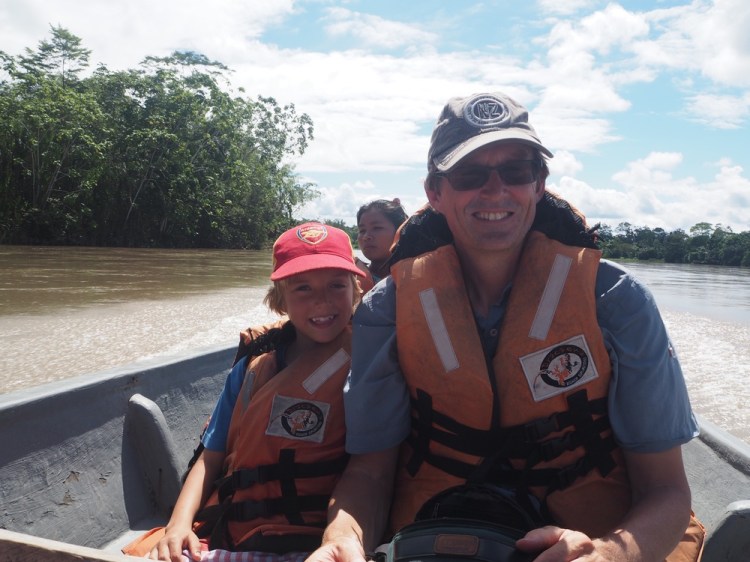
The motorised canoe ride down Rio Aguarico
We climb aboard our motorised canoe and set off downstream, on the slow-moving Aguarico river, which is roughly twice as wide as the Thames in the centre of London. It takes a couple of hours but it’s more comfortable than I expected and the children cope remarkably well. Already I start to think about the mind-boggling enormity of the Amazon river – this pretty sizeable river eventually runs into the much bigger Rio Napo, which itself is just one of over 1,000 tributaries feeding the Amazon. Somewhere on our journey here we’ve passed a point where one drop of rain runs the 200km or so to the Pacific Ocean and the drop landing next to it runs the 8,000km to the Atlantic!
As we journey down the river, the forest gets increasingly dense. Occasionally we see a house or a small community by the riverside, with wooden houses, not surprisingly on stilts, typically with a wooden slatted open walkway on the first floor and a low-pitched corrugated iron roof. We see and hear some wildlife in the distance – red howler monkeys and a pair of yellow & blue macaws flying overhead.

Just before turning off the Rio Aguarico onto the black-watered Rio Cuyabeno (black because of the leaf mould and the fact that it’s only fed by rain water), we suddenly see the community of Playa Cuyabeno. It seems totally incongruous – a community of about 70 brand new, identical, white concrete homes (also built on stilts) with green roofs, regimentally aligned on an immaculately cleared area of river bank. The community has been built by the oil companies working here – they are obliged to support the local Quichua communities, many of whom are their employees. It’s easy to look at this sterile looking collection of dwellings and wonder what’s going to happen to their ancient traditional culture but on the other hand, they are probably very happy to have jobs and clean, dry homes with electricity, cable TV and internet.
About 40 minutes down the Rio Cuyabeno, in the Cuyabeno Reserve, we turn off the river through a clearing in the trees into an oxbow lake, at the end of which lies our home for the next 4 days, Nicky Lodge. We are welcomed ashore and start to explore. The main building has a large, high communal sitting and eating area, with plenty of hammocks for chilling, which is a good sign. There are no windows or mosquito screens. We’re told that there’s electricity for a few hours a day to recharge camera batteries etc. There are also plastic storage bins in which we’re told to keep any food products – no food is to be kept in the bedrooms as it will attract critters!

Nicky Lodge – our home for 4 nights here in the jungle
Behind the main building, connected by raised wooden walkways are about 8 thatched wooden bungalows, each with two ensuite bedrooms connected by a balcony at the front. We knew when we chose Nicky Lodge that the bedroom windows are completely open – no glass or screens – except for the front windows which have screens, presumably for some semblance of privacy from other guests walking past. But they do have very good quality, long mosquito nets – we’ve read that if we tuck them under our mattress we’ll be fine!
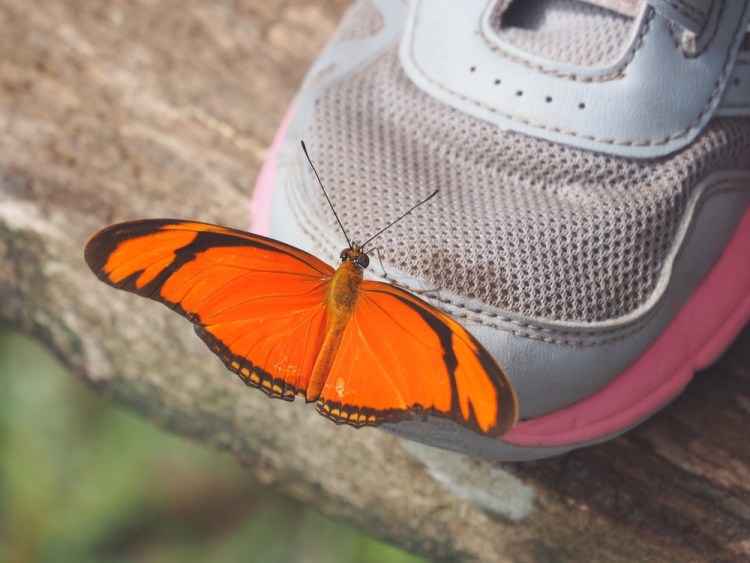
There are plenty of butterflies here

Another one!
Our first learning experience is that while we put our food in the plastic bins as requested, unknown to us there are obviously some crumbs left in some of our bags, which we’ve left on the spare bed in Fi’s room. When we return a couple of hours later, there are dozens of cockroaches scuttling over our luggage, including in our bags and among our clothes!! You don’t need many guesses to discover whose job it is to resolve that little problem! The following day we realise that cockroaches also seem to include toothpaste on their menu, as our toiletries bag (which thankfully is see-though) also has a couple of roaches inside. There are worse things in the world than cockroaches, but they never fail to make me jump with their extraordinary speed off the mark!
There’s a walkway down to the main river, where we’re told we can swim safely – water is pumped from here to our rooms. The water is muddy and dark and I’m afraid to say, I’m not wildly tempted! (We’re told we shouldn’t swim on the other side as the stationary water is more acidic and has electric eels, more caimans and pirañas).
On our first evening we go for a night walk before dinner. We’ve been kitted out with Wellington boots, which is just as well as it’s extremely wet underfoot. Before we even reach the forest, we see several cane toads sitting on the grass, about as large as a tennis ball. We have to be careful to pick them out with our torches so that we don’t tread on them. Immediately we’re into the forest, Diego starts to spot all sorts of crickets, grasshoppers and various hunting spiders (they go hunting for prey rather than building a nest). Jemima and Gabriel are right into it, immediately showing great skill at spotting things. Millie, needless to say, is bored.
After a very good meal, with our mosquito nets safely tucked in (after a thorough check for roaches) and the hum of the jungle to lull us to sleep, we have a surprisingly good night. Our first full day begins with a canoe ride before breakfast – it’s beautiful going up and down the river, with the trees reflected in the water. Right opposite the lodge there is a tree that’s full of dozens of Hoatzin – a large, noisy birds that look a bit like a prehistoric turkey. This is clearly not the Galapagos – as we quietly slip through the water across the river, they all disappear into the trees behind. Diego has an extraordinary ability to spot and identify wildlife. At one point he stops the canoe and points to a tree saying there’s a 3-toed sloth moving through the branches. Even with him describing exactly where it is, it takes me about 10 minutes to see it through the binoculars – it’s pretty motionless and incredibly well camouflaged – how he saw it I really don’t know. We also see a few toucans flying high overhead – Diego tells us exactly which species but again it’s remarkable how he can tell. Millie is sitting next to Fi and once again she’s bored after 10 minutes – it’s really difficult for Fi to keep her occupied; we need to find another solution.
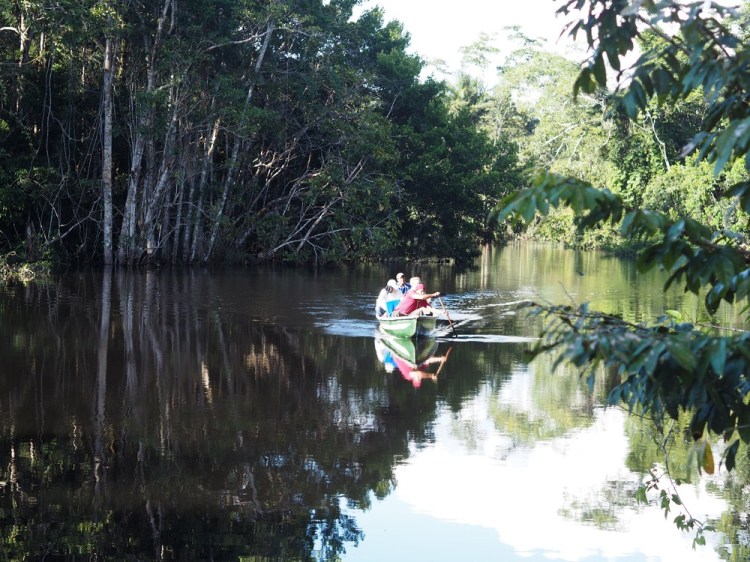
The tranquility of a canoe on the river
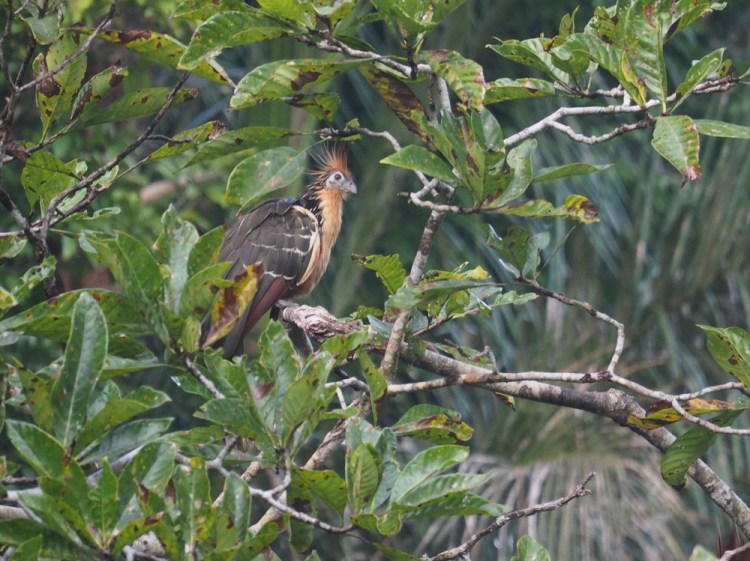
The strange, noisy, hoatzin
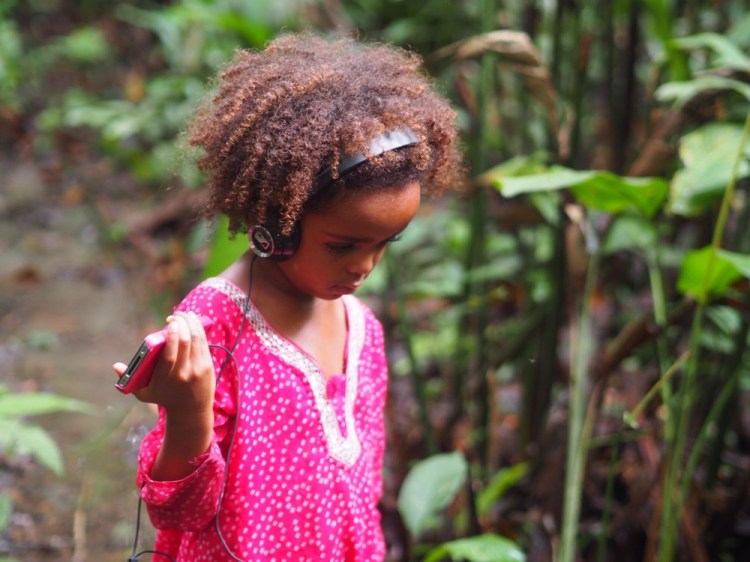
Millie, enjoying our educational jungle walk!
After a large breakfast we head off for a walk into the forest. After last night’s experience with Millie, we decide to bring an iPhone and headphones to keep her entertained – so while the rest of us are hanging onto Diego’s every word as he tells us about the plants, trees and animals, Millie is in her own little world, listening to the Mama Mia soundtrack!! Highlights (of our walk, rather than Mama Mia) include:
– the Unguraua tree, which is incredibly useful for the indigenous tribes: the roots are used as a dental anaesthetic; the trunk for house-building; the fruit for making Chica (jungle beer); and the stringy bits around the top of the roots (part of the new leaves) for making dolls hair (and moustaches!).
– Diego shows us how fibres from leaves of a Pita (a type of bromeliad) are extracted and used to make ropes.
– There are dozens of fungi, including the beautifully delicate Wine-glass mushrooms and the ‘immortality mushroom’ (Ganoderna Aplanatus) – a type of bracket fungus that’s incredibly valuable in Asia where it’s used for medicines to boost the immune system, eg for cancer. Also another thin mushroom that can be used as a natural antiseptic wound dressing
– The Pechiche Tree – this is a super hard and durable tree; we see a dead tree has apparently been lying there for 50 years (most trees would decompose completely within 3 years).
– Walking trees: they have spiky, stilt-like roots, with the trunk about 1.5m above the ground. As the old roots die off, they throw out more new roots in the direction of the sunlight and can thereby can move to find more light – about 4m over 20 years. Their spiky roots are also used to grate food, such as yucca.
– Leaf cutting ants – incredibly fascinating and impressive creatures – I could write a whole blog about them but Gabriel has already done that, so I won’t bother!
– Army ants: the large soldier ant used to be / is used by tribes here to staple wounds. The ant is held to the wound so that it grabs each side of the cut with its strong pincers and holds it together; you then pull off its body and leave its head attached. It even has its own in-built anaesthetic!
– an enormous Ceiba Tree; this one is around 800 years old and 42m tall, with enormous buttress roots. They can grow to around 70m tall and curiously, apparently always occur in primary rain forest in pairs, growing close together.
– the Blue morpho butterfly; an extraordinarily beautiful, iridescent blue butterfly the size of my hand, that dances through the undergrowth. When they land, they close their wings and are dull brown, but when they fly – wow!

Jemima and Gabriel hang onto Diego’s every word
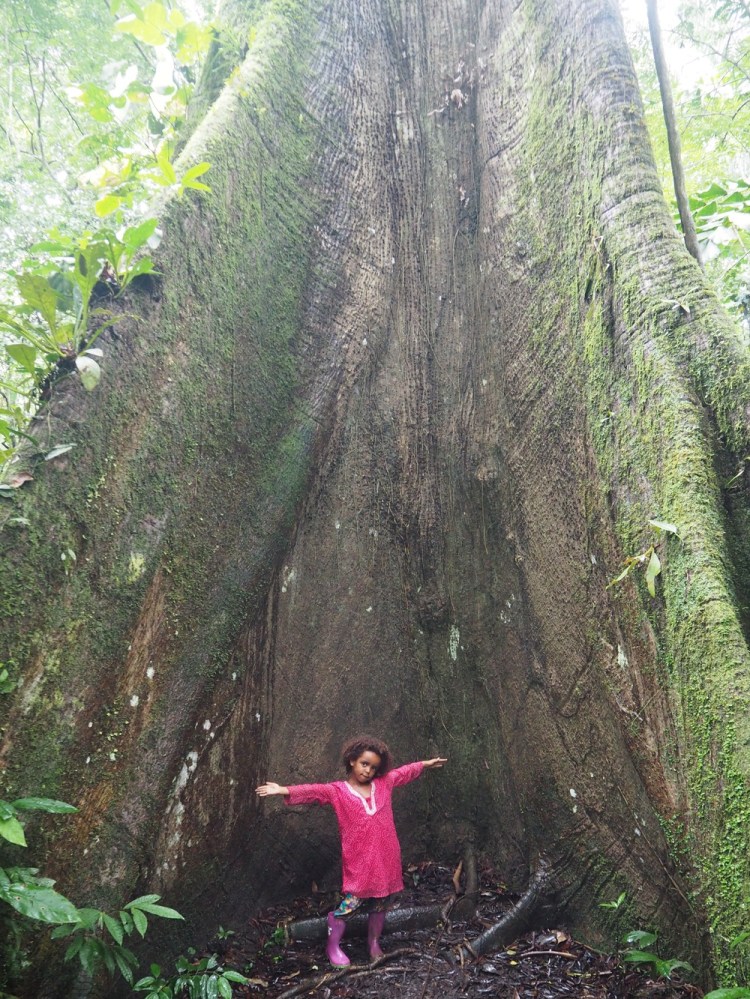
A serousy large Ceiba tree – those are what I call buttress roots!

Beautifully delicate wine glass mushrooms…
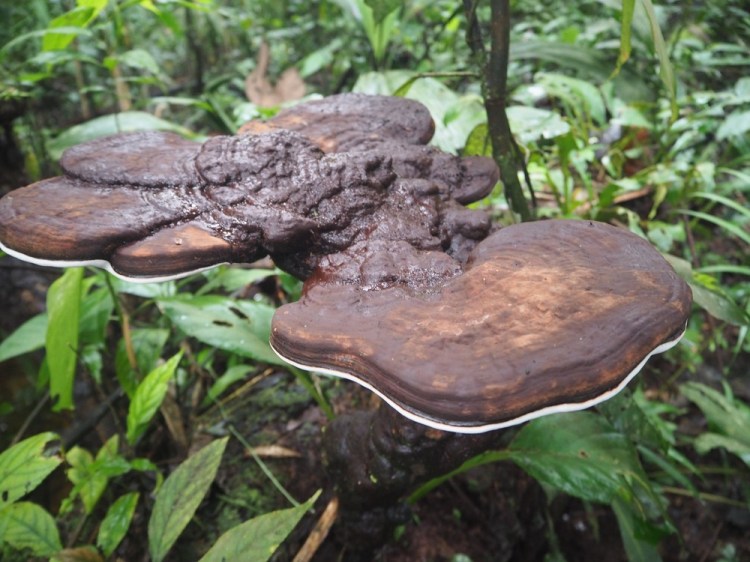
…and the ‘immortality mushroom’
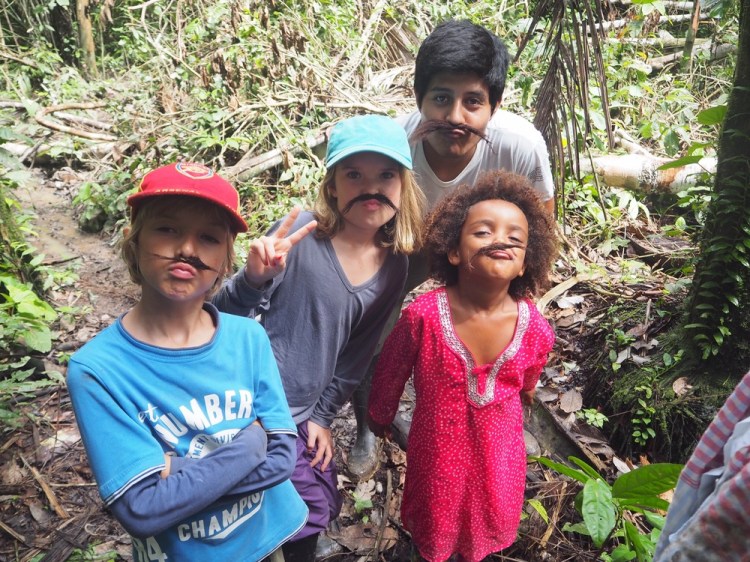
We’re not in Mexico yet, guys!

The truly incredible leaf-cutter ants
After a large 3-course lunch, we rest for a couple of hours before going out for another canoe ride late in the afternoon. Again, we’ve gone for the iPad and headphones approach for Millie, which seems to work pretty well! This time we see beautiful scarlet and chestnut fronted macaws; flocks of greater ani (with similar colouring to starlings – black, with hints of petrol blue as they catch the light); a troop of a hundred or so squirrel monkeys swinging their way through the trees and black-mantled tamarind monkeys (there are 10 species of monkey in Cuyabeno reserve). As darkness falls, we see some night monkeys in the distance and as we glide silently back to the lodge, we are greeted by candles that have been placed down each side of the jetty – it’s a magical sight.
There’s a Dutch couple staying in the Lodge, too – she (Tatiana) is passionately into wildlife and the rain forest. She was born in Siberia and grew up with animals – apparently she was 7 years old before she met a single person other than her family! She spends every spare minute out walking alone in the forest. They tell us that they’ve got bats in their room – lots of them! They live in a tiny crack between two wooden boards in the corner of their room and are continually flying around them at night! They don’t seem to bother them too much.
The staff here are terrific – there’s an obvious camaraderie between them and they all help each other out. Diego, our guide, is the main joker. The chef is from Bangladesh; he has a really long name that’s difficult to pronounce, so the others just call him Bangladesh! His food is very good but portions are enormous, with a large breakfast and a 3-course meal for both lunch and dinner. And sitting in a canoe doesn’t work up much of an appetite! We have to repeatedly ask to reduce the portion sizes for the children. Another of the staff kindly spends ages carving a beautiful ring for Jemima out of the seed from the walking tree.
Just after we’ve finished dinner, one of the other guests suddenly points out a long, skinny snake that’s gliding along the rail on the waist high wall of the dining area. We all (other than Fi) move closer to take a look. Millie doesn’t seem to realise what’s going on and suddenly walks alongside the wall, running her hand along the rail. Fi shrieks and she stops just inches away from the snake; Millie seems to think this is a great joke and can’t stop laughing! (Fi is not laughing quite so much!)
We spend day 3 almost entirely in the canoe. We see squirrel and capuchin monkeys living together (see Jemima’s blog on their symbiotic relationship); red howlers again (they make a truly wonderful noise); yellow & blue macaws (we get a great view of them in a tree); green ibis; the brilliantly coloured Masked Crimson Tanager; and loads of white-winged and white-barred swallows catching insects just above the river.
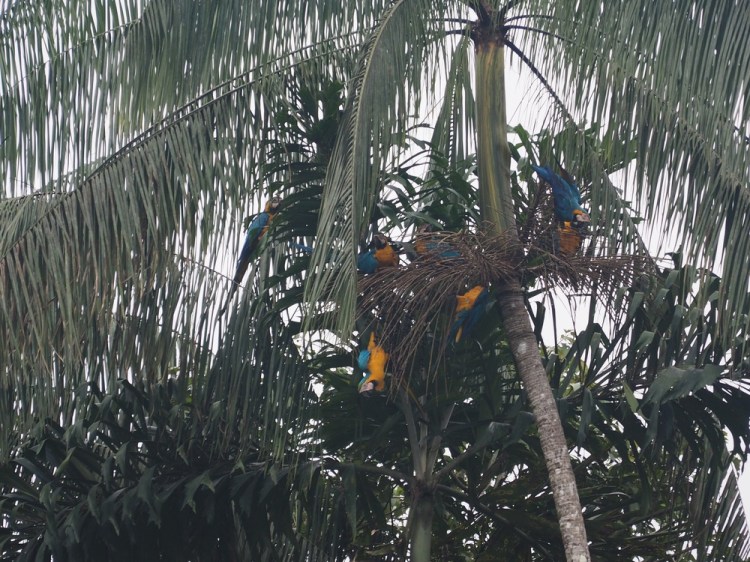
A great display of yellow & blue macaws

Masked Crimson tanager
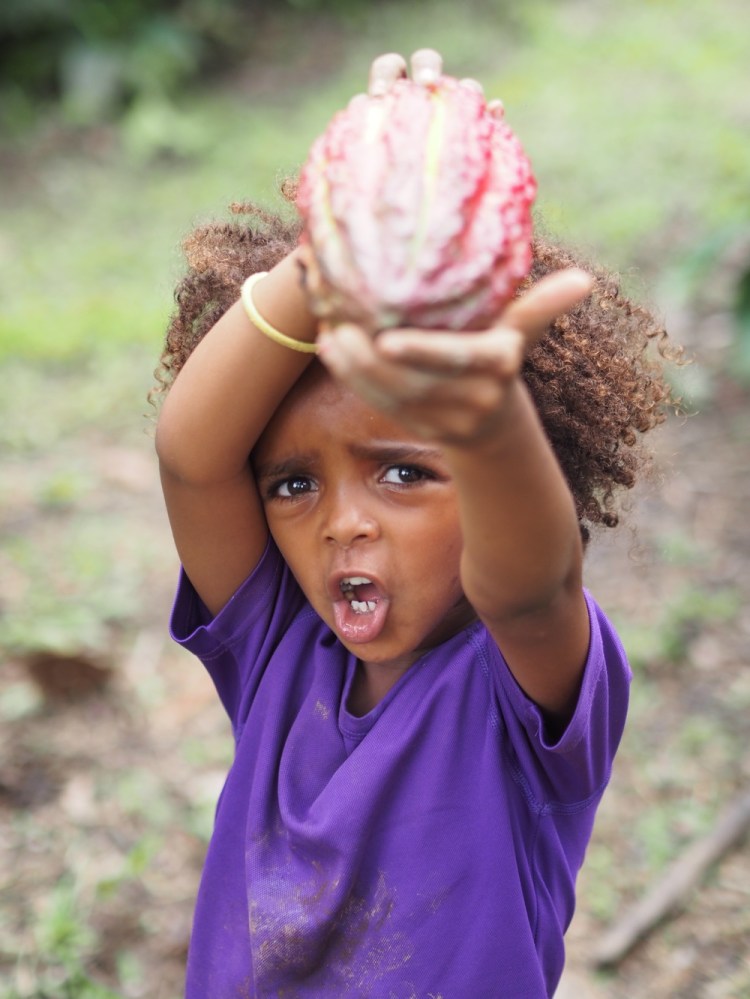
Look at my cacao pod!
At lunch time, we stop at a friendly Quichua house, where we get to dig up yuccas and make yucca bread, as well as seeing their cacao plantation. They used to grow a lot of coffee here but the profit they made was derisory – they can make significantly more growing cacao. Unlike Ethiopia, people here don’t drink much coffee – it all goes to export. The same is true for chocolate.
The process for making yucca bread is interesting, although it’s all done in a purpose built building and the woman demonstrating is wearing a Dracaena (the tour company that runs Nicky Lodge) T-shirt. What’s more, it turns out they don’t make yucca bread for themselves either these days – it’s just for the tourists – so it’s not quite the authentic tribal experience that we’ve enjoyed elsewhere. We all join in grating the yucca root into a wet pulp (on an iron sheet with nail holes through it – not on the walking tree root, like in the good old days!). It’s then laid out on a length of woven tree bark and the excess water squeezed out. The dry powder that’s left is cooked directly over a fire, like flat breads we’ve seen in various other countries we’ve visited. The dry particles stick together surprisingly well in the heat, and the final product tastes pretty good.
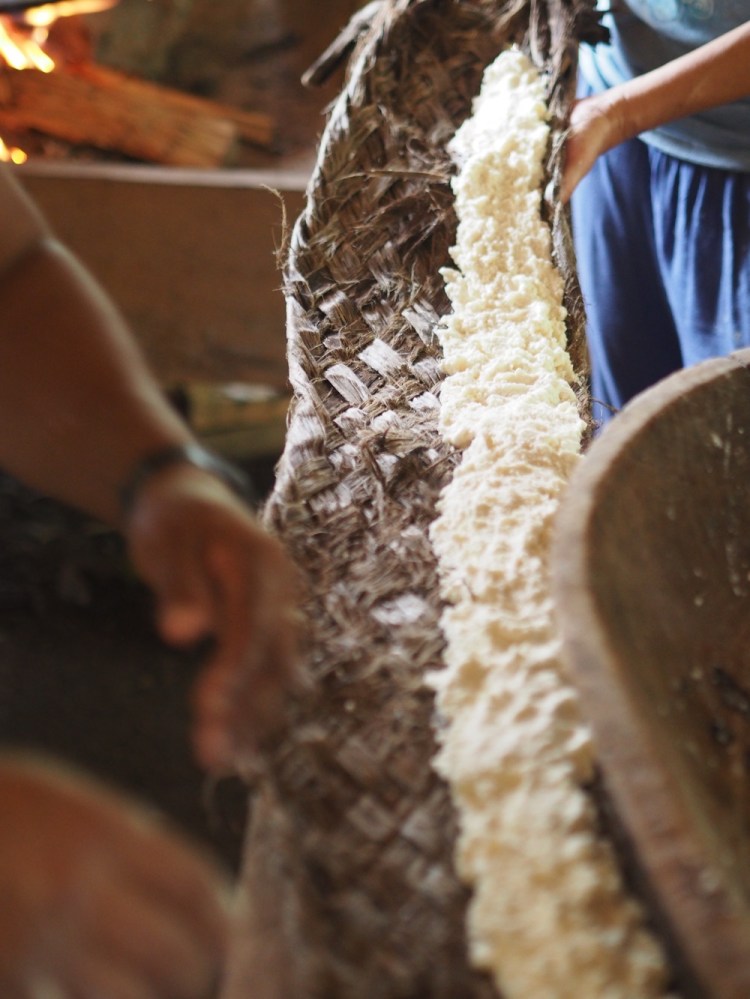
After grating the yucca into a soggy wet pulp, it’s laid in this dryer made of woven tree bark, wrapped tight, suspended from the ceiling and twisted really tight, using a stick to get maximum leverage to squeeze the excess liquid out. what remains is almost completely dry.
After lunch we go piraña fishing. It’s pretty simple, with a length of fishing line tied to a stick, attached to a steel trace and a hook. We put a small piece of beef on the hook, thrash the water a few times with the stick and let our bait fall into the water. Immediately, I get a nibble. But I’m too slow and when I lift the hook out of the water, the bait has gone. I repeat the exercise with identical results. Diego reminds me that the objective is to catch the fish, not to feed them! Then Jemima get a bite and manages to get her fish out of the water… but it falls off the line before she can get it into the boat! Our boat driver does manage to get the fish aboard; it’s pretty small – only about 10 cm long – but it’s all been great fun.
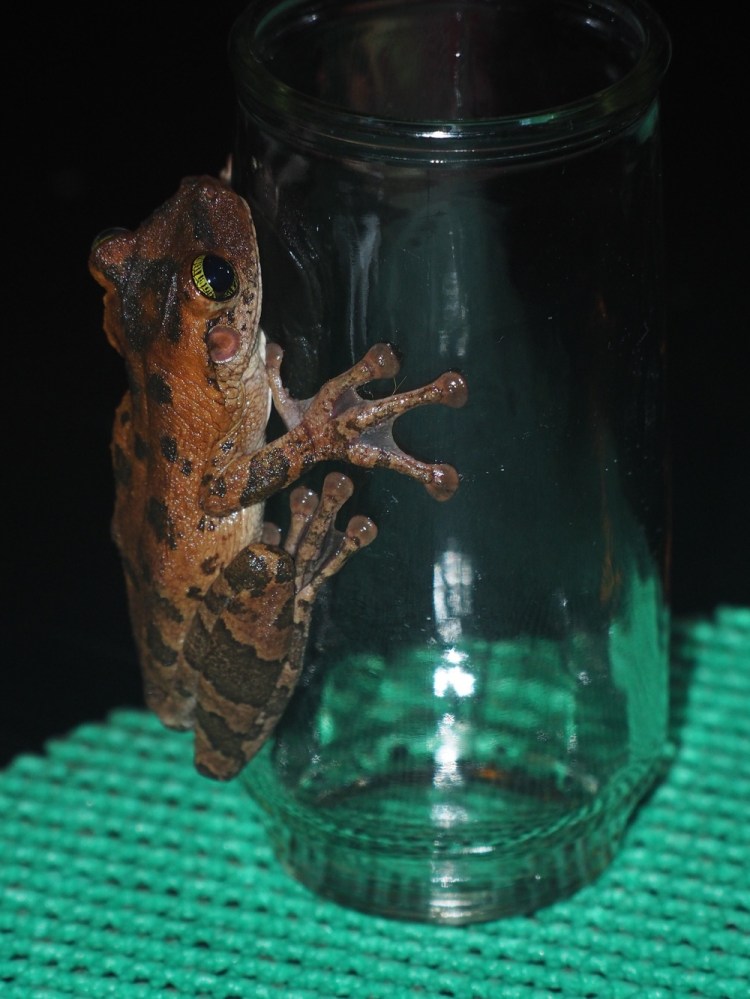
This frog made Jemima shriek by jumping onto her hand after dinner!
Day 4 starts early with another boat ride to a clay lick where parrots come to get essential minerals. The water levels aren’t ideal at the moment but we still get to see: Dusky-headed parakeet; Orange-cheeked parrot; Cobalt-winged parrot; Yellow-crowned amazon (parrot); Orange-winged amazon (parrot). We also get to see another sloth – this time the 2-toed variety – and again it’s absolutely extraordinary how Diego manages to spot it, a motionless bundle hidden among the branches about 100m away.
After breakfast, it’s another jungle walk. This time we decide to leave Millie at the lodge with one of the staff. She’s got to know them well enough by now and so is okay with that. And it’s a much better option for us as we can focus on what Diego is telling us, without worrying what Millie is up to. It’s another incredibly interesting and informative walk. Just as we are setting off, Gabriel spots a white throated Toucan really close to us in the trees. Up to now we’ve only seen them at a considerable distance, flying overhead, but this is a fantastic view of this extraordinary bird with its ludicrous bill. Once again, we see loads of ants: leafcutters; army aunts; fat bottomed ants (!); and bullet ants. Of all the creatures here it’s the bullet ants that I am most afraid of. They have a potent neurotoxin and are so named because if you are bitten by one, and the pain is like being hit by a bullet and it lasts for 24 hours with a high fever. Our guide, Diego, was bitten by one a few months ago; it fell onto his neck and he picked it off his neck, thinking it was something else. It bit him on the thumb and he lost his nail. And unlike other ants, which we see by the thousand, these seem to wander around in ones and twos on leaves and branches, often quite close to the paths. Talking of ants, we find a tiny variety on a tree trunk. Diego tells the children to put their finger among them until they climb onto their finger and then to eat them! We all do as instructed – incredibly, they taste of lemon! We also find lots of termite nests; Diego puts his hand on a nest and waits until his hand is absolutely covered in termites. After several seconds he shakes them all off and wipes his hand all over his face and neck. He tells us that the substance they excrete is a particularly good mosquitoe repellant!
Fi and Jemima catch a glimpse of a small Fer de Lance snake, but unfortunately Gabriel and I miss it. Diego makes a valiant attempt to find where it has gone, by poking around with a stick in the roots of a tree, but apart from the snake being highly venemous, he has to stand amongst thousands of army ants to get close, so gives up pretty soon. Diego shows us a vine with sap that’s an anti-neurotoxin – pretty handy for bullet ant bites – that smells like tea tree oil. We also see a tree with bark that smells like garlic and a huge strangler fig. I find these amazing, how they start from a single aerial route and grow to such an enormous size, the individual strands melding into one another to form a massive trunk.

The white throated toucan – a fabulous spot by Gabriel!

Eating lemon ants – look carefully, you can see them on Jemima’s tongue!
For the afternoon’s canoe ride, Diego unusually insists that we all wear lifejackets, which I find a little strange. He tells us he has a surprise for us. As we approach a very ordinary looking bush, he tells us to be very quiet, and then on the count of three, to shout “MARCH” as loud as we can. We do as instructed and immediately hear what sounds like soldiers marching on gravel, coming from within the bush. Diego tells us it’s a wasps nest and that the wasps are warning us to steer clear. After a couple of minutes the marching sound dies down, so we shout again and it immediately starts up again. It’s extraordinary how thousands of wasps can immediately synchronise the sound. Diego says that if we poked the nest, the wasps would immediately come out and attack us, and we’d have to jump into the river to escape. I realise he’s not joking and that’s why we’re all wearing lifejackets! For the record, we also see a Spix’s guan, a Long-billed wood creeper, a Red-capped Cardinal and Fishing bats.
Diego offers to take whoever wants to go on a night walk before supper. Gabriel and I immediately accept; the girls head for the hammocks! Diego guarantees that we will see a tarantula – take him up on that by saying that if we don’t, he will have to give us a full refund on the trip! He seems pretty confident. We head to one of the huts in the lodge and Diego starts to poke a stick into a hole in the ground, about the size of a table tennis ball. After a couple of minutes it’s clear that the inhabitant has no intention of playing ball. We head to another hole by the path and Diego tries again. It looks like we might be unlucky again, but after much perseverance, a tarantula emerges from another hole a few centimetres away from the first – they have several doors to the houses! I’d always thought that tarantulas were not venomous but apparently that’s only true for one species that’s always used in films. The majority, whilst not deadly, have a pretty nasty bite, with a neurotoxin. As soon as we are into the forest we see several more spiders, including a Machine spider and a Scorpion spider. We also see a snail eating snake; it’s pretty small, but it’s a snake!
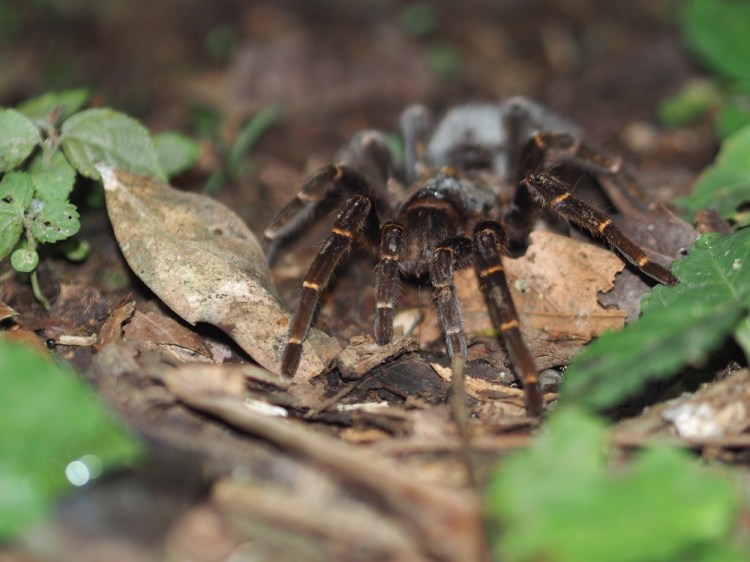
The tarantula that cost us our refund!

A machine spider – this one’s about as big as my hand. It’s also venomous and apparently they can jump!
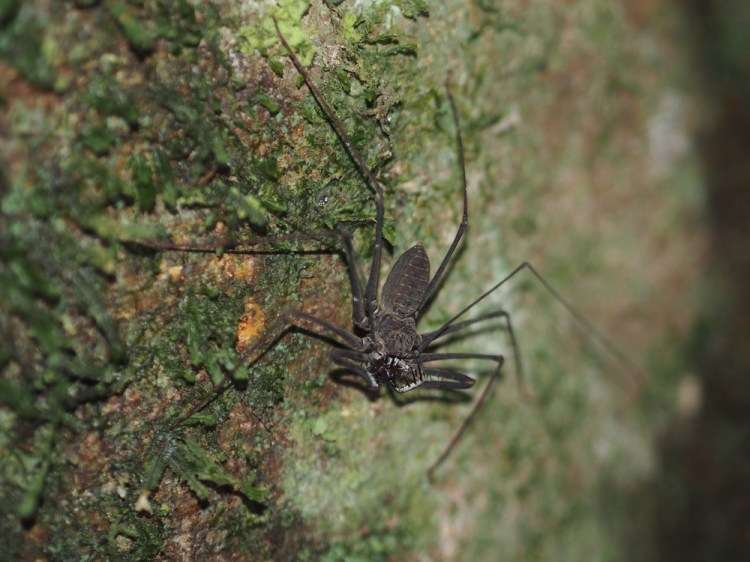
This scorpion spider is also about the size of my hand; when fully grown they can be as large as a dinner plate – eek!
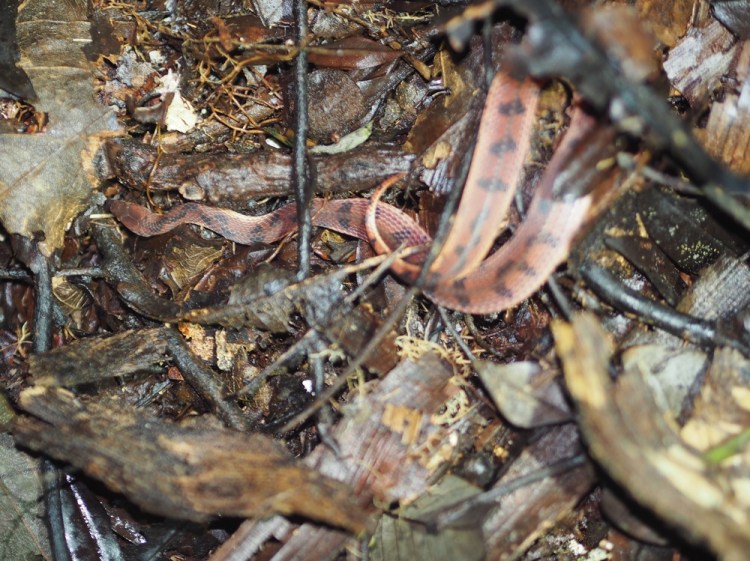
A snail eating snake – one of the very few snakes we’ve seen on this trip.
The next day we retrace our steps back to Lago Agrio. It’s been an ordinary experience here and we’ve seen loads of wildlife. As expected, it’s been completely and utterly different to the Galapagos. In the Galapagos, we saw lots of a relatively small number of species. And the wildlife there is so extraordinarily approachable. Here, the opposite is true. The biodiversity is mind-boggling – when walking in the forest it’s easier to see 30 different species of trees than it is to see 30 specimens of one species. And you can easily count dozens of species living on a single branch of a tree. But it’s much more difficult to see the larger animals at close quarters – it’s mainly been thrush binoculars.
So, was bringing the whole family into the Amazon jungle a good idea? Well, despite all the venomous creatures we saw, we always felt completely safe and didn’t really have any close shaves. Both Jemima and Gabriel absolutely loved it, despite Jemima’s fears at the outset. Only once did they complain that ancanoe ride was boring. However, bringing a four-year-old into the jungle is certainly a challenge! All our fears about Millie being bored on walks and canoe trips were realised – without resorting to music and headphones it would have been incredibly difficult! And it was much more difficult to make sure Millie didn’t touch anything on the walks.
Apart from the cockroaches, it was extraordinary how few insects and other creatures came into our bedrooms, despite the lack of windows, and the whole set up, including the staff, was excellent. As for Fi, I think on balance she’s pleased that we all came, although I think she’s pretty relieved we didn’t find any anacondas!

A house across the river where some of the cleaning staff live
[Some other animals that Diego says we saw, that I haven’t already mentioned:
Red throated caracara
White hawk
Great potoo
Whispering ibis
Amazon kingfisher
Green kingfisher
Ringed kingfisher
Many banded aracari
Ivory billed aracari
Channel billed toucan
Lineated woodpecker
Long tailed woodcreeper
Social flycatcher
Crested oropendola ]
 Five Go Round The World
This is utterly, utterly fascinating. Freya has been studying rainforests at school this term and we’re sending this blog to her teacher to use in class. Thank you for painting such a wonderfully vivid picture Mark!Frances x
LikeLike
Thanks, Frances xxx
LikeLike