We leave Siem Reap after a few short days, having survived the temple visits and enjoyed the hotel & pool, and take a bus down to Phnom Penh. We’re only here for a day but First impressions are of a sophisticated modern city. Although 80% of vehicles are motorbikes, I’m struck by the quality of the cars on the streets – they all seem fairly new and while the leading brand by a long way is Toyota, the 2nd most common is clearly Lexus (lots of SUVs), which would be out of our price range in London!
While I’m here I feel that I have to see either the Killing Fields or the Tuol Sleng Genocide Museum. Fi would like to go too, but we feel that it’s not suitable to take the children so she kindly offers to stay back while I go. I get a tuk-tuk to take me – I’m a little taken aback as the driver asks if I’d also like to visit a shooting range where you can shoot rifles and automatic weapons, which is nearby the Killing Fields. After my visit, I reflect again on the shocking irony of that offer.
It was a strange 30-minute journey to the site – I was torn between observing the very real, everyday life of people in what was a very ordinary and poor part of town, and the fact that I was about to visit a truly extraordinary place in which thousands of innocent people were bludgeoned to death and dumped into mass graves. For those of you who have visited this place, you’ll understand when I say that’s it’s hard to find the words to describe the experience. There is very little physically remaining, but the audio tour is as excellent as it is harrowing, with personal stories of survivors of this truly terrible time. I found myself audibly gasping in horror at some of the things I heard and saw, amplified by the fragments of clothing and bone that are still emerging out of the earth 50 years on. It’s hard to comprehend just how extraordinarily cruel ordinary people (for that’s what the perpetrators were, just like you and me) can be to others, including small children. In the commemorative temple, filled with thousands of skulls recovered from the site, it was shocking to see the very matter of fact illustrations of the different skull injuries caused by each of the farming implements that were used as murder weapons – they were images that came back and back for several days.
I’m emotionally spent by the time I’ve finished and sit quietly in the tuk-tuk as I’m slowly reabsorbed back into 2014 Phnom Penh. Apart from the sheer inhumanity and cruelty, I reflect on the warped political ideology that drove Pol Pot and the Khmer Rouge – how could they possibly have believed that their social experiment could succeed? Okay, I’m the product of a capitalist country (and the Thatcher years), have worked for many years for a global corporation and am viewing it from a largely post-communist era, but still. Obviously, their goals were completely different to any modern country (North Korea excepted), but for them to seriously think they could isolate themselves completely from the rest of the world, eliminate commerce, even the currency, and survive let alone succeed? To actively rip out the foundations of their society and tear up the fabric of their culture, dismantling religion, deliberately rupturing family structures, friendships and loyalties, all sense of stability and belonging, and expect to successfully replace this with a commitment and loyalty to a state concept? How could they possibly imagine they could succeed in increasing rice production threefold in year 1 (which is what was required for self-sufficiency) with a completely traumatised, emotionally bereft, under-nourished workforce, motivated purely by fear for their lives?
As we drive back, the modern buildings, signs of technology and ubiquitous Lexus strike me differently… how on earth has this country recovered to such an extent (economically at least) in just one generation from a situation in which everyone with any education or who was involved in any form of commerce was either summarily executed or sent to a labour camp where they were starved to death? I look at everyone my age and over and wonder what their story is – were they perpetrator or victim? And how does the one get on with the other these days? As depressing as my visit to the killing fields was, surely the nature of this startling recovery is cause for optimism and belief in human spirit? (On the other hand, the current Prime Minister is ex-Khmer Rouge and has been in power for 25 years, by brutally suppressing political opposition and through corrupt elections).
With all of this weighing on my mind, I’m grateful for the fact that we’re meeting with Shunmay and Nicola for dinner. It’s lovely to see them, and they treat us to one of the most memorable meals of our entire trip – a traditional barbecue with a vast selection of fish, seafood and meat, with the traditional dipping sauce made from Kampot pepper, salt and lime juice – it had our taste buds dancing in delight! And we didn’t talk about the Killing Fields all evening!
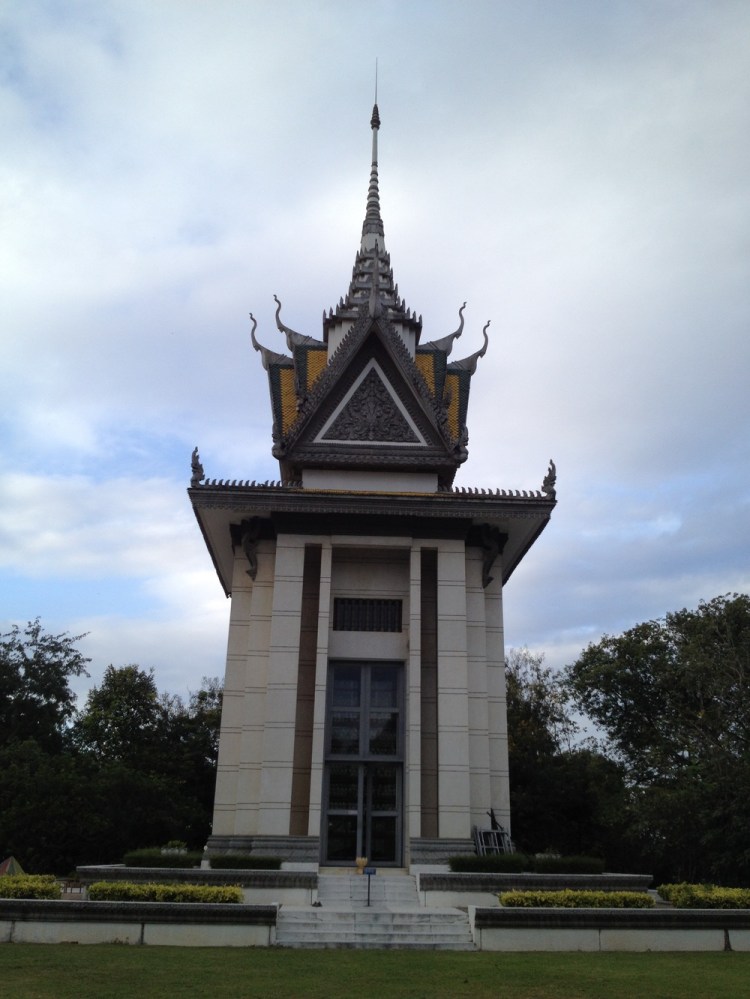
The commemorative temple at the Killing Fields, completed filled by human skulls from the site.
 Five Go Round The World