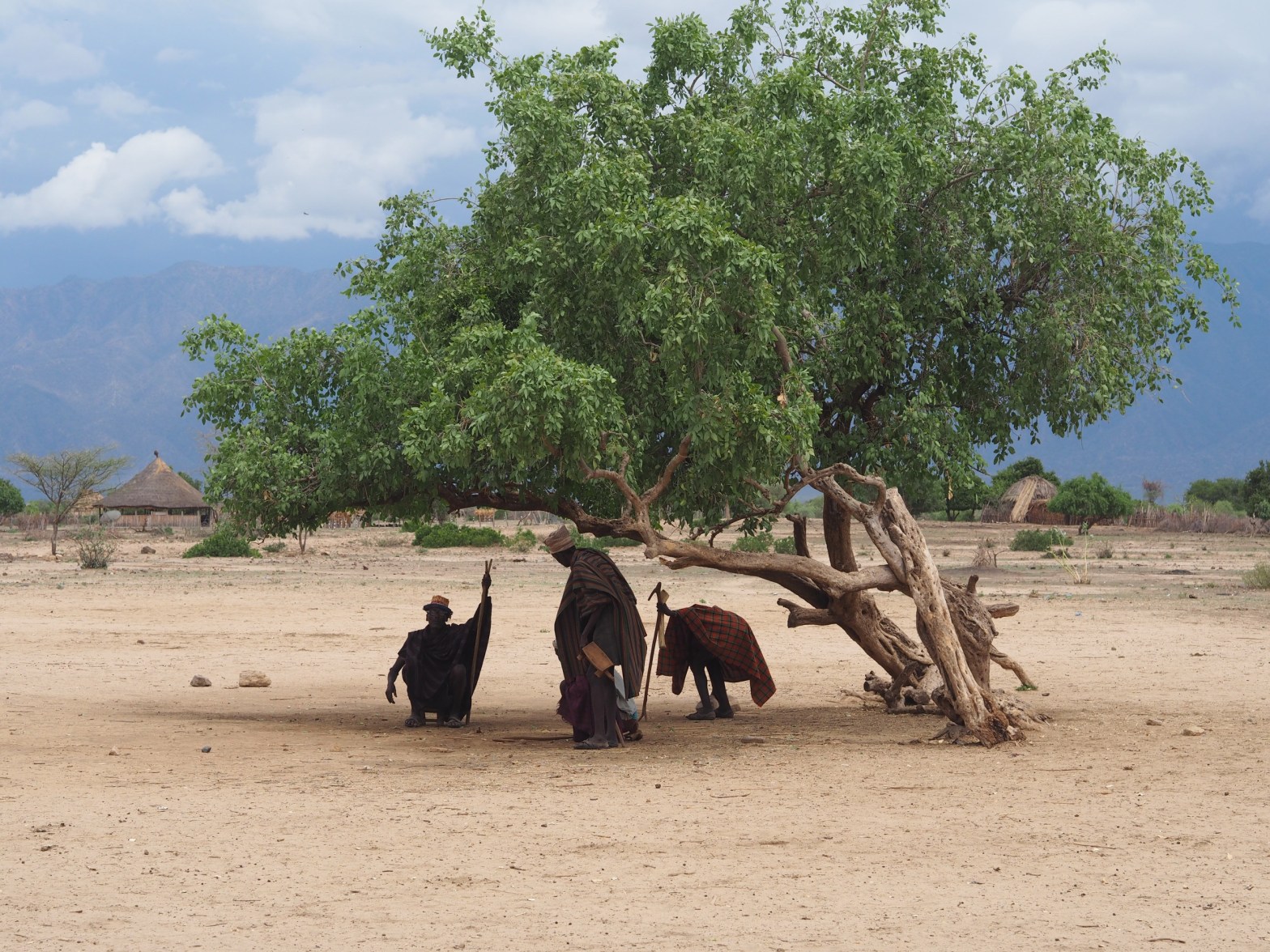
Before we arrived at Arba Minch we visited a Dorze village, the first of several local communities we would visit over the next few days. This visit set the tone for what we would become accustomed to – hire a local guide for 600 Birr (about £18), which includes an entrance fee into the village. Most of the money goes (we’re told) to support local community infrastructure, such as education, health clinics, etc. In this case, we’re given a really good tour of the village, including visiting a traditional house (that looks uncannily like an elephant’s face and in which the family’s livestock also live) and a demonstration of how the local staple flat bread / tortilla is made from the fermented pulp of the false banana tree. This we get to eat with a combination of local spicy sauce and honey – I really liked it. Fi, on the other hand, was still suffering from a very dodgy tummy; they insisted that the local firewater (which again I thought was highly acceptable) would kill the bugs in her stomach – unfortunately, this had a rather different and quite violent effect!
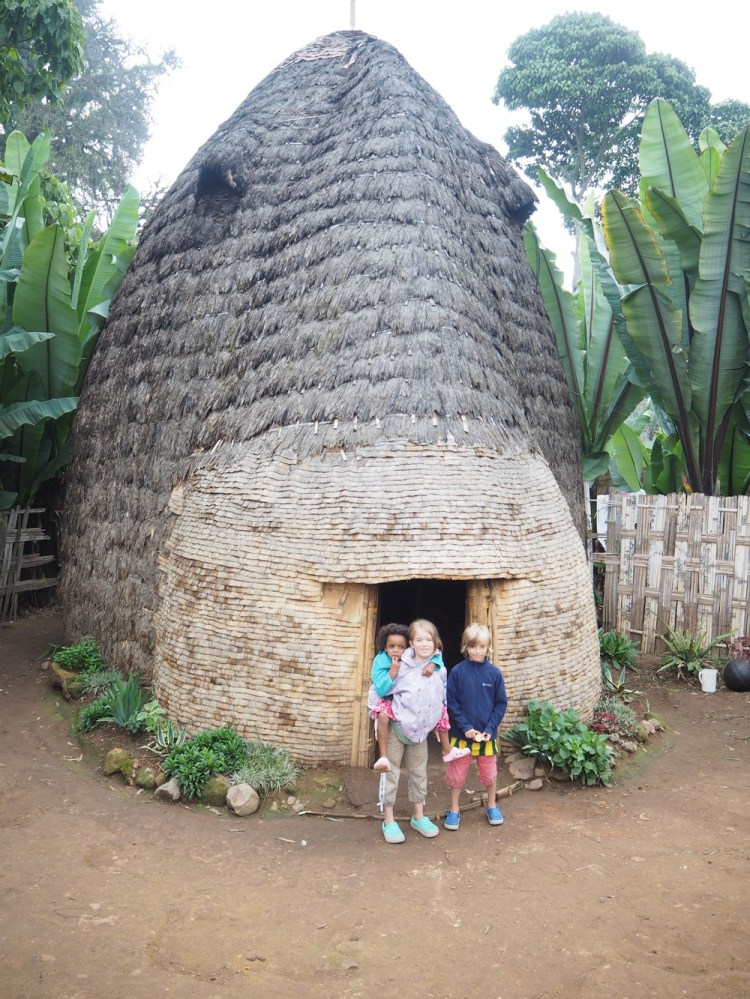
With a big pair of ears and without its trunk chopped off, it would be perfect!
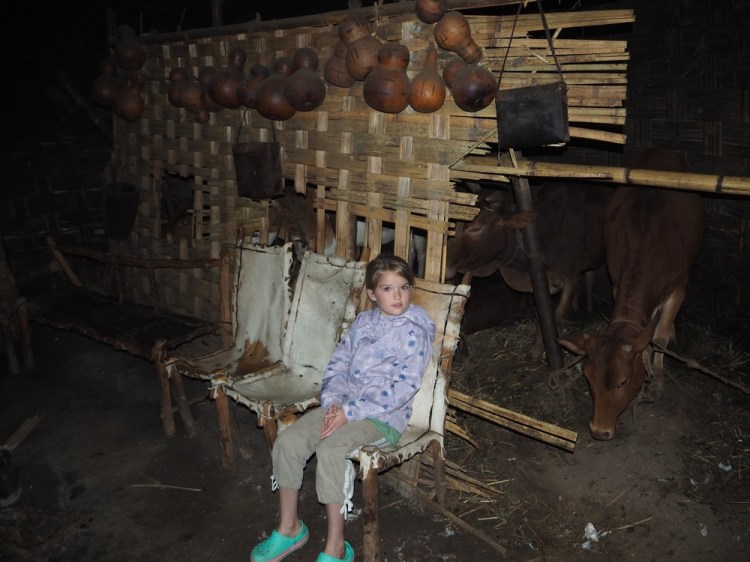
Inside the ‘elephant’ house – note the cow’s quarters right next to the sitting room

Weaving in Dorze
The Dorze are famous for their weaving, which we also got to see in action – a highly skilled technique using hand looms (actually operated by hands and feet). It took me back to my Lancashire roots, where communities were also built around cotton and weaving – of course there the process was transformed by Arkwright’s spinning frame, the flying shuttle and steam power.

A distortion of natural beauty with the lip (& ear) rings in. (By the way, the necklace is made of birds’ beaks)
The next tribe we saw was the Mursi – this really was a culture shock and the whole experience left us all feeling quite uncomfortable. First, the obvious: this is the tribe famous for the large clay plates the women wear in their lips. Now, I’m not a big fan of tattoos and body piercings at the best of times and have seen some sights on the tube in London that have made me squirm. But this puts all of that completely in the shade and having seen photos beforehand doesn’t really prepare you for it. With the lip plates in it is a gross distortion of natural beauty. With the plates out, it looks truly horrendous and of course the women struggle to talk clearly – presumably eating and drinking is equally difficult.
Secondly, there was more cow poo in this village than anywhere else we’ve been – there were flies everywhere and we had to watch where we put every step.
Thirdly and most fundamentally, the culture of paying for photos led to a real tension and an unpleasant experience for all – we felt the villagers resented having photos taken and yet were demanding that we did so (you need to pay each person in the photo 5 Birr, equivalent to about 15p). Choosing who was in and particularly who was out of the photos was a very unpleasant experience. Here, we didn’t get to have any conversation with the villagers – we left wondering why on earth we were doing this.
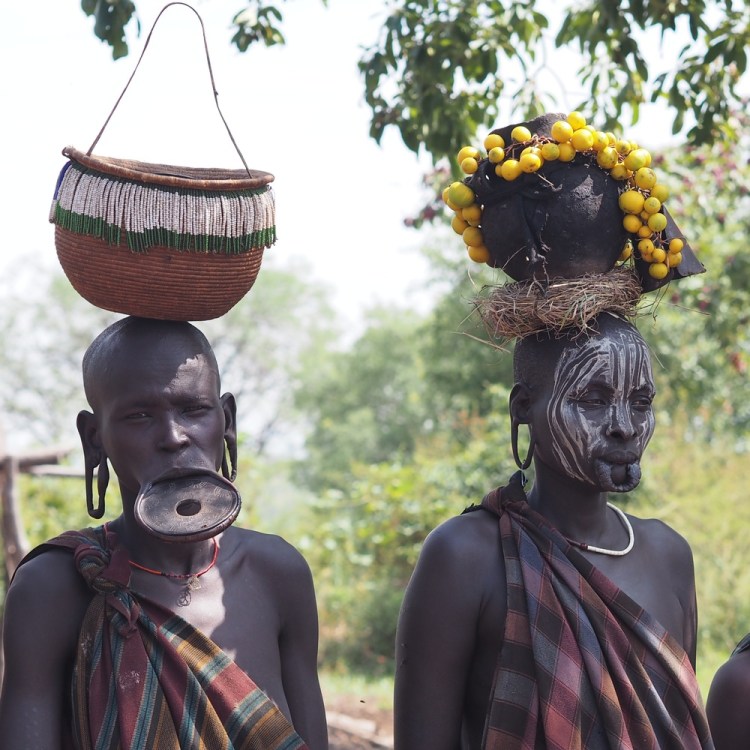
Lip plate in or out? You decide!

In the end, we were happy to leave our ‘friends’ in the Mursi village!
Next stop, the Hammer tribe. We’d heard that for an extra fee (and if we were lucky) we’d be able to watch the famous bull jumping. When a boy reaches 18 years of age, to prove that he’s ready for marriage, he has to jump/run over the backs of about 10 bulls. The more times he can do this, the greater honour bestowed upon him. This all sounds fine so far but… if he succeeds, the women in his family are then beaten in turn with wooden sticks – maybe 10-20 blows each, drawing blood (and obviously leaving horrible scars). They apparently subject themselves to this beating to demonstrate their love for the initiated boy – right. Not surprisingly, we decline to pay money to see physical violence against women.
Based on our experience with the Mursi, we decide to leave the camera in the car until the end of the visit – this is much better and we managed to get much better photos (ie not simply a sullen line-up) of far fewer people.

This woman is the 2nd wife (in parallel, not in sequence) of the owner of the hut – looking pretty good after having had 6 children! The characteristic hairstyle is created by applying a mixture of dried earth and butter, and winding the hair around thin sticks.
The husband of the woman above had decorative scarification on his arms and chest – we learned that only men who have killed another man in battle are recognised with this scarification, for their heroism. We were somewhat gratified to learn that he was one of only three in the village with these scars, and the battle was many years ago, when he was in his teens.
Next, the Koro tribe on the Omo river. This is a tiny tribe of just 3 villages and <3,000 people, famous for their body painting, the white dots beings based on the guinea fowl.

Typical decoration based on the guinea fowl

Check out the Dr Beats (not connected to any device!)

This guy broke out into a broad, friendly smile after I’d taken the picture – the gun is apparently for hunting and theoretically for the defence of the village.
Next, the Ari tribe. They live in a very flat & arid area; their houses differ in that they have a front porch attached for shelter from the sun. Like other tribes, the houses have no windows and no chimneys, and yet they cook on a fire in the house. So it’s pitch black and as smokey as hell – otherwise, lovely to cook in!
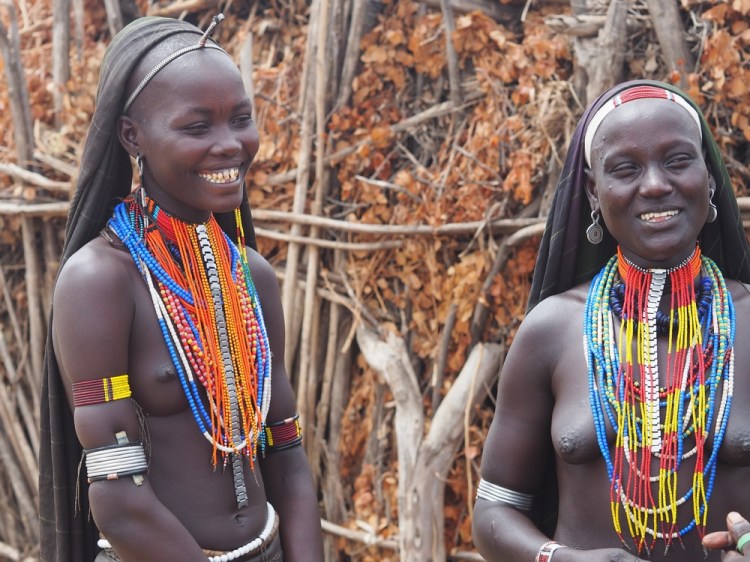
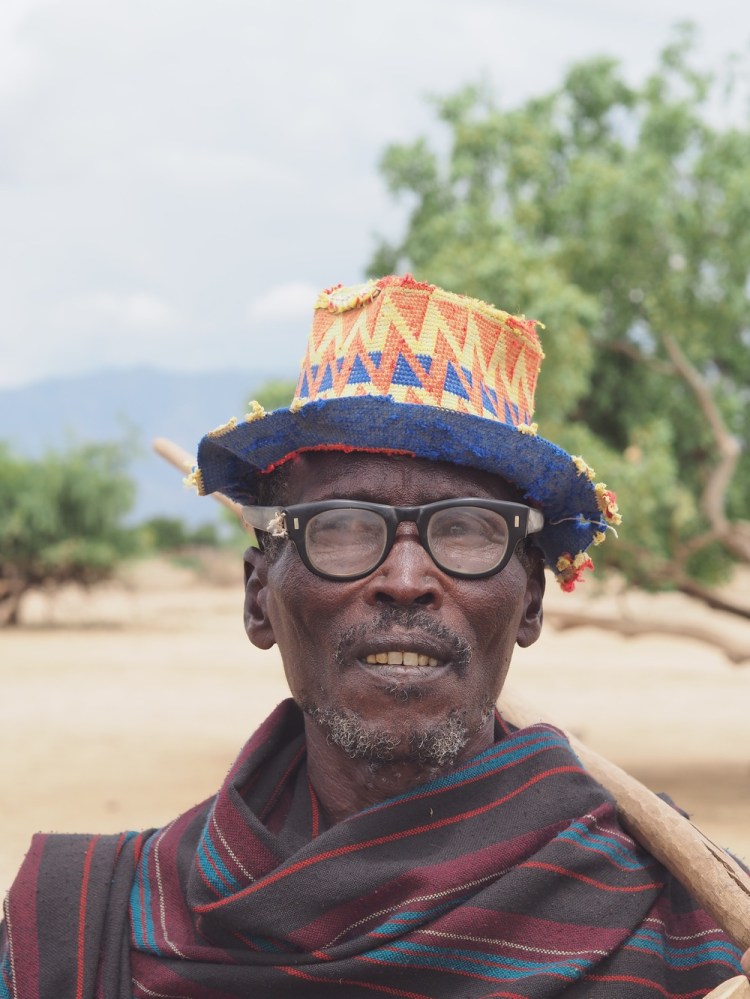
Quite a cool character!
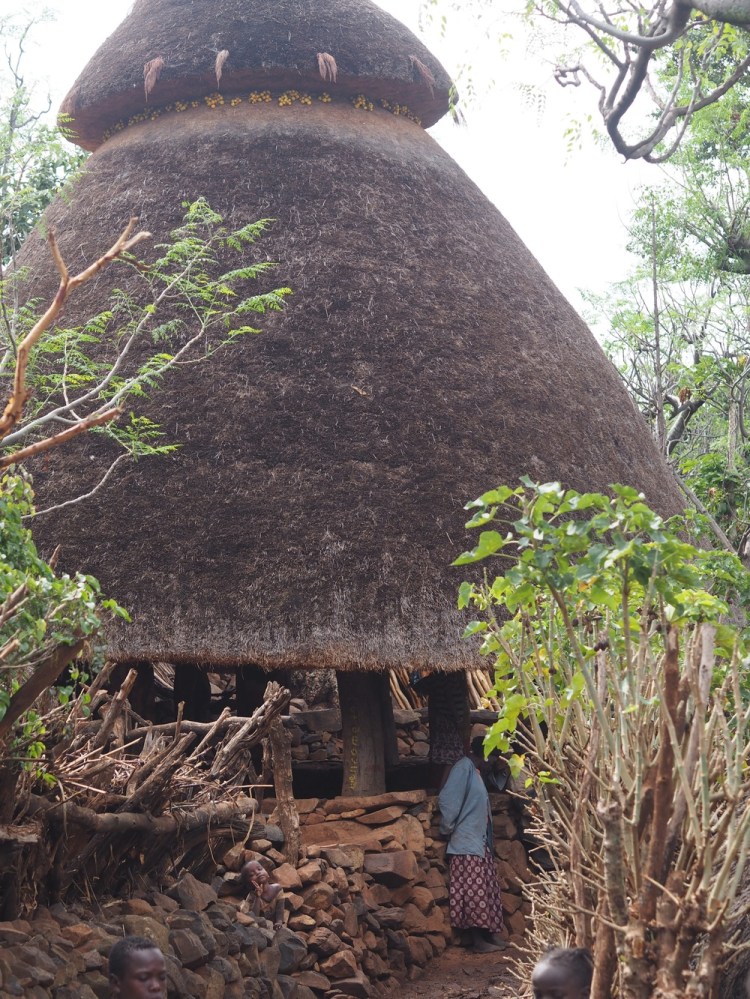
A communal house where meeting are held and where the teenage males sleep. They act as community firemen, ambulance and defenders of the village. I’d challenge anyone to find a better quality thatch, anywhere!
Our last visit was to the Konso tribe – by this time we were felling pretty tribed out, but Bek quite rightly persuaded us that it was worth going. It was completely different to the other communities – we were back to western clothes and we saw stone built walls and buildings for the first time in days. They have a concept that the running of the village should be passed on from generation to generation, so every 18 years there is a celebration to mark that passing, including the planting of a tall tree trunk in the ground. Therefore, by counting the tree trunks, you can calculate the age of the village (this village had 45 trunks). Those that relinquish day to day running of the village act as consultants and advisors to the incoming generation. I love this concept and have been wondering how we could learn from this in our culture??
Here it really did appear that the money from our village entrance fee was going to support community infrastructure projects, such as communal houses / meeting spaces.

Kids in Konso
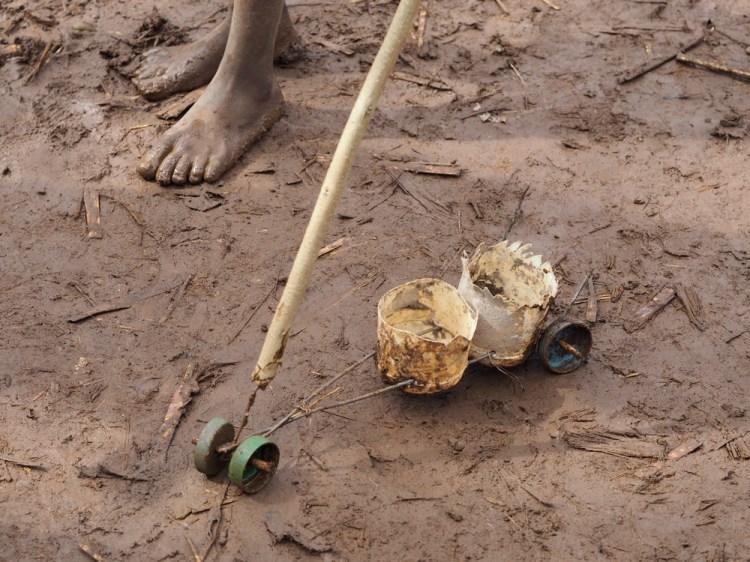
A really typical toy made by a small Konso boy – so simple and yet creates hours of muddy fun!
Fi and I have discussed for hours the whys and wherefores of this human safari tourism. The paying of individuals for photos certainly jars with our sense of decency (is that the right word?) and certainly spoils the experience from our point of view, but is this and the entrance fee to the village good or bad for the communities? That is surely the important question and I don’t think there’s an easy answer. If the entrance fee money lines the pockets of a few village elders, then it’s clearly bad, but if it genuinely supports village infrastructure then that’s surely good? (Needless to say, there seems to be a spectrum, with the Mursi at the bottom end and the Konso at the top). And does tourism reach a point where it overwhelms their traditional way of life, such that they are simply the products of tourism and their traditional way of life and ability to sustain their community (without tourism) is lost? On the other hand, who are we (with our vastly greater wealth and comfortable lifestyles) to deny them choice and additional income from tourism?
We feel uncomfortable paying these people for pictures (and in particular choosing some but not others), yet we’re happy to take pictures of unusually dressed and interesting people in other situations, whether it be in a market or a Beefeater at the Tower of London. And don’t they deserve to be rewarded if tourists continually thrust a camera lens in their face? At least you know the money is getting to the villagers themselves (although are the ones who REALLY need it – the infirm, the fistula sufferers, the misfits – actually hidden away out of view when we arrive?)
And then do we try to sustain this diversity of culture and tradition, when some of it is clearly wise, some just different and some downright barbaric and inhuman? There’s no doubt the the image portrayed by the villagers we met has been airbrushed. It was striking that all the communities mentioned that the girls in their village don’t get married until the age of 17 or 18 and yet we know there are major issues of childhood pregnancy and it’s associated problems. Female genital cutting remains a traditional practice in some of the tribes and we heard some horrendous stories about children being killed because they were believed to be possessed by evil spirits. Diversity is good, right? But do we get to choose which bits to preserve and which to lose based on our culture and values?
As you can probably tell, I’m still wrestling with this and would love to hear the views of others.
 Five Go Round The World
As you say Mark, lots of food for thought. And I don’t know what the answer is either. If education and health care are improved, presumably the outcome is that the tribes "move on" from their traditional customs. Some (to us) seem obviously bad, some obviously good, and some just different. Unrelated – why are you in August?!Love to you all xxx
LikeLike
The reason we’re still in August is because we were waiting for Josh to finish building the site. Then uploading pictures with incredibly slow internet is a real test of patience. So we’re trying to catch up xxx
LikeLike
Anne, Sorry for the very belated reply but thanks for your comment – it’s reassuring to know that at someone is reading it!! Yes, tricky issues and very complicated – I’d really like to discuss with someone knowledgable who’s thought more deeply about it.We’re still desperately trying to get up to date with the blogs – it’s extremely challenging when there’s poor internet, pictures are just about impossible to upload. At times when we’ve got to the point set which doing the blog is seriously getting in the way of ending the trip. Hopefully we’ve got a bit better balance now and we’re a bit more laid back about it.
How are things at your end? Any news? We had a fairly lengthy chat with Dad via Skype the other night – he seemed on pretty good form and really pleased to see the children, even if it was on a computer screen. How are you coping with him?
We’ll try to call to wish you happy birthday but of course it will depend on the internet. You’re on Skype, aren’t you?
With lots of love,
Mark xxx
LikeLike
I think that the girls were very pretty. I would really like to wear what they were wearing, especially the necklaces. Now that mummy’s come back, we do lots of fun things and I’ve got lots of friend’s coming to my house and I’m going to lots of my friends’ house.Hope you’re having a really nice timeLove from Alex xxx
LikeLike
Alex,
Many thanks for commenting on my blog – hope your reading Jemima & Gabriel’s too? They are not doing enough school work I’m afraid, especially maths – I don’t think I’m a strict enough teacher!
With lots of love,
Mark xx
LikeLike
Fascinating Mark – not sure how we would reconcile the issues you talk about either.Fi asked that we fill you in on our news… well it’s all business as usual here! The kids are loving their new teachers at school and I’m looking forward to starting my new ventures in freelancing. (And loving the concept of gardening leave! – Giving me a terrific opportunity to sort out the "black hole" that is Michael’s office!)Michael has done wonders to the house, so it looked terrific for my party! What a lot of fun that was! We did miss you and Fi though.I heard Jeremy Vine was going to do a piece on people hating their neighbour’s fake grass – made me think of you!! I hope you don’t come back to a luscious real lawn!!Keep battling with the internet connection… we’re loving these blogs! Laters…H&M xx
LikeLike
Helen,
Sorry for the belated reply but thanks for commenting on the blog – at least someone is reading it!! I’d love to hear mor ant your freelancing – how did that come about? How’s it going? Sounds like you had a fab party – I’m sure it was a blast!
We’re now in India, in Coonoor, a small hill station the British built to get away from the heat. Lovely spot – we’re tempted to stay here a few more days and just chill.
With lots of love,
Mark xx
LikeLike
Josh tells me your site is fully built! it’s more to do with your internet speed!!
I love these Mark, and the photos are great! I dont think there are easy answers to your musings, though – I think it’s no bad thing to have to see these things with our own eyes – it puts our lives in perspective! You can imagine life in Pakistan continually threw up its own questions, too!So much love to you all. Lubi xxxxxx
LikeLike
Lucinda,
A very belated thanks for responding to our blog – I’m glad someone’s reading it 😉
As you, say, it’s been a real challenge with slow internet, losing a lot of work and having to redo it. At one stage it was really getting in the way of enjoying the trip. Hopefully we’ve got a better balance now, and internet is a bit better!
It’s all a fantastic experience, but needless to say, pretty intense. Just us all being together for such a huge proportion of the day can be testing – it’s important to get a good nights sleep! Mealtimes seem particularly tough – Jemima is being great, eating everything; Gabriel is pickier bit slowly getting there; and Millie seems to need spoon feeding at Every meal. We seem to be in a bit of a difficult cycle with her – we’re disciplining her much more than the others because her behaviour is worse, but then I’m sure she then feels victimised which makes her behaviour worse. And it’s very difficult to get any time for ourselves – whatever time we have seems to be focused on the children and planning what we’re going to do next.
Still, we’re having some fantastic experiences and it’s obviously a huge privilege to be ble to spend so much time with the children. They seem to be growing up so fast on this trip!
Hope all’s well with you all – Fi’s sharing the emails from you all, it seems like everything is focused around Alwyne Sq at the moment!!
With lots of love,
Mark xxx
LikeLike