It was always a trip Mark wanted to make more than I did, mainly because there’s not much of interest down here in these flat, hot, forbidding lands but fascinating tribal people. Scenery matters to me, but my main objection is the people safari element to it.
This is the southern most part of Ethiopia, home to 73 tribes who have their own individual language and extraordinary rituals. They are mostly animalistic, hunter gatherers, nomadic people. Their lives couldn’t be more different in every way from our ours.They are almost becoming an endangered species. The Ethiopian Government wants them to become more mainstream and school their children, integrating them into society.
As you drive through these areas you can only wonder in awe at how strong man’s survival instincts are against all the odds. Surprisingly, this wasn’t where the famine of 1984 was, though it would be easy to imagine it. Desolate, parched, thirsty ground, NOTHINGNESS, no crops growing, nothing, except scrappy looking trees, and even these are being cut down for firewood. No visible water, no wells, no pumps, like we have seen everywhere else. What do people eat? It’s a depressing, hopeless landscape. I am beginning to feel homesick for lovely safe England, Cornwish coves, wild Mull, homesickness now with a feeling of guilt – what are we doing, bringing our children here to these inhospitable parts? What if we breakdown – how many hours worth of water do we have? And enough food? How long will the signal last on Mark’s phone? I am now wishing that I had put my foot down about either NOT doing this trip or Mark doing it on this own.
To visit the tribes you pay entrance fees to enter the park, guides to take you to the villages and then if you want to take photos, cash direct to the person, even if they 4 years old. All fair enough – I have no objection to giving them cash for showing us how they live their lives. They are remote, unusual tribes, the money purportedly goes to improving the infrastructure within their communities. Fair deal. We see very clear signs of this in one village, the Konso tribe, with beautifully defined paths and fences, communal loos and beautifully made thatched communal areas where the young men act as security guards, and gather to protect the villagers. Only problem is we are led to believe that the money often goes into the pockets of just a few men. Giving people money for taking their photo sounds just too.
I hasten to add that we are the only feranji (foreigners) there and in fact we do not see any other tourists at all visiting, during our 10 days of travelling. Admittedly it’s the rainy reason.
The minute we get out of the car, everyone wants to shake hands and then it’s photo, photo and they all line up to try and stand in long lines, squeezing as many people into one long line, to increase earning potential. Now I am regretting that we took the camera out of the car.
Our Addis friend Michelle talked of her brother-in-law being chased out of the village by the elder with a Kalashnikov??? Maybe he didn’t take enough photos, or the wrong sort. Where did he get his Kalashnikov from? Are we supporting their arms supplies?
If we didn’t support them by paying these fees, would these tribes in fact die out? I am going to be true to my word and NOT publish photos of people in the villages! For that you will have to go Mark’s blog, instead I shall describe them instead.
What I found fascinating was seeing, watching, smelling, touring round the villages, taking in all the details about their immaculate sparse habitats. Their swept porches, their neat animal holdings, their thin goat mats on the floor where the family all sleep, in their very dark huts, alongside the animals lying down next to them. Their cooking pots, nothing is surplus to requirement. Our children were as much a fascination to them, so I felt we had a fair deal, as they touched our children’s hair and skin and eyed every bit of them up and down.
The children even started exchanging loom bands for their bracelets – they were delighted, excited, lots of laughter from these naked little children and adults. Our children were fascinated.
The costumes vary from village to village. The people are handsome and tall. Their dark, beautiful, ebony skin is surprisingly smooth and shiny, considering it is exposed to the harsh elements. They are all barefoot. The men from the Hamas tribe are tall and long legged and muscly, they wear a short miniskirt. it’s quite a look . And a dagger and a hat, the unmarried women are shaven headed and the married women have ringlets in their hair where butter is smeared, followed by the red earth. The effect is very striking and doesn’t smell at all, you would expect it to be quite rancid.
The Mursi tribe are something else, the women have their lip pierced so that the lower lip gradually separates from the upper lip – it is a grotesque sight . The lip withers and dies. They then stretch the lip by inserting a wooden saucer, it resembles a very large wagon wheel disc but instead of chocolate it’s hard wood . This then means the women can’t talk – at least it’s not audible – or eat. Apparently the men find it attractive. I can’t help feeling its a way of keeping the women subordinate.
This tribe are quite aggressive and unfriendly; I want to get back in the car quickly. Gabriel has not been feeling too good, so he decides to stay in the car (can’t say I blame him). What he sees while no one else is watching is one of the elder men smothering wet cow poo over a naked little toddler. The whole place is covered in flies. The minute we are back in the car on the road, I discreetly get out the hand gel and we all lather up….I am a little paranoid, particularly as I have two children who bite their nails, Is it a wonder we have all been sick and several times over!
As we were returning back to our lodge, the skies open up and torrential rain falls from the skies, and the desperately empty parched rivers are now not looking so dry after all.
We have to wait for half an hour for the waters to subside. In an hour there will be no water in this river.
We’ve been here a month now – In many ways I think this is the hardest country to travel in – it’s refreshingly unset up for tourism, the distances are enormous, which means we have to get internal flights and hiring 4×4 cars to get around a prerogative and therefore the most expensive country, too. We have already spent twice our monthly budget! Which means that we will have to live much more cheaply somewhere else, though I have vowed to myself that that won’t happen in India.
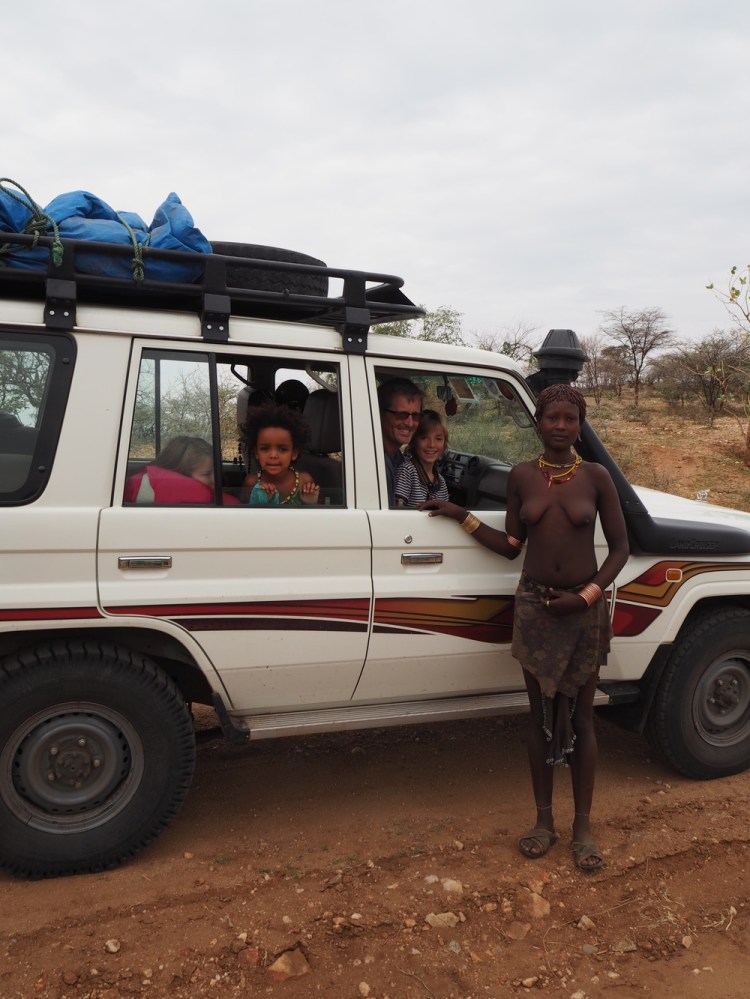
I get out of the car to take a photo of a pink flower, when I return to the car this beautiful scantily clad lady is chatting Mark up, under normal circumstances, I might be a bit concerned…..She is on her own in the middle of nowhere, just ambling along the road.

Gathering under the only shade around
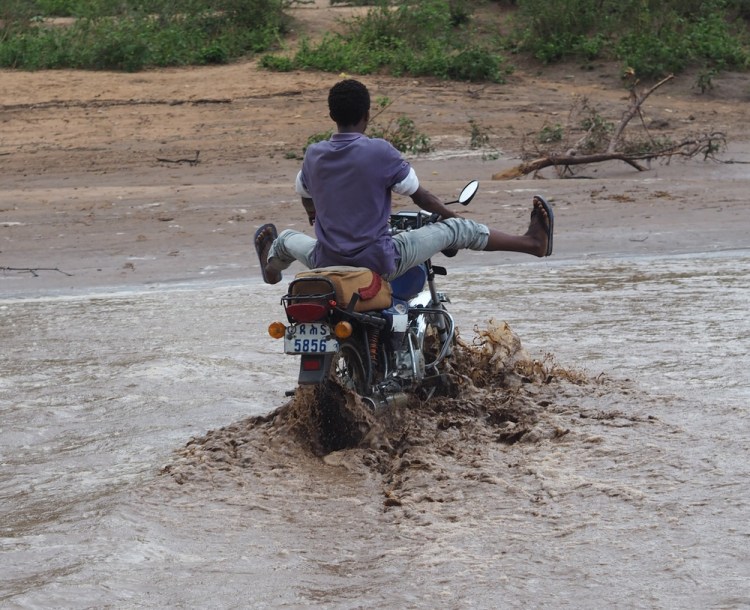
Minutes later the dry river bed looks like this, in a flash…..
e
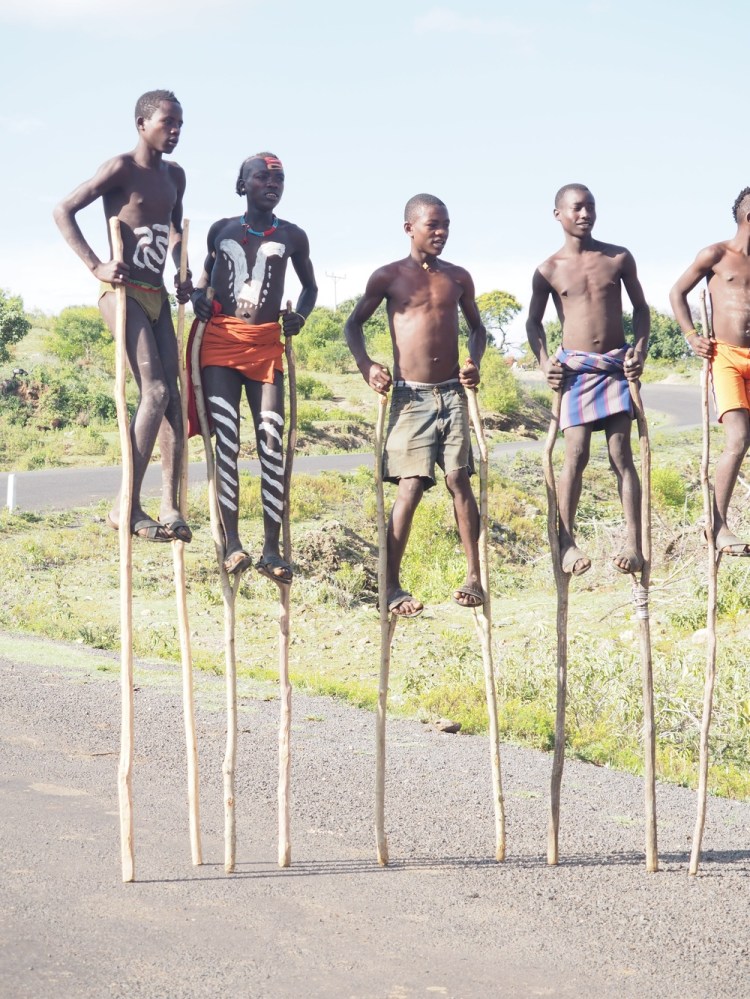
These boys are lingering on the side of the road, I can’t help feeling they are quite entrepreneurial to devise a way of attracting our attention. Of course I will give them some coins
 Five Go Round The World
Fi, it’s as if you were talking to my face – I love your conversational style and the honest way you spill the contents of your brain onto to the screen, for better or for worse! Chin up you’re doing great!
LikeLike
That’s encouragement for me ! Thanks LizFi x
LikeLike
Hang in there Fi. Loving the updates and sending you ‘warm cozies’ from CA.
LikeLike