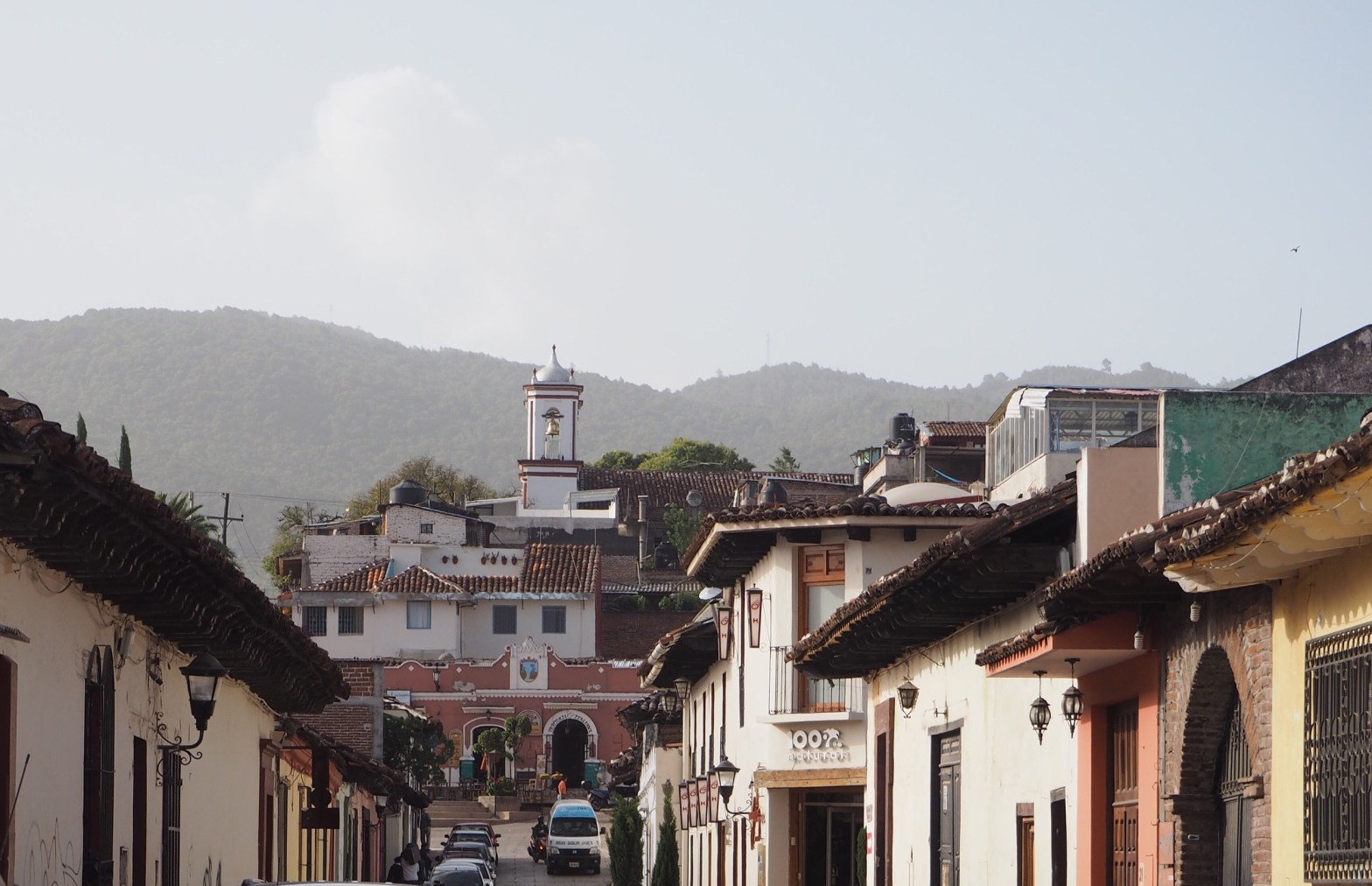
Before I capture my final thought thoughts on San Cristobal, there are one or two other highlights to mention…
Chamula fiesta
The full name for Chamula is San Juan de Chamula; on the festival day for San Juan, we decide we have to go back and check out the fiesta! When we arrive (mid-afternoon) and walk down into the main square it’s surprising how different it is – the market isn’t here, just a few food stalls around the edge; instead there’s a large stage, with a band playing. There’s rubbish everywhere (particularly old corn cobs) – it looks like this fiesta has been going on for days! There is plenty of open space in the square away from the stage (unlike last time we were here – see ‘Settling into San Cristobal life’) and we pick our way through. Half way across there’s an impromptu bar, with a bunch of young guys sitting around, drinking. They beckon me over and offer me a glass of ‘posh’, the local moonshine. I accept and chat briefly to them – by the way, the posh is surprisingly smooth and tasty! One of them speaks very good English (which surprises me in this small village – most people here speak Tzotzil and some of the older folk don’t even seem to speak too much Spanish). He’s keen to practice and asks where we’re from and about our trip – they seem keen for me to sit down with them and get really stuck into the beers and posh, but I decline. I can see Gabriel and Jemima looking on very suspiciously and as I leave the group they’re immediately asking me “Were those men drunk?” I explain that they were, but not very!

These guys are looking more sober than most!

A typical Chamula family, although who knows what’s going on with the box on the head?!
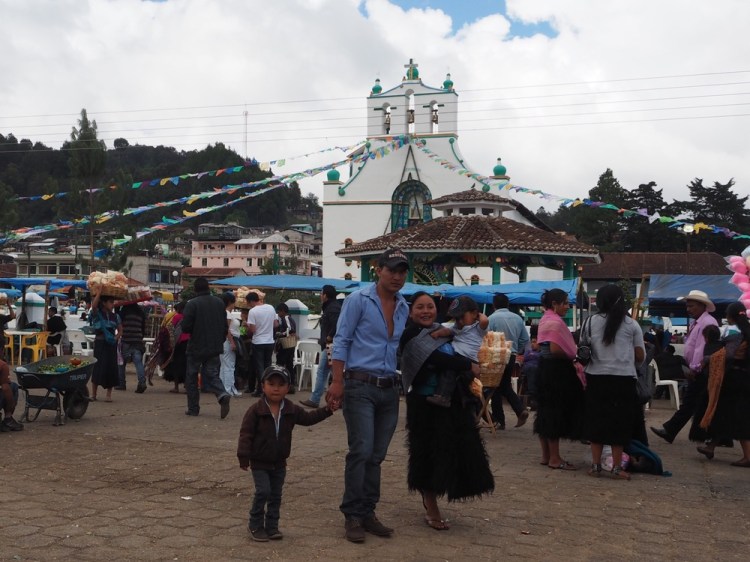
We wander over to the church, where there really are some drunk (older) men, dancing (staggering would be a better description) in a small group. Goodness know how long they’ve been drinking for. There are a couple who’ve taken it to the next level – they’ve passed out on the floor, with congealed blood around their face from when they fell. It goes within to saying that it’s only men dancing.
The lovely church at Chamula
The church is remarkable, unlike any church I’ve been in before. There are no pews or seats inside, just pine needles with a lovely aroma, scattered over the floor. Down each side, there are effigies of saints, colourfully dressed in glass-fronted wooden caskets. Enormous swathes of pale material, decorated with printed flowers, hang from the centre and to both sides, all down the length of the church. Interestingly, there are no statues of Christ on the cross to be seen. Individuals and families are kneeling on the floor, with rows of small candles stuck to the floor in front of them. Apparently they are praying to heal sick family members. There is one woman with two very small children who clears an area of pine needles and tries to light several rows of tiny candles; unfortunately she’s picked a very draughty spot in the church and they keep blowing out. She keeps trying to light them but again and again t hey blow out – I wonder if she’s interpreting this as a bad omen; I feel really sorry for her. There’s a man working his way around who’s job is clearly to scrape up the remaining wax from burnt out candles. Suddenly, a large group of people process into the church and up to the altar. At the front, there are a couple of men wearing obviously ceremonial clothes and behind them in the crowd there are two women carrying bowls of incense, wafting the aromatic smoke all through the church. As I said, it’s quite unlike any church I’ve been into before – it’s a real fusion between catholicism and the pre-Colombian Mayan religions (apparently on some occasions they sacrifice chickens here).
Sumidero Canyon

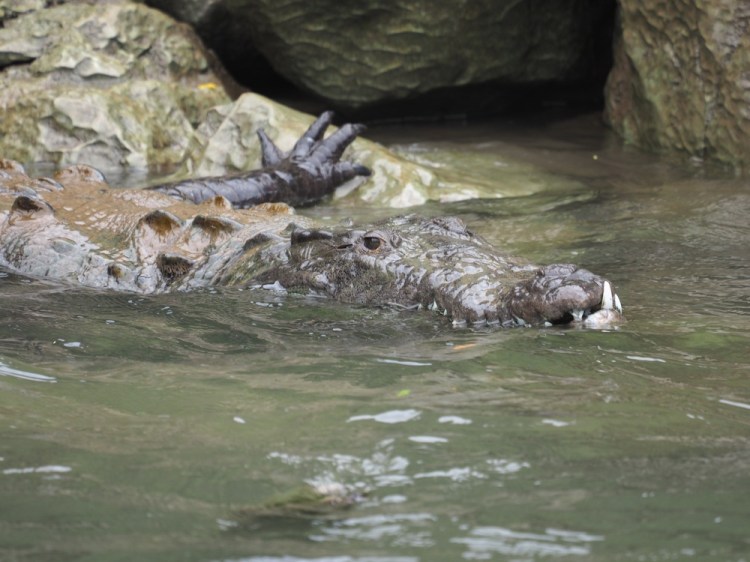
We take a day tour to the Sumidero Canyon and to Chiapas del Corzo. It’s an hour or so’s bus ride until we reach the river bank where all the boats leave for this trip. They are fast, flat-bottomed boats that take about 30 passengers. The driver sits high up at the back, steering and controlling the large outboard motors. I didn’t really know what we should expect to see in this trip, so I was pretty surprised when after about 5 minutes we pulled to the side of the river to see a crocodile! It’s a great trip, with lots of birdlife on the river and the highest point the cliff face rises 1 km above us. We eventually reach a dam and hydroelectric station, where there are lots of boats selling cups of freshly cut fruit, crisps and drinks for the tourists. We quickly speed back upstream, jump back into the bus and head to Chiapas de Corzo for lunch. Its another small, pretty town with lots of indigenous people, but unfortunately we don’t have too long to stay. We have tasty food at a pavement restaurant, with a strange chocolatey corn drink that was served in a gourd shell. There are lots more beautiful embroidered clothes on sale around the small market – the workmanship is incredible and it’s all so colourful.
I wasn’t expecting to see this guy!
The strangest family gathering
Amatenango is definitely off the main tourist route, but Stephanie from Rancho Evergreen has recommended that we stop by. Its most famous for its hand-painted ceramics, particularly jaguars. Stephanie has very kindly arranged for us to meet with a friend of hers who lives there, who she says will show us around. We take a collectivo to Teopisco and then a short taxi ride. We manage to find Stephanie’s friend, who tells us that today the family is celebrating her nephews graduation from primary school, and that we are all invited to come along. After roughly five minutes’ walk she invites us into her house, pulls up a few wooden chairs in the courtyard and invites us to sit down for a rest! So, having recovered from our extensive walk, we continue the remaining five minutes to the house where the party is. It’s all taking place in a large courtyard, with two long trestle tables, all covered by a large tarpaulin. We’d bought some flowers for Stephanie’s friend; it’s just as well as she suggests that we give them to her nephew – we soon realise that all the guests are bringing him gifts. He’s obviously got some new clothes for the occasion: shiny black shoes, black trousers, black belt with a remarkably large shiny buckle, a new purple shirt (that he will grow into) and a large tie.
We sit down at one of the tables and somebody brings us each a large bowl of coffee (including the children) and some dry, sweet bread to dip into it. They then bring around tamales and refrescos. It’s a remarkable gathering – we are on the table where the seating seems to be a bit more relaxed, but on the other table it’s strictly men down one side and women along the other. All the women are in traditional dress, with a piece of folded material perched on their head. Remarkably, no one is speaking to each other and they all look like they have much better things to do than be at this boy’s graduation.
There is a small band playing, which breaks the silence – one blind man playing an electronic keyboard with his mate on backing vocals. They play a variety of Mexican music, changing the sound on his keyboard from accordion to trumpets according to the song.
After a while, a bunch of the man decide enough is enough and take their peers to the table up on the stage where the band are playing. This seems to be where all the fun is happening. We are wondering how long we need to stay without appearing too rude (I have the feeling we’re not the only ones considering this question). In the end, we make our excuses and leave after about an hour. Despite the fact that it was pretty dull, we note the difference between here and at home. We can’t imagine a bunch of strangers being invited into a formal family gathering and being offered food and drink in the UK. And yet the people here can clearly afford it much less than folk back home.
Reflections on San Cristobal
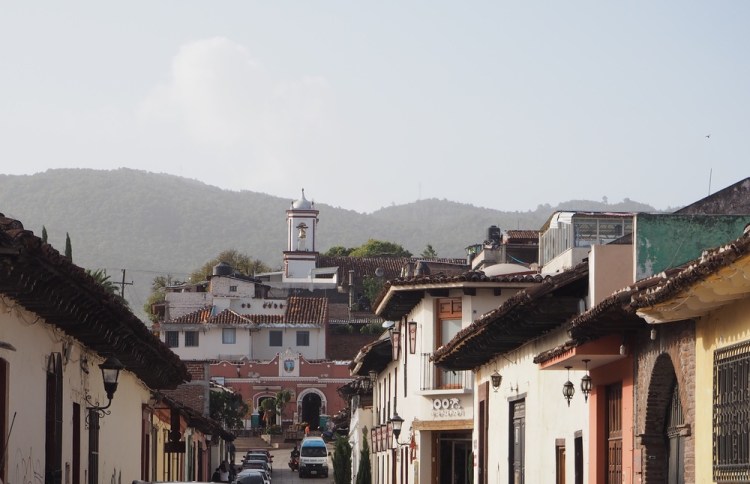
We’ve really loved our time here, despite the initial problems with our house! Once again, it’s been lovely to be able to immerse ourselves in a place, really settle in and get to know it.
San Cristobal is such a vibrant place, despite all its political problems – there seem to be parties and fiestas going on all the time, with the sound of cohetes (rockets) going off at all times of the day and night (literally). Then there’s the sound of the various trucks going around the streets with their characteristic sounds to advertise their presence: a chain with metal rings suspended from the back, jingling along for the gas truck; ‘Raindrops are falling on my head’ from the water truck.
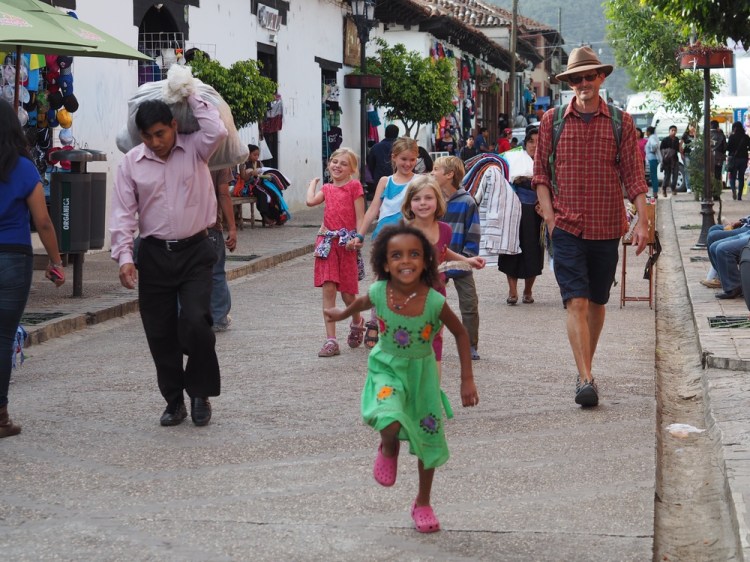
The pedestrian sections of the main streets are always busy, with the indigenous women and children wandering up and down selling their wares and the buskers. Then there are the foreign, very bohemian, residents, selling their bracelets, biscuits, jewellery, etc. There’s one tall, quite elegant European looking woman who walks the streets, pulling a small cubic bag on wheels. She repeatedly calls out what she’s selling – it’s difficult to grasp at first but when we concentrate we realise it’s mango ice cream! I’ve seen her many times but never serving a customer – how do these people earn enough to survive?
School has been a great success, both for Jemima, Gabriel and me at Spanish school and for Millie at her little nursery.

Salsas at our favourite cochinita pibil restaurant
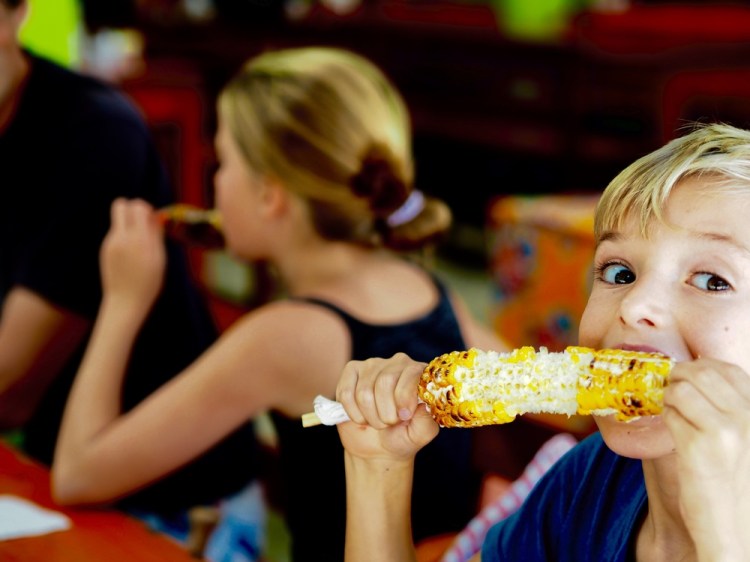
We’ve found a couple of favourite lunch places: the tiny little place near Millie’s school with just 4 small tables, run by a friendly woman who’s a really good cook. We tend to eat what she’s got in and it’s always delicious, and she does fabulous cochinita pibil (it’s like Mexican pulled pork, served on a tortilla with pickled red onion and crumbly cheese – and salsa of course – absolutely delicious). Then there’s the other small restaurant that only sells cochinita pibil, served in a variety of ways with a wonderful selection of salsas ranging from piquante to extremely piquante! And the children absolutely love the chewy roasted sweetcorn from the street vendors and the fresh fruit paletas (ice lollies) that are so much more delicious and cheaper than mainstream branded ice-creams.
The papelerias (paper shops) here are fabulous – there are several of them in town, and all have an extensive collection of pencils, pens, drawing paper, arts and crafts materials. Everyone has been really into drawing and painting here, even me! Jemima, Millie and I enjoy following online videos on how to draw various things – Jemima has done about 100 drawings from the fun2draw site and I’ve done a few pencil drawings, mainly from Mark Crilley’s YouTube site. Gabriel prefers Fi’s approach of copying still images – with lots of dragons!
We’ve met some really lovely people here, including Anshu and Ramadatta (see ???) and Sam, Laura and Renee from evergreen ranch (see ???). They all have very different lifestyles and perspectives to our friends back home. I’m not sure whether it’s because we’re so far into our trip that life at home is sufficiently distant, or because we’re getting close enough to the end to start thinking about what happens next, or simply because of the coincidence of meeting these particular people at a similar time, but they have really made us think about how we measure success in our lives. We realise how easy it is to get sucked onto the standard issue hamster wheel – measuring success in terms of furthering our careers, earning money, buying material things that we don’t really need, getting our children into good schools, etc, etc. Then there’s the tranquility of the countryside with the freedom it offers children to explore and create (without a screen). It feels that something needs to change when we get home – we’re not sure what, but we both feel that we can’t simply climb back onto that same hamster wheel.

So we leave leave San Cristobal with very fond memories and some new friends. I feel that in contrast to Tulum, we have now experienced real Mexico. However, Chiapas is the poorest state in and many people have said in many ways it’s more like Guatemala than Mexico. So while I feel we’ve got a good sense of Chiapas, I’m not sure how representative it is of the country as a whole and I’m looking forward to moving on to Oaxaca and seeing more of this vibrant and fascinating country.
 Five Go Round The World