

Lilies from the garden are helping us deal with the underlying smell of cats’ pee in our dining room
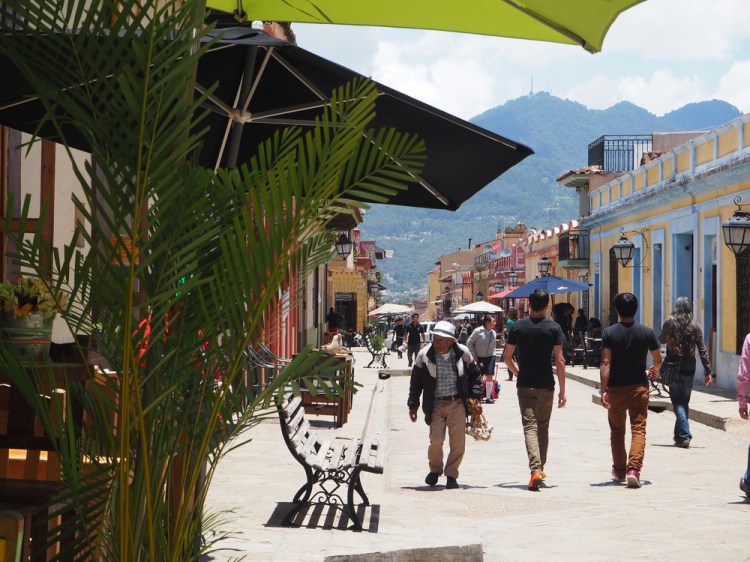
We start to settle down into a rhythm in the lovely town of San Cristobal. The town is not massively touristy and yet there are enough to ensure a good supply of lovely shops, cafés and restaurants. Our house is slightly out of town and the walk through the fields is lovely. We’re still regularly burning incense in the house and we have lilies from the garden which cheer the place up and help cover the smell of animals! We start to build a den in the garden by laying bamboo up against a tree and weaving twigs with leaves in between. The next day we realise that Marta’s son, Luiz, has taken over our work and built a fabulous den! Not only that, he’s made a chair by putting holes through the edge of an old car tyre and weaving a piece of washing line through to make the seat!
Jemima, Gabriel and I sign up for Spanish school again – 3 hours each morning. They are in a class of their own; I’m with Elizabeth from Grand Rapids, Michigan. Her husband Jay is having lessons separately, as are their two daughters Emma (7) and Briana (6). We explore the idea of all 4 children being together in one class, but Jemima and Gabriel are that little bit older and, more importantly, have several weeks of classes from Ecuador under their belt. But it does mean that the children have new friends and very soon we’re arranging play dates, which have the added benefit that the parents not on duty have a few precious hours off! The classes here are run slightly differently in that we all have two teachers – we have Victor from 9-10.30am and then Berenice from 10.45-12.00. They say it’s to give us more variety and to stop us getting bored, but I’m sure that works just as well for the teachers! Another benefit is that we get two different perspectives on life here rather than just one. As in Ecuador, it’s clear that as well as learning Spanish, having these lessons is going to give a much deeper insight into local life and culture – more of that to come in a separate blog.
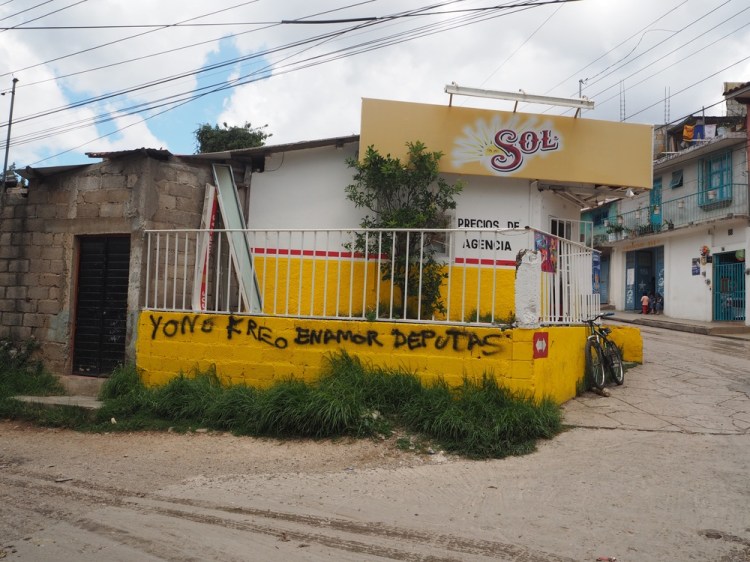
The corner shop that we pass on our way to school every day is such a typical example of shops on the back streets here – in Sol colours, with graffiti
We check out a couple of school options for Millie, and end up enrolling her into a gorgeous little Montessori school. It’s run by José, a tall lanky Bohemian type from Barcelona (beard, baggy cotton pants & baggy jumper – you get the picture); he apparently came to San Cristóbal because he supports the Zapatista politics. There are 20 or so children here, aged 3 to 6, none of whom speak English, but that doesn’t seem to prevent Millie from making friends and having fun. They all have breakfast there in the morning and then wash and stack their own dishes and brush their teeth. Everything is very simple and earthy and all the food is vegetarian. We settle into a routine of collecting Millie after our Spanish school has ended and meeting up with Fi for lunch, either in town or back at the house.
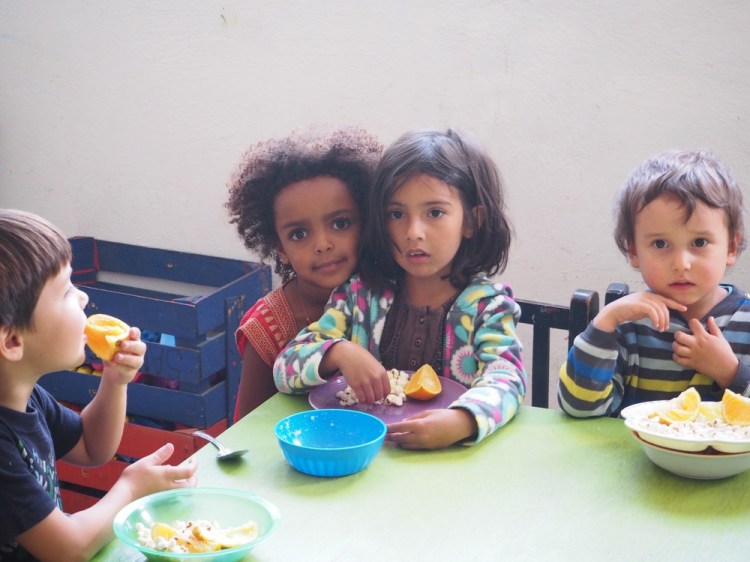
Millie wastes no time in making new friends at school!
I go out to find a chicken to cook for dinner and discover something much better – a restaurant / takeaway that sells chickens grilled on a wood fire! On this first occasion I get a takeaway but it becomes a regular venue for a quick meal for us. There is a real wood fire in a metal cage, with 4 rotating skewers that can accommodate 7 spatchcocked chickens each. It comes with grilled onions, grilled chillies (HOT!), frijoles, freshly made corn tortillas, mashed potatoes and salsa. The teamwork of the staff is incredible – there’s one team on chickens: loading & unloading the grill; cutting them up with shears (about 5 seconds per chicken); serving on plates / trays. Then another team on tortillas: rolling and flattening the dough in a hand press; and cooking on a large hot plate. Finally, a team on everything else: salsa, frijoles, potato, etc. It’s a super-slick operation with everyone working flat out… and it’s not at all clear who’s in charge.
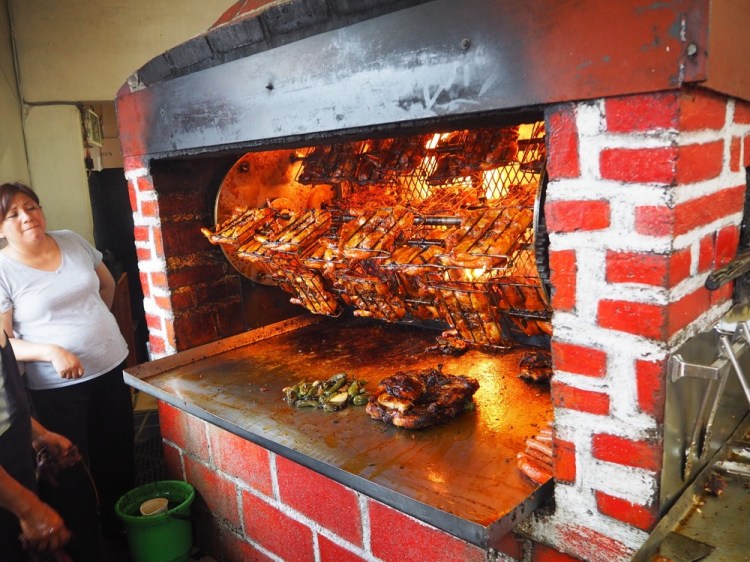
Our favourite chicken restaurant – they can cook 28 chickens at a time on this wood-fired grill.
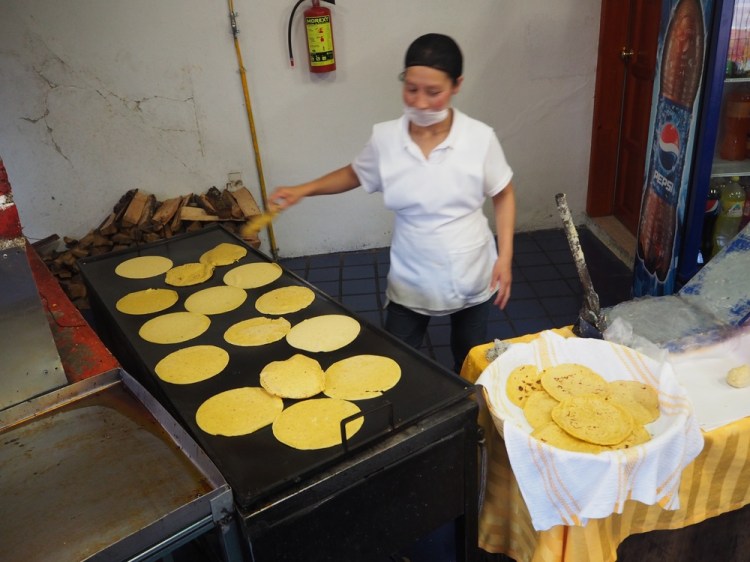
…served with hand-made corn tortillas
As I mentioned in my last blog, there are lots of indigenous people here, who live in the city or travel in from surrounding villages to sell their wares. They’re all selling the same things: the women with beautiful woven shawls and blankets; the children with woven bracelets and dolls. They continually walk the streets, laden down – the women carry 10-15 shawls / blankets on their left arm (how heavy must that feel after several hours?) and another mountain over their right shoulder. Their right arm they keep free to deal with the money. It’s also striking how many (poor) people have metal in their mouth – it looks like silver (it’s not) around and between many of their teeth, as repairs to and to protect from decay.

These indigenous women walk the streets all day laden down with blankets no shawls. If they stop to set up on the pavement, the police move them on.
On our first Sunday, we decide to visit the local town of Chamula – on horseback. All the tour operators In town run this trip; it seems to be the only horse riding that’s available around here. We check with the tour operator what’s involved and they assure us that there will be helmets for everyone. We turn up at their office at the appointed time and are met by a man who bundles us into the back of a pick-up truck with a group of half a dozen young Mexicans who are volunteering for a charity working with indigenous communities – we are assured once again that helmets will be available. We drive to the edge of town where a group of horses are waiting for us by the side of the road and guess what? There are no helmets – what a surprise! We’re told it’s going to be gentle walking only, so we go with it (there are plenty of things that we used to do as children that we wouldn’t let our children do today, and we survived, so why not?!) We climb aboard and walk for about an hour to the edge of Chamula – he was right, these horses have only 2 speeds: slow and stop. However, San Cristobal is set high up in the mountains, so the scenery in the countryside is lovely.
We dismount and are told we need to be back with the horses in an hour’s time. We walk down a street lined with stalls selling food and various artisan clothes that descends to the town square. Most of the women are wearing the traditional Chamula skirt – essentially a length of thick, black, long-haired fabric woven from sheeps wool, simply wrapped around and held up with a wide belt. It’s very bulky and looks extremely heavy and hot. These are apparently prized possessions that last for years – it takes the wool of 5 sheep to make one skirt and they cost around 3,000 pesos (about £120). Many of the men are wearing a tunic made of the same material. A smaller number are wearing the same, but in white wool – they are dressed identically, with brown sandals, white cotton calf-length trousers, a white shirt and a wide, pale brown leather belt with a walky-talky attached. It turns out they are local police, elected into the position for a one-year term. They certainly seem to carry themselves with a greater sense of confidence and self-importance.
It turns out that it was good day to come, as it’s clear there is also a fiesta going on. Around one end of the square there is a group of people sat in a line, wearing what looks like ceremonial dress: black and red outfits with flat, wide, black and red hats with tassles hanging down. A procession then emerges from around the corner with people all wearing their traditional costumes, some carrying huge bunches of flowers including what look like gladioli, some carrying large wooden caskets, some glass fronted, some not (but with crosses on the top or carved into one side); and behind them comes a brass band. The square is a cacophony of sound as apart from the brass band, and the general background hubbub, men are letting off the loudest fireworks you’ve ever heard. The safety advice around fireworks with which we are all so familiar has certainly not made it here! Men are letting off rockets in their hands, I made a crowded market. They are extremely loud when they explode as intended in the air; they are absolutely deafening when they explode on the ground. I can’t imagine that there weren’t several injuries. Our children were quite afraid of the loud noise but we did hang around as the procession wound its way around in front of the beautiful white church, banded with flowers and butterflies. We have what is becoming our regular snack of corn on the cob; I have mine smothered in mayonnaise and lashings of tomato sauce.
It’s a fabulous market with all sorts on sale: waistcoats, jumpers, shirts and blouses, cowboy boots, sheep’s wool, the woven woollen fabric that the skirts and tunics are made of, artisan crafts, fruit and veg, lots of dried shrimp, etc. this is right up there, on a par with the tribal markets that we visited in Ethiopian. It’s extraordinary to behold.
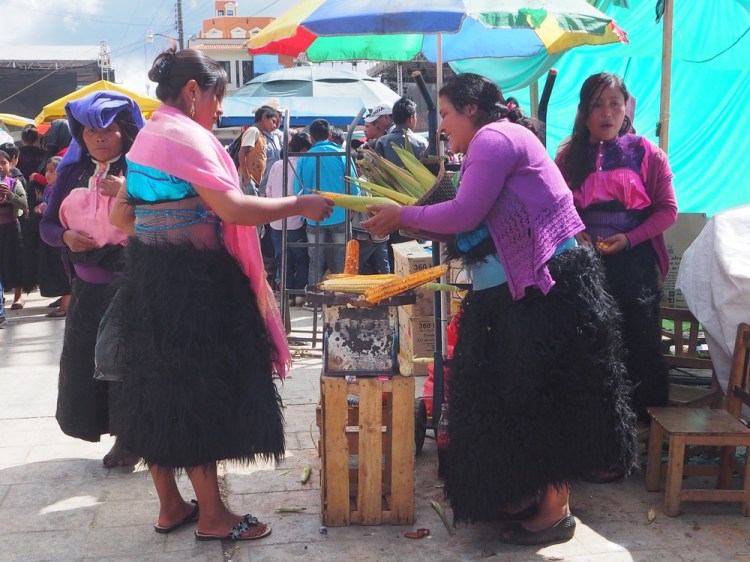
The traditional woollen skirts in Chamula
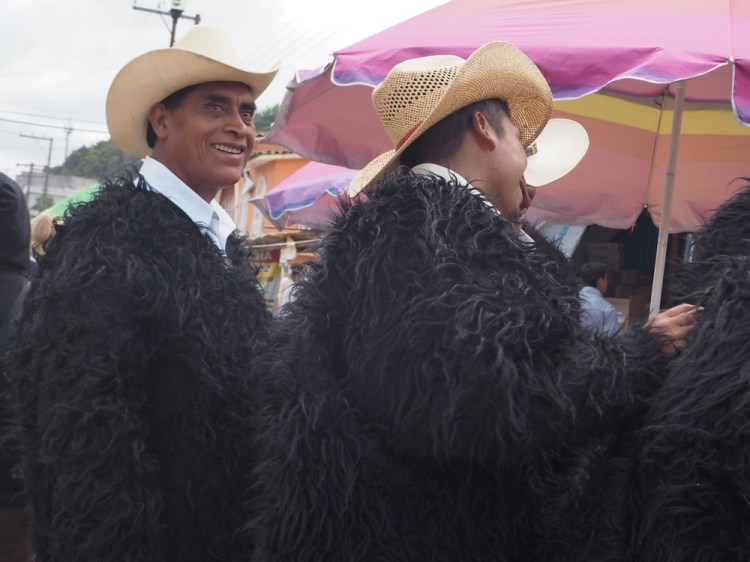
The corresponding traditional men’s tunics
Men all around the square are madly letting off fireworks (cohetes) – they are simply daytime rockets designed for maximum noise, rather than a beautiful display. There is no health and safety here – the men are simply holding the rockets in their hands and lighting them. And these are not small rockets – they are at least waist high. The square is packed and at least some of the spent rockets fall down onto the heads of the crowd. They are deafening and our children really don’t like it.
We make our way back to the horses at the appointed time – just before we get there, Fi questions what on earth we are doing? “This is Mexico!” she says, “There is no way the others will be back on time!” Sure enough she’s right – we hang around for another 20 minutes or so before our guides and the other group of Mexicans wander back. The ride home is equally sedate – Gabriel complains that is the worst horse ride he’s ever been on as his horse simply refuses to break into a trot, despite all his vigorous kicking!
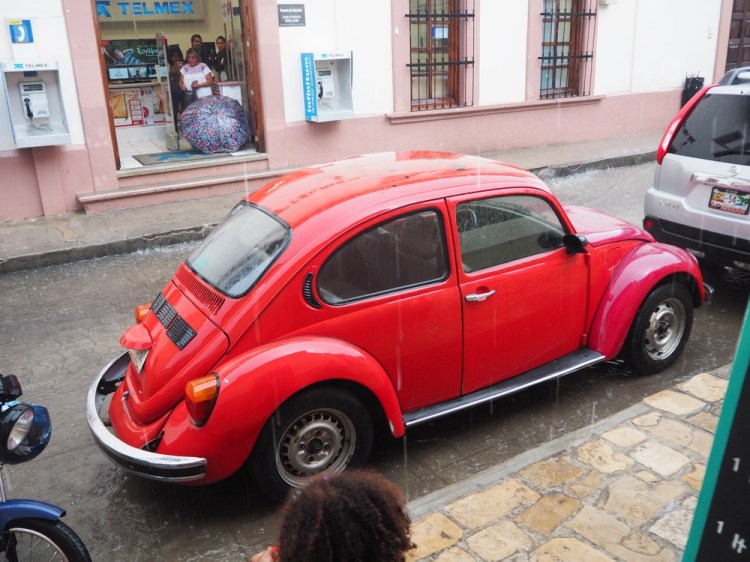
There are an extraordinary number of VW Beetles here in San Cristobal – some old and clapped out, some new, some ridiculously pimped with lights in the wheel hubs. One day I count 15 on my walk home fro town!
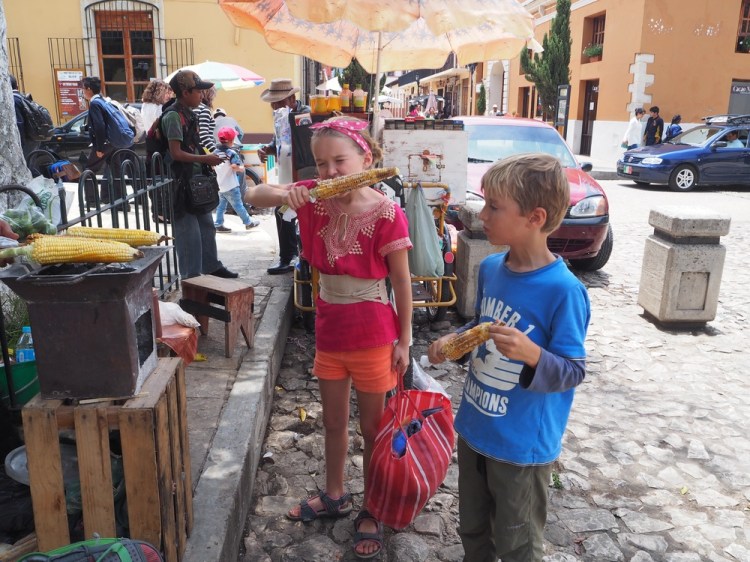
Roasted sweet corn – chewier than at home – served with a bit of salt and smothered in mayonnaise! The children ask to have one every day!
 Five Go Round The World