
It seems as though all of my recent blogs start with a long, arduous journey and this is no exception! We wondered about breaking the journey between Tulum and Palenque, but eventually decide to take the overnight bus and do it in one go. We’re getting used to these journeys – the buses are air-conditioned and the seats recline significantly more than in an aeroplane (economy seats, at least… goodness, the days of business class air travel seem a lifetime ago!) and the children generally sleep very well. This turns out to be no exception.
We arrive early in Palenque and take a taxi to the Mayabell hotel / restaurant / camping site, where we’re booked in. We arrive early in the morning and already it’s hot – the hotel has a large pool, which is essential in this heat, so we decide to spend the day relaxing. I take the colectivo (minibus) into town to find a bank… the Lonely Planet is absolutely correct in saying that the town of Palenque has nothing to recommend it. It’s very ordinary, the architecture is basically concrete blocks and it’s all very hot, dusty and run down. I’m glad we’re staying out of town.
I wake early in the morning to the incredible deep growling sound of Howler Monkeys in the forest around – I go out and can see a few in the distance, but it’s the volume of sound they can create that’s so extraordinary – it’s wonderfully atmospheric. I could hear it very clearly from the bedroom of our bungalow / cabin which is a little way away from the trees, but there are a few people camping who are significantly closer to the forest – the sound they woke up to must have been amazing!
Unfortunately I’ve either eaten something dodgy or have picked up a virus, because I feel hot and dizzy and my stomach is playing all sorts of tricks. We’ve decided to go to the ruins early to avoid the heat – I almost decide to stay back but decide to give it a go. Its only a five minute ride in a colectivo to the site of the ruins and it’s easy to pick up a guide.
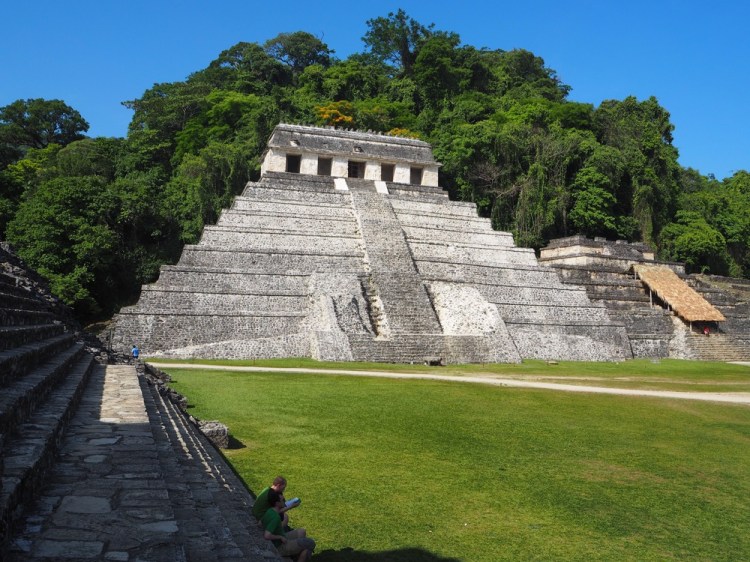
One of the impressive coloseums at Palenque ruins
The Mayan ruins here are reputedly some of the best in Mexico and they are indeed impressive, with enormous pyramids. The peak of the civilisation here was around 600-700 AD and it all fell into ruin around 900 AD. It’s extraordinary to think that this was all built without metal tools, pack animals or the wheel and yet the Mayans were apparently highly expert in astronomy. Our guide has good English and sets off with great energy and enthusiasm, trying to engage our children. Of course, we know it’s a thankless task and maybe he does too, but he tries nonetheless. I’m feeling rubbish and am just about hanging on, sitting down in the shade wherever I can. We arrived just after it opened at 8am but already the temperature is beginning to soar. He spends an inordinate amount of time explaining the Mayan number system (base 20; one dot = 1; one bar = 5) and (extremely complicated) calendar system. Jemima and Gabriel go with it to start with, but he draws it out too long much and starts to lose them – we know there’s no way back from here!
It seems that the Mayan rulers spent much of their energy on duping and controlling their subjects, with buildings constructed such that on key days (solstice, equinox, zenith), the sun would pass through a sequence of openings and illuminate a king who just so happened to be addressing the masses at that precise moment. It was their equivalent of spotlights and lighting effects on a stage, I suppose. Due to our children’s boredom and my nausea / dizziness we cut the walk through the jungle short (only a very small percentage of the buildings on this 15km2 site have been excavated – most are submerged in the depths of the forest). We grab a quick juice and bite to eat and head back to the hotel, where Fi and the children swim and hang around the pool, and I sleep.
The next morning we head off to the bus station for the journey to San Cristobal de Las Casas in the neighbouring state of Chiapas. From our comfortable air-conditioned seats, we look out onto the lush green countryside as we begin out climb out of the city. It’s hard to believe how incredibly hot it is out there, given how green and verdant it is. It’s been difficult to judge how long this journey will take – I’ve asked various times and been told anything between 4 and 7 hours. It’s actually closer to 7 hours than 4 and of course the films are as always, completely unsuitable for small children – on this journey we have Skyfall (which we let Jemima and Gabriel watch) and The Dark Knight Rises (which we don’t). The volume is always set very high, so the only way to avoid them is to plug the children into films on the iPads, with headphones – actually, it’s very effective!
We get to a San Cristobal and take a taxi to our rental house, which has been advertised as ‘an artists paradise’. We’ve really been swayed by the fabulous garden it obviously has, so the children can play. We arrive at a the gate in a high, orangey-pink wall, pull the cord and hear the bell tinkle, and wait. Before long, the gate opens and we’re greeted warmly by Marta, the indigenous indian woman who looks after the house in the owner, Janet’s absence. There are 3 dogs – one golden retriever and two smaller dogs – and they escort us up the steps, past Marta’s small house that’s underneath the main house to the front door. So far so good – we have a good feeling, the garden is large and looks well kept, so the children will be happy.
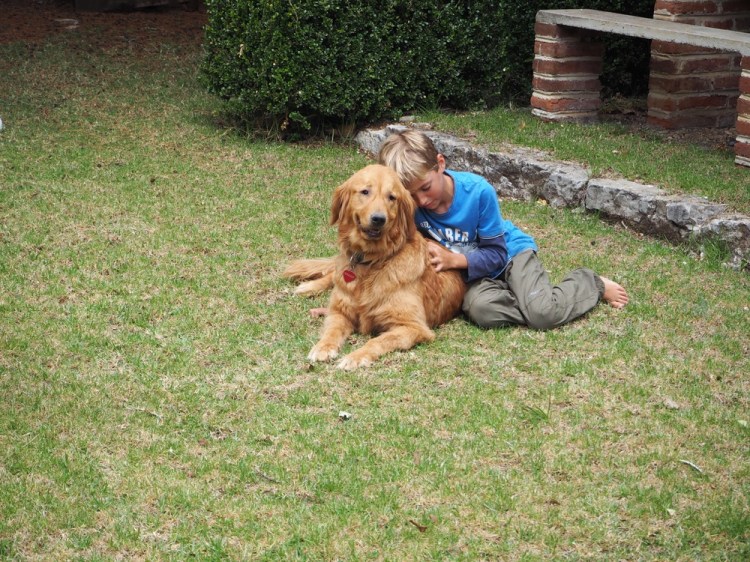
Gabriel is happy with dogs and a garden!
Marta then opens the door and shows us into the house – our hearts immediately sink. There’s a strong smell of cats and dogs and everything is dark and dingy. But at least it’s got a real fire. As we explore, it gets worse – the sofa, covered in a throw, is completely wrecked; the frame has broken and the fabric is completely worn through. The stuffing of several cushions is bursting out. The equipment in the kitchen leaves a lot to be desired and apparently Janet has left lots of her ingredients behind – a shelf-full in the fridge, a tray of extremely greasy and dirty condiments by the cooker, and various stuff in the cupboards. Next to the kitchen area there’s a tiny table against a wall – we’re never all going to be able to sit around that! On her website, there’s a dining room with a large wooden dining table – however, the door to this room is closed and we’re told we shouldn’t use it. On closer inspection, it has a couple of large open sacks of pet food against the wall and a couple of cat litter trays on the ‘dining’ table. Fi has a particularly sensitive nose and she wretches as she goes in to take a look. In all these months of travelling, this is by far the worst rental property we’ve come across. There were a few rough hotels in Ethiopia but they were just for a night or two – this is supposed to be our home for a month!
We spend the next couple of days trying to find somewhere else to stay. (I also check the terms & conditions of the Trip Advisor website, which of courses we’ve electronically signed without reading properly. It turns out to be the most one-sided legal contract I’ve ever read – everything is in there to protect the owner; the renter takes it as seen and has no rights whatsoever). There is surprisingly little rental property here and after a couple of days we decide to make the best of it and stay. Of course the children see past all the grime, the threadbare sheets (so much so that they rip during the night!) and the smell, and want to stay so they can have the garden and play with the dogs! In fact, it’s the best thing we could have done, because of course when you’ve made that decision, the course it set and you adapt. We exchange the sofa, easy chair and coffee table with those in the other (vacant) rental property at the bottom of the garden and Marta works tirelessly to clean the dining room. We buy lots of incense to burn and keep the windows open for as long as possible – for me the smell is soon OK but for Fi we never get rid of that underlying smell of cats and their pee.

The view back up Real de Guadalupe to the church at the top of the hill.
On our first morning we wander into town – about a 15 minute walk. I’ve been really looking forward to arriving here and my expectations in terms of the attractiveness of the town are set high, based on Fi’s descriptions from when she visited 40 years ago! For the first 10 minutes or so of our walk I start to question this – has it all declined in the meantime? The buildings are dull, there are plenty of Corona & Sol adverts and graffiti, but not too much more colour and it’s all looking a bit run down. Then just as I’m really starting to re-evaluate, we turn a corner and phew, perhaps I don’t need to after all. Suddenly, the low rise, flat-roofed building are all painted in the most fabulous vibrant colours, the windows have attractive wrought iron bars and the tops of the building are all topped with distinctive and attractive cornices (is that the correct term?). It all has a very Spanish colonial feel. We turn another corner and we’re on the main street, Real de Guadalupe that gets more and more attractive as it turns into a pedestrian only area that leads to the Cathedral and main plaza.
We have breakfast on a gorgeous cafe one block into the pedestrian only section of the street. It reminds me immediately of our wedding – the decor is bright pink and lime green and the flowers are the same as we had, in the same tin buckets. Was this the place Fi drew her inspiration from?? Breakfast is tasty and enormous – chilaquilles (pulled chicken with tomato salsa on fried corn tortillas, with refried beans, cheese and avocado) and incredible juices. Already I like this town!
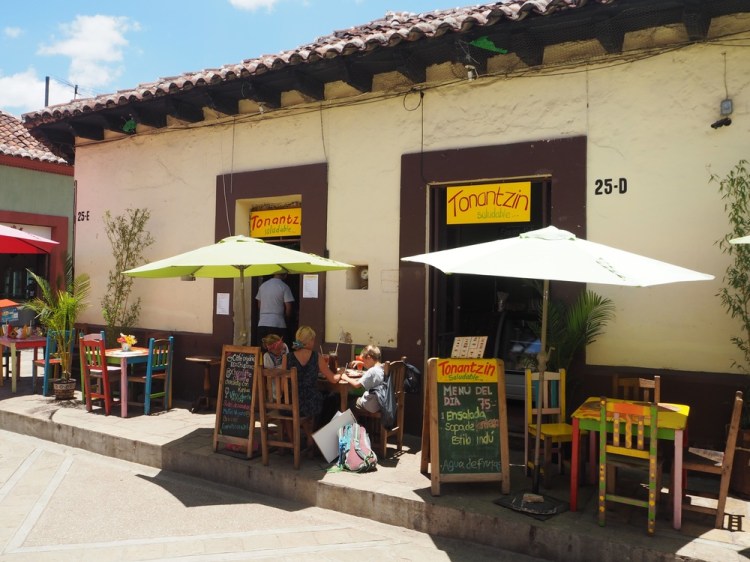
Our first breakfast venue – yum!
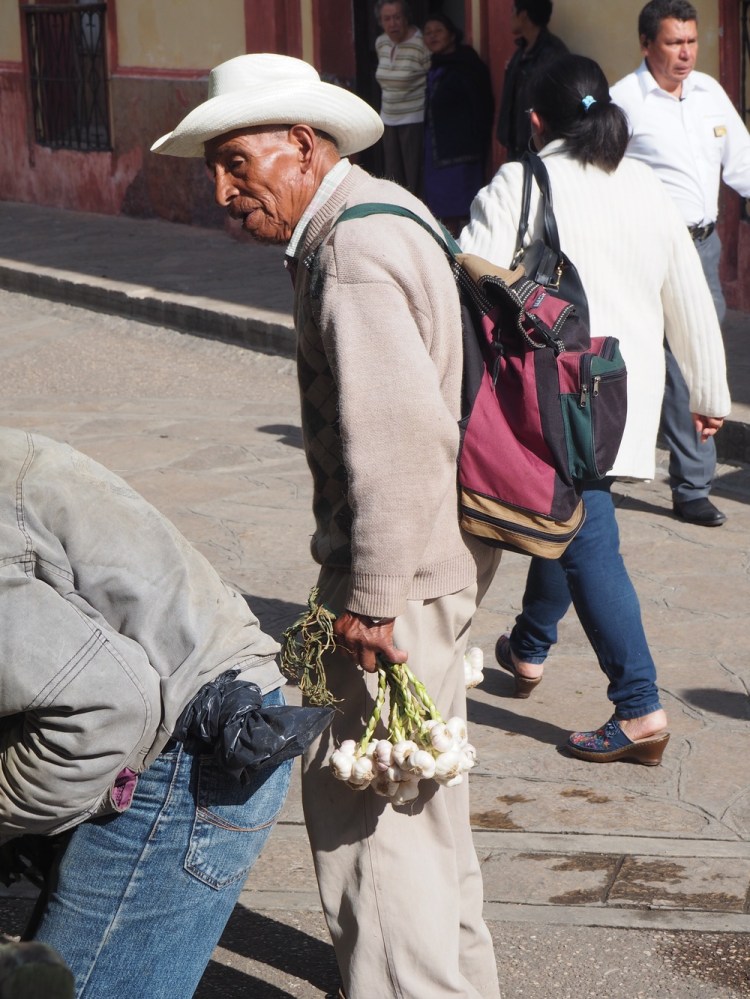
Selling garlic on the street is no way for a man of this age to be making a living – it’s the harsh reality of life here, though.
Chiapas is the poorest state in Mexico and the polarisation in wealth is immediately striking. As we sit on the pavement enjoying our breakfast, juice and coffee, we’re approached by local indigenous women and children, selling their wares. It soon becomes clear that this is the reality – local Mestizo or foreign restaurant and shop owners do well from the tourist trade; the indigenous folk from the city and surrounding villages all walk the streets, hour after hour, day after day, all selling (or trying to sell) the same products. It’s all summed up by an old boy who we see regularly, trying to sell a few bunches of garlic. It’s a harsh reality of what is clearly going to be a beautiful town.
Despite the house, I’m now really looking forward to our stay here, exploring further, getting booked into Spanish school and settling into a rhythm.
 Five Go Round The World