
We return back to Puerto Ayora in Santa Cruz the same way that we came – on a very bumpy 2-hour boat ride. It’s quite extraordinary – despite the severe bumps, all 3 of our children sleep most of the way! We have just one night on Santa Cruz, in a basic but clean hotel. The hustle and bustle of Puerto Ayora seems like a major metropolis in comparison to laid back Isabella!
We manage to get to the only main sight that we’d meant to get to on our week here but didn’t make – the Darwin centre. One species we do get to see here that we haven’t managed so far is the land iguana – much bigger than the marine iguana and brightly coloured rather than volcanic black. But of course this is in captivity rather than in the wild, so it’s not quite the same.
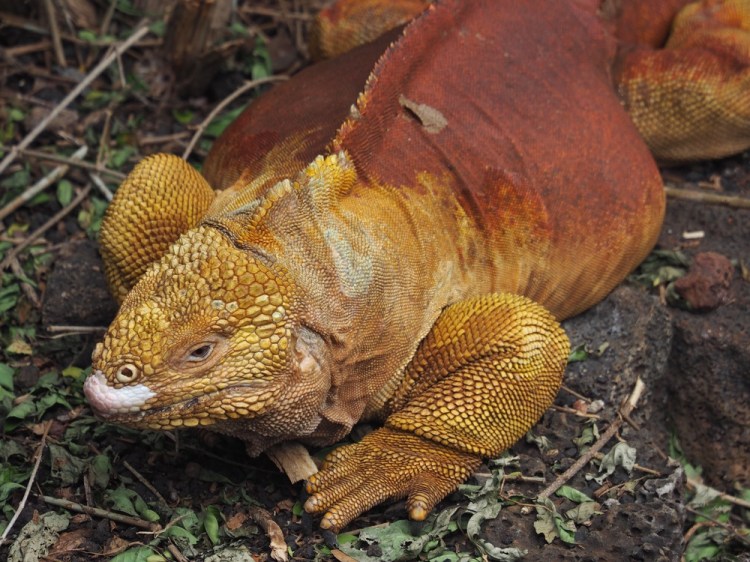
A land Iguana at the Darwin Centre
I also manage to get a shot of one of the famous Darwin’s finches – while they’re not afraid, they do tend to flit around a lot and so are tricky to catch. Although they’re often quoted as a classic example of evolution, he never mentioned them in his great book “The Origin of Species by Means of Natural Selection’. Apparently his assistant was a little sloppy in how he captured and recorded each of the species (Darwin identified 14 different species, each with its own niche), so he left it out completely.
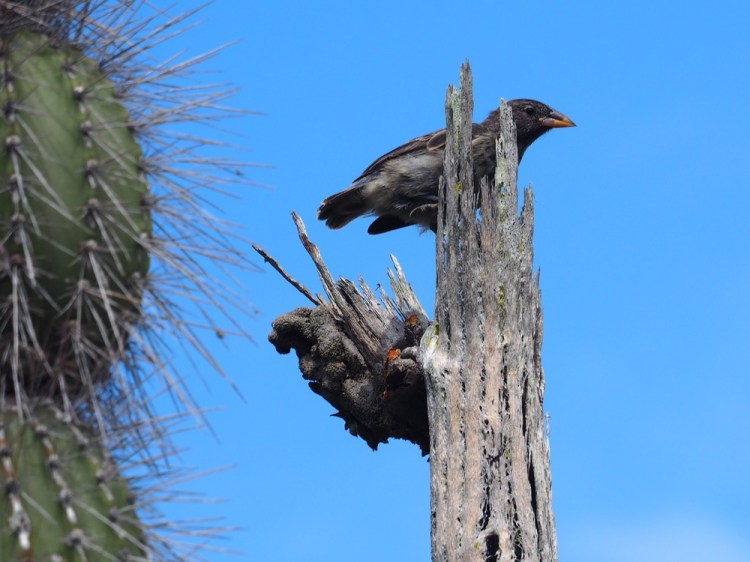
One of the 14 species of finch identified by Darwin on the Galapagos, that were so influential in his thinking
I’ve long been fascinated by evolution and considered Darwin as one of THE great scientists – and the concept of evolution has greatly influenced my view on the world and on religion. So it feels like a real privilege to be following in his footsteps, seeing these extraordinary species at first hand and imagining what he was thinking as he was here studying and meticulously cataloging them. Looking back at my photos, I’m sure the marine iguanas on Santa Cruz are different to those on Isabella (those on Isabella have a lightly longer head, I’m sure).
I decide to download ‘Origin of Species’ on my Kindle and have a crack a reading it – I thought I should, seeing that we’re here and I’m such a proponent of evolution. To be honest, it’s not a page-turner; it’s very dry and obviously the language is old and a bit turgid. I’ve not made it all the way through, but have read enough to be incredibly impressed by his foresight, courage and above all, his scientific rigour and determination to challenge his own theories. For example, the first chapter is entitled ‘Variation under domestication’. He clearly sought the expertise of as many experts as he could in the field, covering many different species of domesticated animals and plants; but also became a pigeon fancier for 8 years, solely as research for his studies. Eight years’ work, for just one section of one chapter! One of the reasons it’s hard to read is because he gives so many examples to support each point. It’s clear to me that in addition to his natural scientific rigour, he was ever conscious of the reaction his book would provoke, both in the scientific and public communities, and hence his need to preempt every potential challenge and thoroughly evidence every point.
I obviously knew the core of of his work, but ‘Origen of Species’ goes much further than I was aware. Not only does he propose the mechanism of evolution and the conditions necessary for it to work, which is extraordinary enough, given the prevailing views of the time, but he explores it in much more detail. For example, he asks whether evolution is more efficient on a small, isolated land mass (like the Galapagos) with relatively little competition, or on large land mass like Eurasia? Is it more efficient and rapid (producing more competitive species) within a large genera with many species, or a small genera with few? And what are the implications?
I’ve long admired admired the dedication of great observational scientists of the past: eg Sir Richard Doll and his 50-year longitudinal study of UK doctors, to prove the link between smoking and cancer; and Dr Edgar Hope-Simpson – a Dorset GP whose 11 year study (that involved following every single recorded cased on the Island of Yell in the Shetlands) showed that Chickenpox and Shingles are caused by the very same virus. Also, those who’ve had the foresight and intellect to challenge the accepted wisdom of the time (Copernicus, Galileo, etc) and come up up with entirely novel concepts. I find it extraordinary that Darwin came up with his theory of evolution given: a) the prevailing view at the time; and b) the lack of supporting information and knowledge. He knew that there were aspects that couldn’t yet be explained but fully expected future science to fill in the gaps. Mendel’s work on dominant and recessive traits in pea plants, concepts of genes and chromosomes all came later, not to mention DNA and genetic decoding. And of course all have supported his theory.
To change gear, we’ve had a truly memorable couple of weeks in the Galapagos. And we’ve managed to do it on a sensible budget. It can be done! With our budget and particularly with children, it was definitely the right idea to do it ourselves, to stay on land and to take our time. The cost of day tours was shocking, but we only did one in two weeks – other than that one, we just waited and most of the wildlife came to us. OK, we didn’t see everything there is to see, but I reckon we saw at least 80%, maybe more. And the incredible thing about these Islands is not the extraordinary biodiversity, it’s the fearlessness and accessibility of the wildlife. Although I’d known that would be the case, it’s still extraordinary to witness. The memory of swimming within touching distance of a 1.5m green sea turtle, weighing more than 150kg and yet swimming so gracefully, with its beautiful markings, will stay with me for a long time.
We’ve got another week’s wildlife action to come, but completely different – we’re now off to the Amazon jungle. It’s a hell of a journey to get there, but I can’t wait!
 Five Go Round The World