
The boat ride from Santa Cruz to Izabella is not the most comfortable! It’s a fairly small boat, at its maximum capacity of about 25 people. It has three Yamaha 250 hp outboard motors and so is no slouch. There’s a gentle swell out in the ocean but the boat really slams back down onto the water after going over each wave. Fi is sat right at the front with Gabriel and Millie, so they get the worst of it. It’s not at all good for Fi’s injured shoulder. As the boat is packed, I end up right at the back with Jemima. We are in full sunshine and my left arm is completely saturated from the spray but at least it isn’t quite so bumpy. Nevertheless, it’s a long two hours!
We land on the southern coast of Isla Isabella, the largest of the Galapagos Islands. It’s essentially six volcanoes joined together – on a map it looks exactly like a seahorse. As soon as we step ashore we realise that this is going to be quite different from Santa Cruz. The jetty, which is right next to the beach, is really small and the town itself is obviously much smaller than Puerto Ayora. There are sea lions lying around the jetty and the beach, and the odd Galapagos Penguin swimming around. There are no paved roads here – just dry, dusty roads that get pretty muddy when it rains. Its laid back, beach-town vibe is immediately obvious.
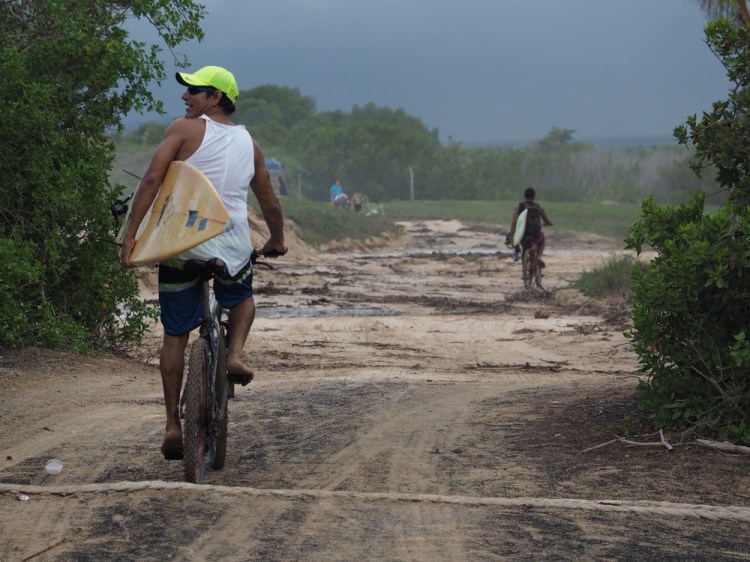
This photo just about captures the vibe of this place.
We take a taxi to our hotel, Casa Rosada – it’s only a five minute ride, to the last building in town along the coast road. It’s managed by a very helpful and friendly Mexican couple – Carlos and his girlfriend (who was very quiet and whose name I kept missing!). As we climb the outdoor staircase to see our room for the first time, several marine iguanas scuttle away, between the steps and into the aptly named Iguana Bar immediately next door. This is our introduction to the smell of iguana poo – it’s a smell with which we become intimately familiar during the course of our stay! The balcony looks down over the bar and right down the beach – it’s a fabulous view. As we explore and get to know our hotel, we realise that there are always 20-30 marine iguanas hanging around; some large, some small – sometimes several on top of each other, usually just sunning themselves. When the tide is out, it reveals an expanse of black volcanic rock that’s covered in hundreds, if not thousands, of crabs. As usual, there’s a mixture of bright orange Sally Lightfoot and another variety of black speckly crabs that are extraordinarily well camouflaged. I wonder if they enjoy some symbiotic relationship?

Our view from the hotel down the beach, with a typical guard of marine iguanas

Our friendly neighbourhood crabs
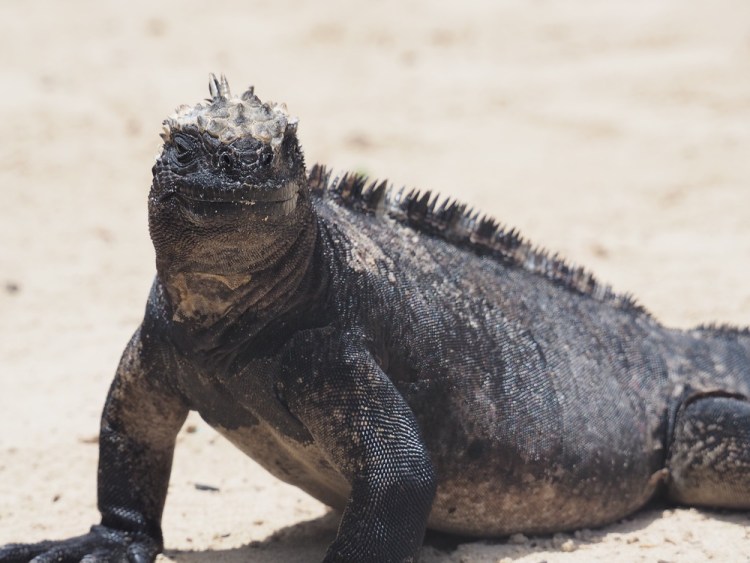
There are marine iguanas everywhere you look here
Immediately next door, the Iguana Bar is one of the coolest we’ve ever been to. It’s an outdoor bar, right on the beach, with a volleyball court and a slackline. We regularly return here for a sundowner – a happy hour cocktail that’s billed as a caipriña – it’s definitely not an authentic caipiriña, but it’s delicious nonetheless. Fi and I relax and enjoy, while the children practice slacklining. It’s a very special time of day – in a very special place!
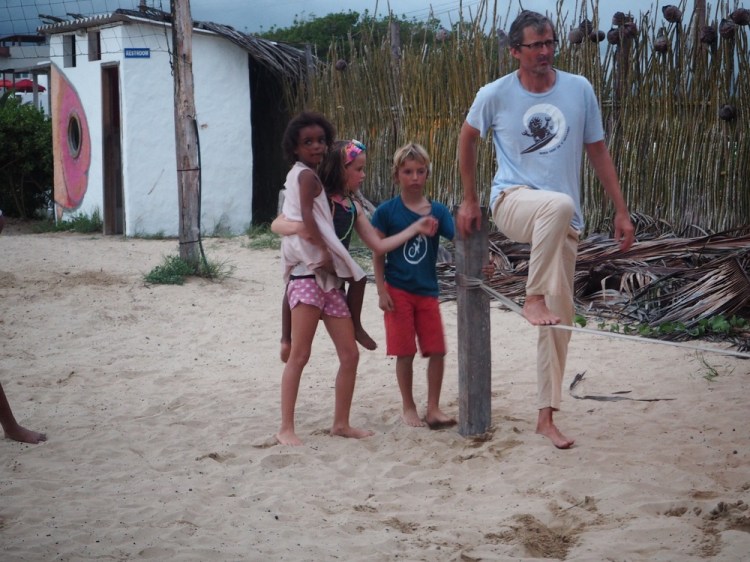
It’s my turn at slack lining. We’re definitely getting one of these in our garden when we get home!
We realise early on that the food here is not that great. There are a couple of streets with various restaurants but the quality is certainly not the best. But we discover an understated cafe/restaurant – the Booby Trap – right across the road from the hotel. It’s run by Jim, an American, and his wife. The food here is of a completely different standard; definitely the best we’ve found here. They’ve been very wise – they’ve kept the menu very short and don’t specify exactly what ingredients are in each meal, so that they can vary it according to what food is available or not at any one time. Jim used to be one of the first naturalist guides here, many years ago – his guiding badge was number 17! The first time we discover the Booby Trap is in the evening – the food is great but the mosquitoes are not; after that we come back every day for lunch.
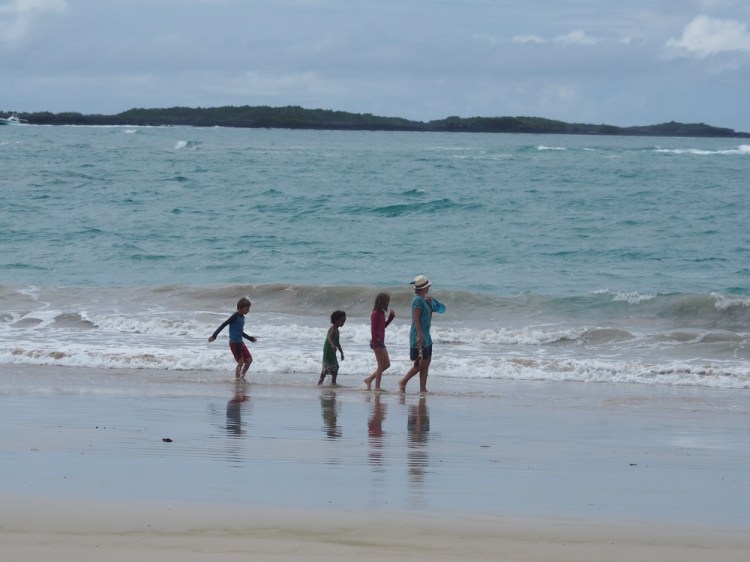
The team, strolling along the beach
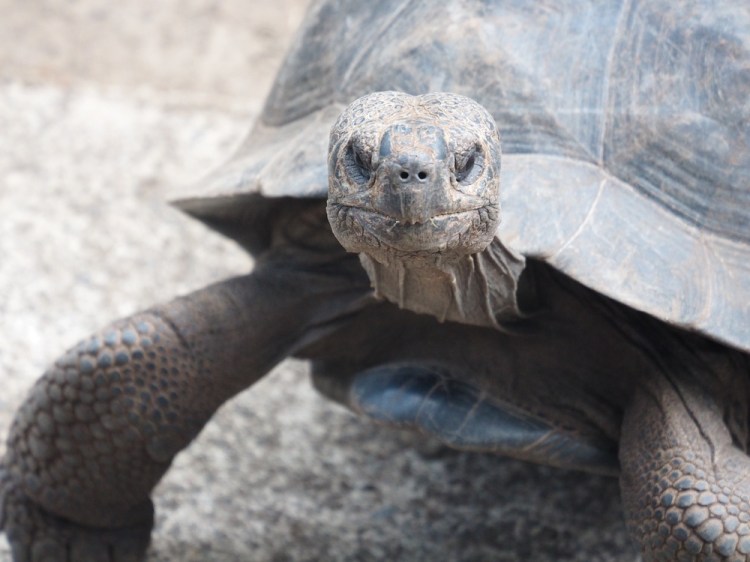
There’s a giant tortas breeding centre within walking distance of the hotel. There are several hundred here, ranging from tiny to this 80-year-old breeding adult.

Needless to say, you see wildlife everywhere here. This is a whimbrel on our beach…

… a handful of very noisy black-necked stilts…
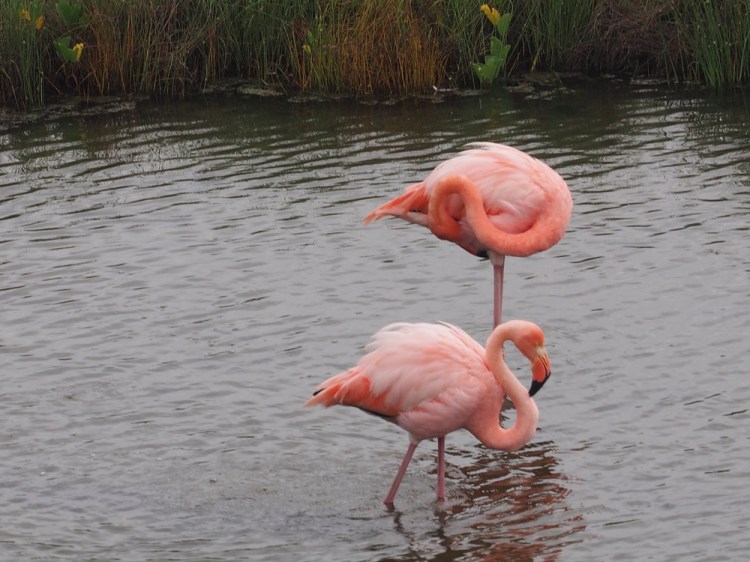
…and flamingoes
We ask Carlos for his recommendations for day tours here and his top recommendation by far is a trip to Los Túneles. It’s mainly a snorkelling trip for $90 per head (they only charged for four of us) – we decide to splash out and go for it. We are not disappointed. There are half a dozen others on our tour; the boat ride out is fairly long (over an hour) but interesting – we go past Union Rock, an enormous hunk of rock sticking out of the ocean, with the waves crashing onto it and masked boobies sitting on top. And beyond that, the boat suddenly slows down: our skipper has spotted manta rays with their shark-like fins sticking out of the water. We see the enormous dark shadows passing close to the boat; I even catch a glimpse of one leaping out of the ocean, flashing its white belly.
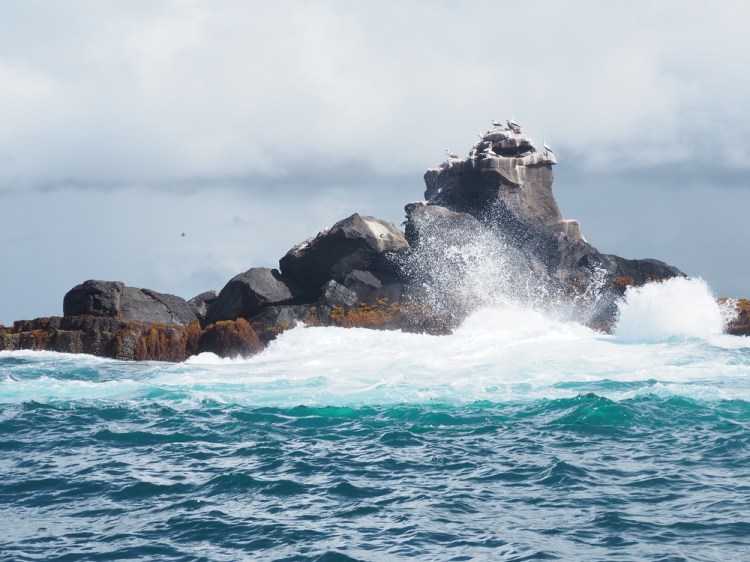
Union Rock – a very large, random hunk of rock in the middle of nowhere. Handy for the seabirds, though.
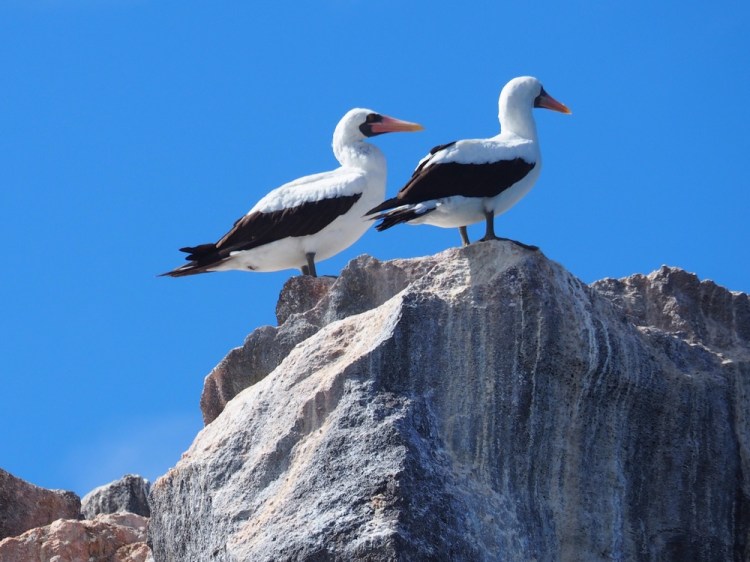
Masked boobies on Union Rock. there are three main types of boobies that live here: blue-footed; red-footed; and masked. They each have their own niche and fish at different distances from the shore, so don’t compete with each other for food. I love evolution!
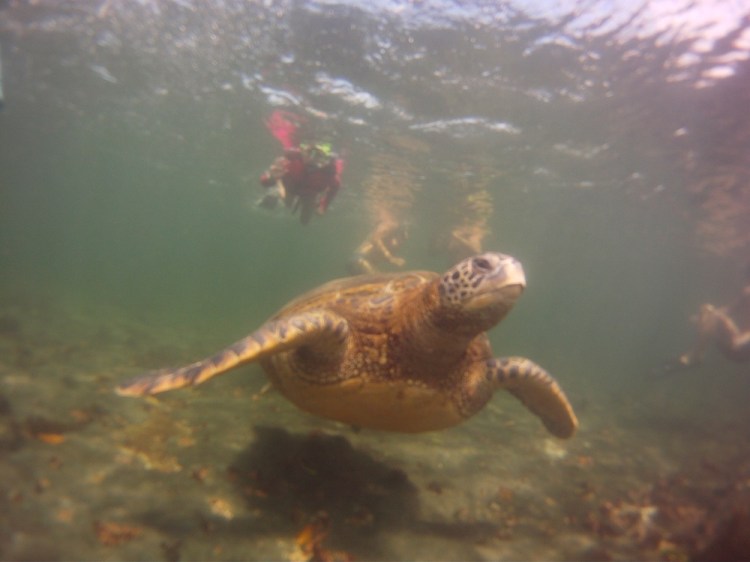
Swimming with the sea turtles was a real highlight.
We reach our main snorkelling point and everybody jumps in. This time we are much better prepared and make sure everyone has their mask and snorkel in place before we get into the water! Gabriel is with me, Millie is with Fi and Jemima is with our skipper, who looks like a rather portly version of John Travolta. Jemima just holds onto his shoulder as he leads the group around. We see lots of brightly coloured reef fish but to start with, Gabriel and I are lagging behind the main group and are frustrated as they all spot a sea turtle and we miss it. But it’s not for long – we soon spot and enormous green turtle and are able to follow it as it flies gracefully through the water beneath us. It’s huge – at least 1.5m long; it’s also incredibly beautiful, with exquisite patterns on its face and a shell. It’s one of three we see during the course of this snorkel.
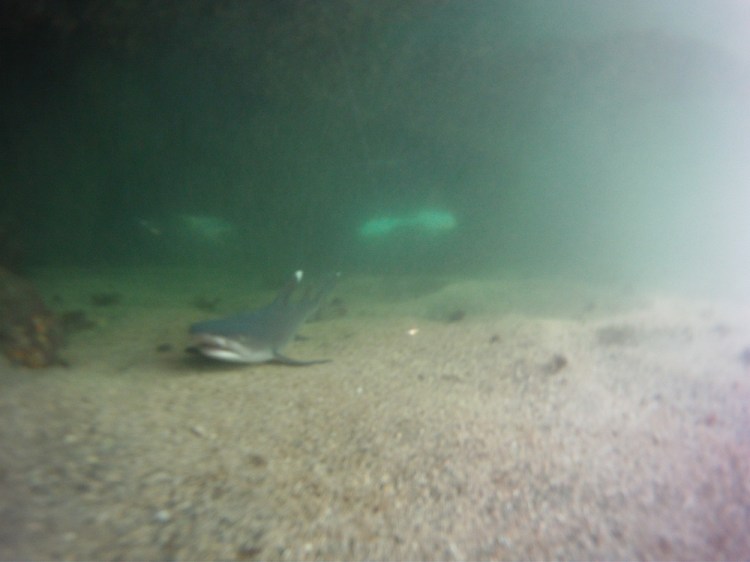
White tipped reef shark, chilling in its cave
John Travolta leads us over to some rocks; there is an underwater cave beneath them and in there, a couple of white tipped reef sharks, chilling out. I knew there was a very good chance that we would get to swim with sharks and was excited at the prospect, but wasn’t 100% sure how I’d react (apparently I didn’t go into the sea for years after seeing Jaws as a child!) But these are beautiful, streamlined, impressive creatures that obviously pose no threat and I’m simply anxious to get as close as I can.
Fi, Jemima and Millie get to see eagle rays (Gabriel and I are obviously lagging behind again) and we all see a couple of seahorses. We have a couple of snorkels in two separate locations; the first for about an hour and the second for 20 minutes. Millie in particular does incredibly well; she manages the whole thing, holding onto Fi’s hand, and doesn’t complain once. From here, our captain cleverly negotiates some very sharp looking submerged volcanic rocks and we clamber ashore at Los Túneles, which this tour is named after. We walk for only 50m or so to a classic viewpoint of an arch of volcanic rock, carved away by the sea. But the highlight here is that we see a couple of blue footed boobies going through their courtship ritual. The male goes through his full routine: beak tucked down tight under his chin; beat stuck up in the air; wings splayed out with his tail stuck in the air; and of course slowly lifting one ridiculously blue foot after the other. He must be doing okay, because she joins in with the synchronised dance. Just before we leave, we see a baby sea lion swimming close to shore. Jemima still has her life jacket to hand and quickly leaps into the water. It’s wonderful to hear her squeals of delight as the sea lion swims around and underneath her, clearly enjoying the game.
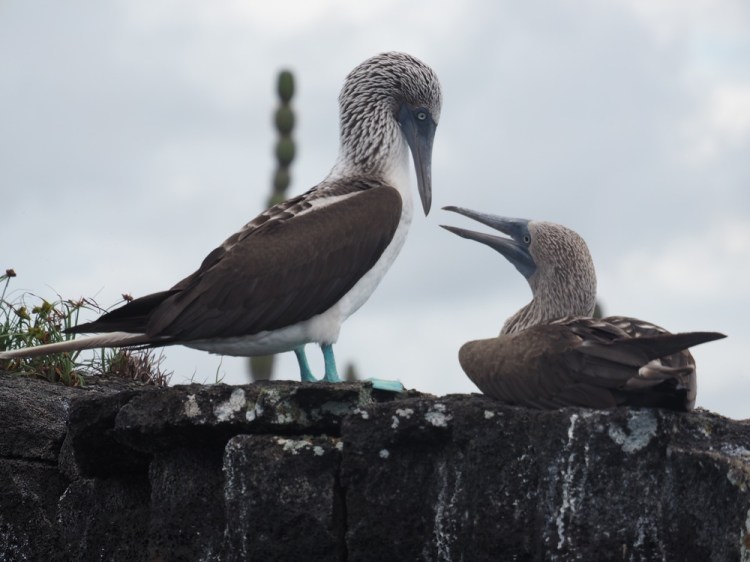
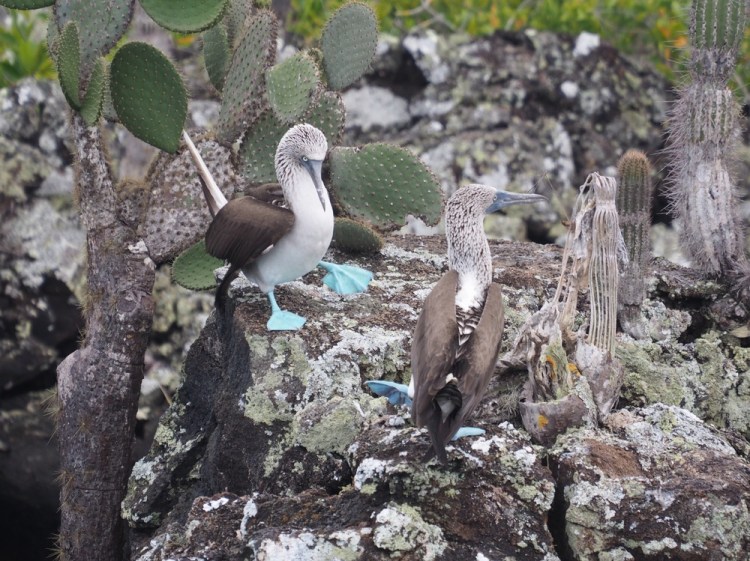
A spot of synchronised foot lifting
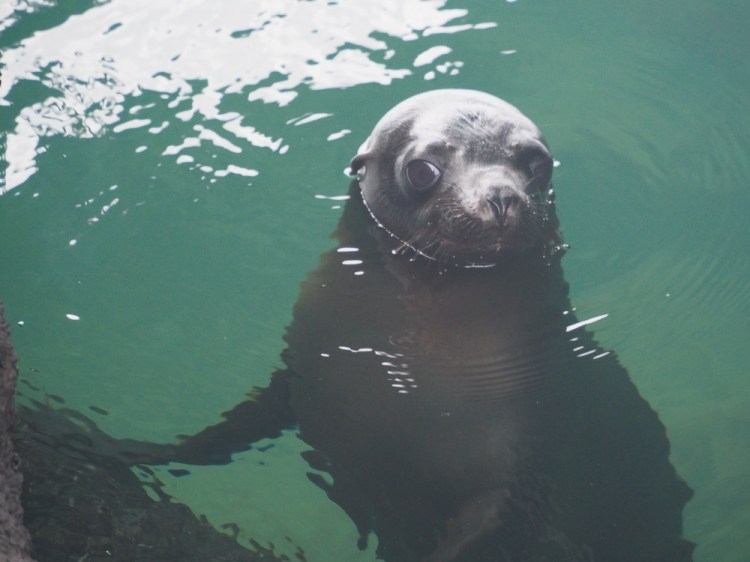
The sealion pup that Jemima swam with
This has been an incredibly special and magical day. Reflecting on it during the course of the evening, Jemima, Gabriel and I find ourselves comparing it to the very best days of our lives! I’m so glad we went for it – it’s going to be a highlight of the whole trip.
We spend two or three afternoons hiring body boards and just playing in the surf. It’s great fun as I have a competition with the children to see who can get furthest up the beach. Every time I think I have won, Gabriel catches another wave coming up the beach and zooms past me, giggling. Occasionally we see a sea lion swimming by. On another afternoon, we simply hire snorkelling gear and go down to the port. Again, we see shoals of brilliantly coloured fish everywhere, and Fi spots a few more eagle rays.
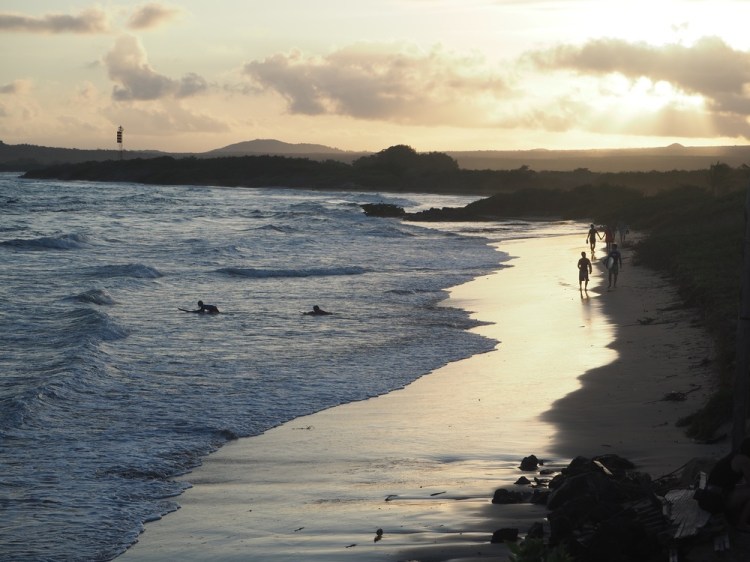
Body boarding continues until the light goes – we just can’t seem to drag ourselves out of the ocean
Towards the end of the week, we’re out on our balcony when I suddenly spot several jet-black frigate birds flying low over the hotel. They’re incredibly agile as they either play their games or fight for food, I’m not sure exactly which. One of the things we haven’t managed to see is frigatebirds blowing up the huge red throat sacks in their courtship display. But I notice that at least one of the birds overhead has its red throat sack hanging down, like a bright red empty scrotum!
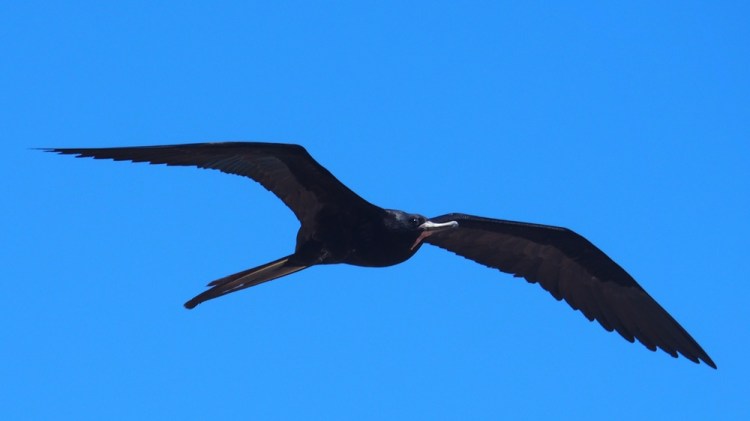
The Magnificent Frigate Bird. This is a male (females have a white breast) but for some reason this one doesn’t have the big red throat pouch.
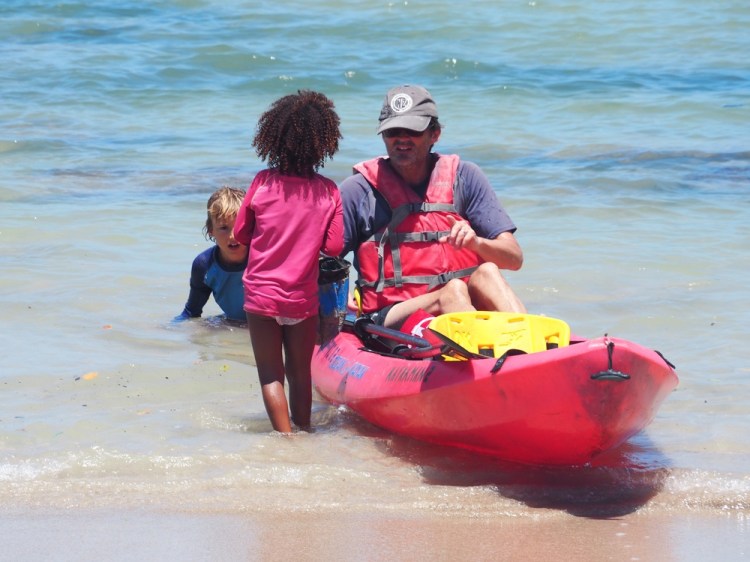
Jemima, Gabriel and I go kayaking around the bay (Fi’s shoulder is still giving her lots of trouble and we decide that kayaking might do it more harm than good). Right around the corner from the beach, we see a huge flock of blue footed boobies, diving en masse into the sea. It’s an incredible sight, with hundreds of them divebombing shoals of fish simultaneously. We see lots of Galapagos penguins swimming around; again within a few metres of our kayaks. And we also see more green sea turtles; not quite as special as swimming with them a couple of days ago, but still very cool.
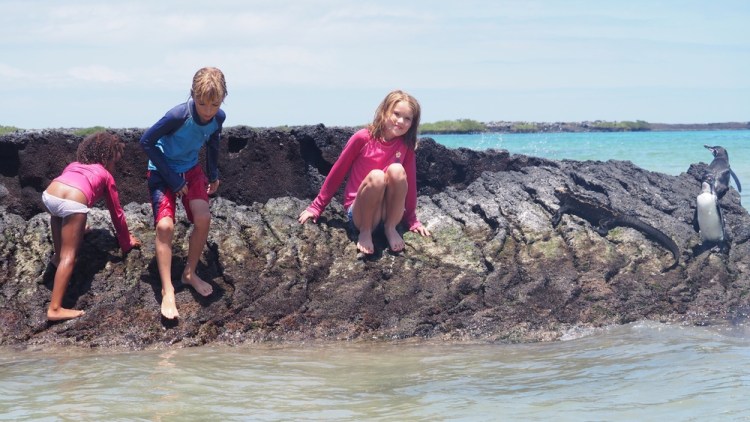
This is so typical of the wildlife here, with the iguana and penguins not batting an eyelid as our children clamber over the rocks
This has been an incredible week on Isabella – only one paid day trip and yet we’ve seen masses of wildlife. And we’ve had a wonderfully chilled time with our body boarding and slack lining. But all good things must come to an end and we now have to start making our way back to the mainland, via Santa Cruz…
 Five Go Round The World