A few years ago I answered a questionnaire; one of the questions was: “if you only had one holiday left in your life and you could go anywhere in the world, where would you go?”. My answer was the Galapagos Islands. So to say I’ve been looking forward to this chapter is a bit of an understatement. My only fear is that I’ve built it up so much in my mind that it can only be a disappointment…
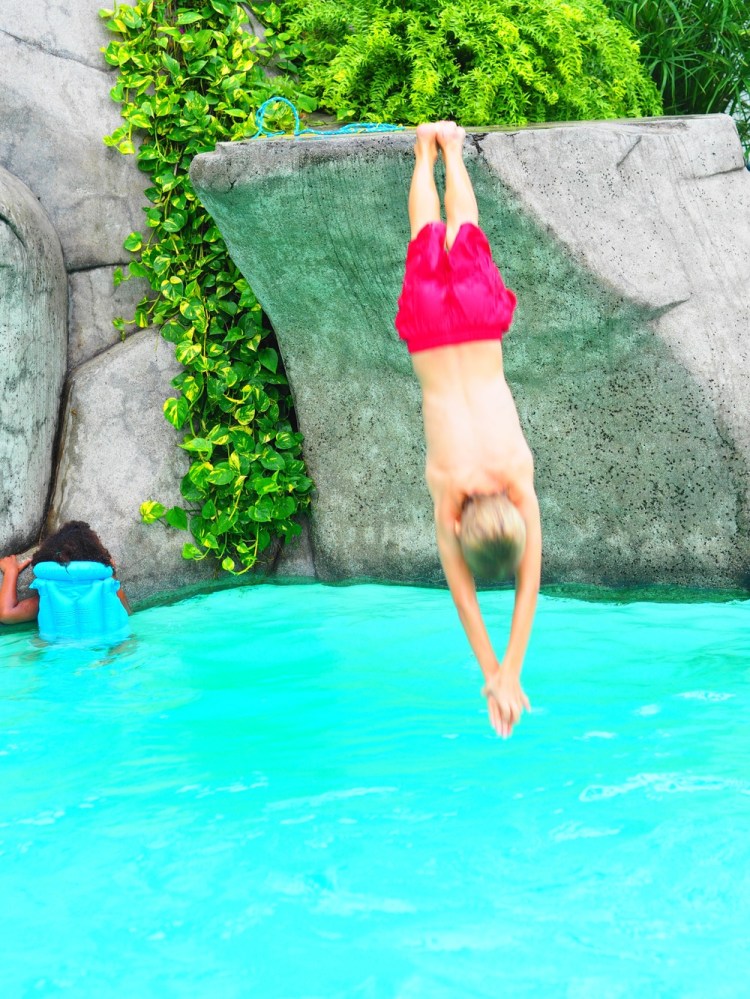
Not a bad dive for a boy that couldn’t really swim when we left the UK 9 months ago!
We arrive in Loja and manage to get a night bus ticket, no problem. These night bus journeys are pretty gruelling (the children seem to sleep pretty well but Fi and I don’t!) and we arrive in Guayaquil very early the following morning. We have several hours to kill and after some back and forth, we head to a hotel – Nazu House – up on a hill, overlooking the town, to try to get some breakfast. It’s a great decision. Not only do we get a lovely breakfast but they have a swimming pool that we can enjoy for a couple of hours before heading back to the airport. We book in to stay here on our way back.

Waiting for the bus outside the airport – he’s awake this time, for a change!
Most flights into the Galapagos Islands are to the tiny island of Baltra, just north of Santa Cruz. The heat hits us as we step out of the plane. We quickly navigate the tiny airport and wait for the free bus service that takes us to the ferry. These islands are about 4 million years old, basically a collection of volcanoes that sprung up from the ocean bed. It’s no more obvious than here, with volcanic rock and sparse vegetation as far as the eye can see. I half expect to see hordes of animals right outside the airport, but we see nothing on the short ride to the ferry. On the short ferry ride across to Santa Cruz we spot a couple of sea lions, with what I later discover to be frigate birds and boobies flying overhead.
We land at the northernmost point of Santa Cruz and take a taxi to Puerto Ayora on the southern coast. There’s a dead straight, new road running right across the island. The bushes and trees are slightly larger here but it’s still a very barren and arid landscape. In the 2010 census, there were 25,000 people living in all of the Galápagos Islands, of whom more than 12,000 live in the town of Puerto Ayora, so it’s quite a sizeable town.
The typical way to visit the Galapagos is via a cruise, sleeping on the boat and visiting a number of the islands, depending on the length of the cruise. However, with 5 of us, we knew that would be cripplingly expensive – plus it’s not much fun for kids to spend so much time on a boat. So we (primarily Fi) did a lot of research on how to do the Galapagos affordably – the net result being that we got the flights over and have rented a house (“Cactus Pad”) in Puerto Ayora for a week; then we take a ferry to the island of Isabella for a week. The return flights for all of us were £850 but the accommodation is pretty reasonable.
On our first day, we take a walk to explore. It’s a five minute walk until we hit the coast road into town and we wander in to check out a cafe next to a ceramic centre. This is where we get our first glimpse of what these islands are all about – there are sea lions on the decking of the cafe, lounging on the benches and taking a snooze under the tables. There are more sea lions than people and it’s clear who’s in charge!
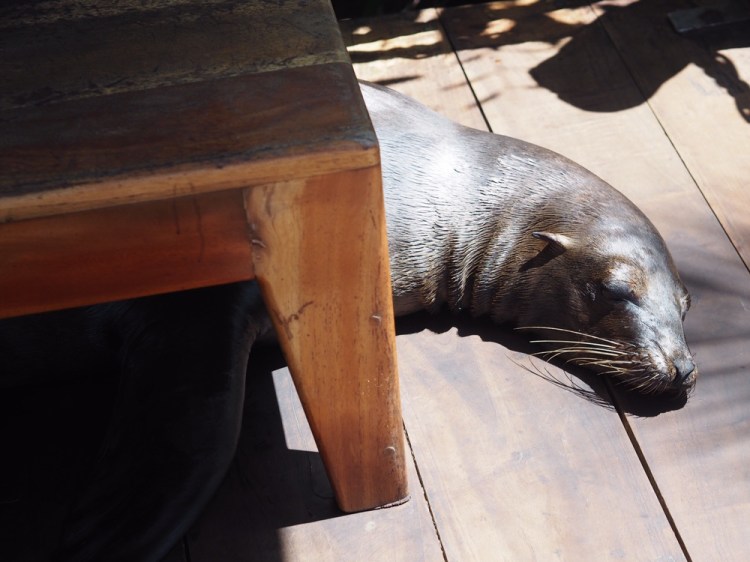
The boss, taking a snooze

A brown Pelican keeping a watchful eye over the fish market
Further along into town there’s a very small fish market, where fish are being sold directly off the dockside. The people cutting up and selling the fish are having to keep the brown pelicans at arms length and there are a couple of sea lions behind the counter, looking for scraps. In the evening, the market turns into a small outdoor restaurant: very simple, fish grilled whole. I’m sure it’s delicious but we are put off by the all-pervading fishy smell!

The fish market – note the sea lion in the background looking for scraps!
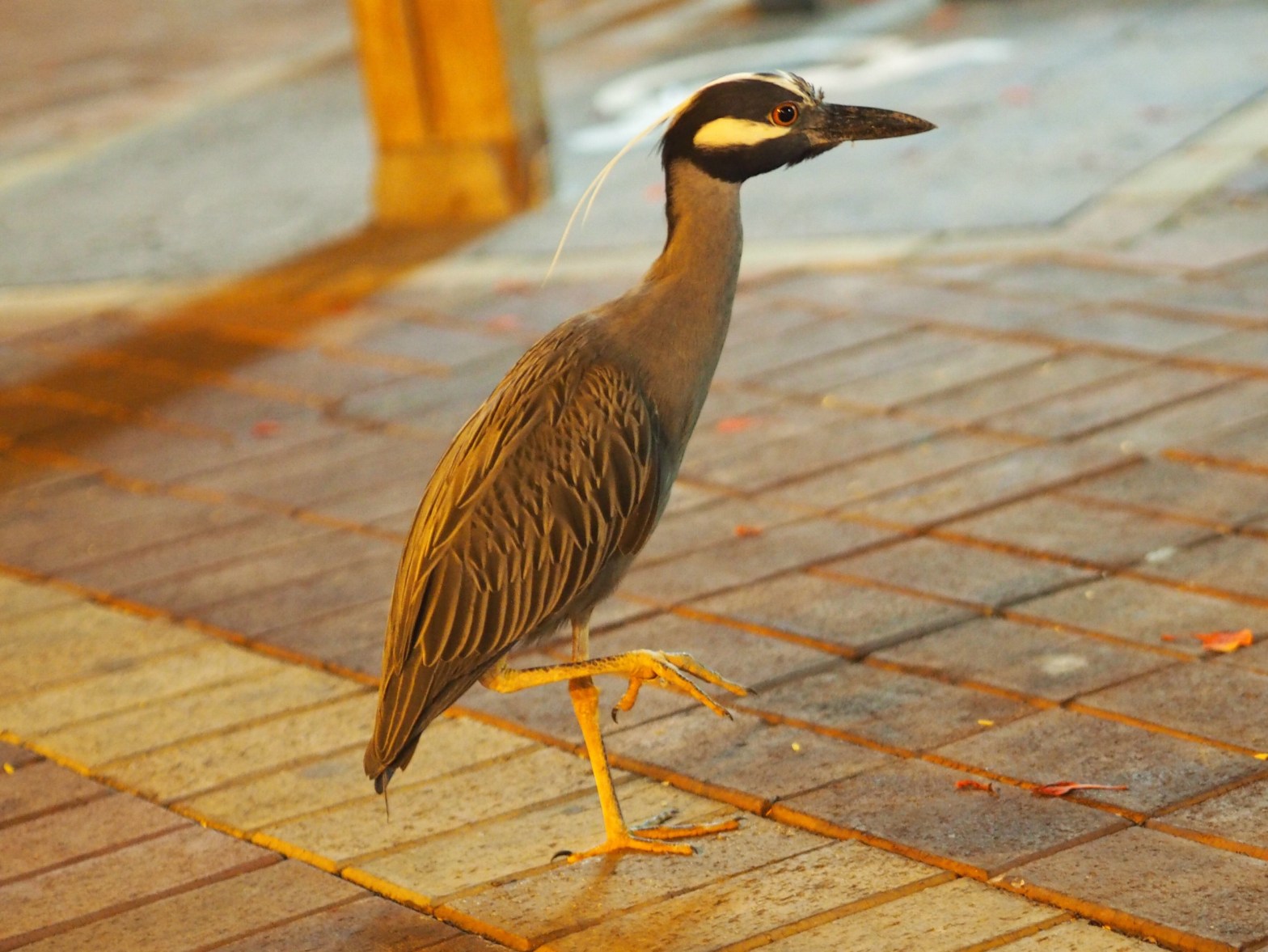
Not surprisingly, this is a touristy town – the main road in is exclusively made up of of tour operators, gift shops, restaurants and bars, with a couple of banks. At the port, there are a couple of volley-ball courts, a ramp for skateboards and a playground for children. We spend some time there, split between watching the children playing and spotting sea lions and baby reef sharks swimming just under the jetty. On the way home in the evening, we have to cross another volley-ball court at the bottom of the road and we walk right past a beautiful yellow-crowned night heron, just standing there by the courtside. We all walk past within 2 metres and it doesn’t bat an eyelid. This is what the Galapagos is about – the absolute fearlessness of the wildlife – it’s extraordinary to witness.
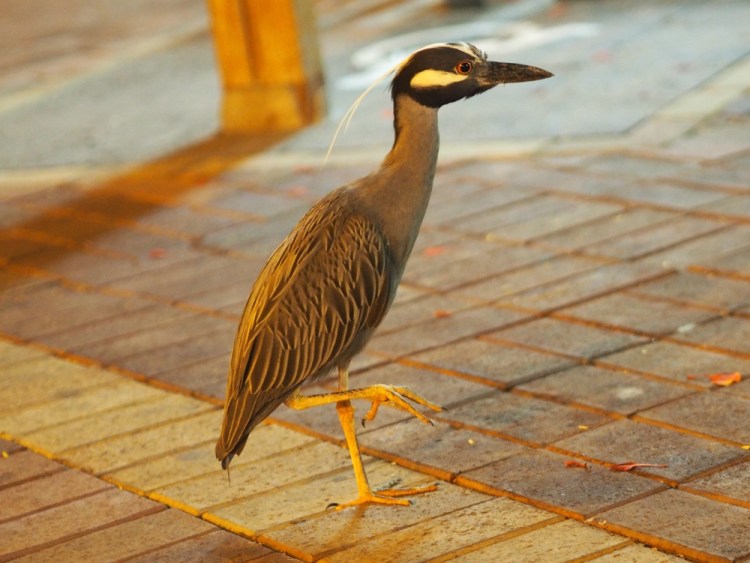
A yellow crowned night heron – he’s clearly a volleyball fan!
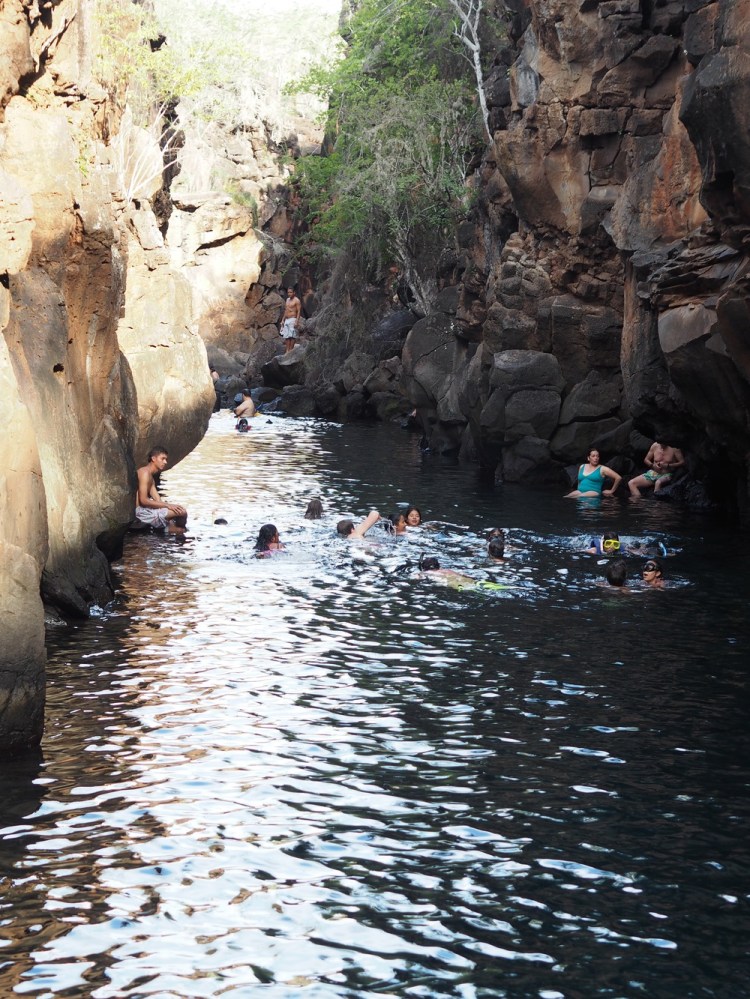
The deep, clear water of Las Grietas
It’s a short hop across the harbour ($1) to the Playa Alemanes; it’s a beautiful white sandy beach, very protected, and the children love playing around there. From there, there’s a 20 minute walk to Las Grietas. It’s a fairly uneventful walk and the sun is searingly hot but it’s worth it – at the end there’s a natural ravine in the rock with half-fresh, half-salt water that’s deliciously cool and clear. Steps and wooden decking have been installed to make access easy; we dive into the deep, cool water and as we swim we see that there are some pretty large fish swimming down below us. It’s super refreshing in this heat.
The restaurants on the side of the harbour are prohibitively expensive but we stop for a very welcome margarita on the way back
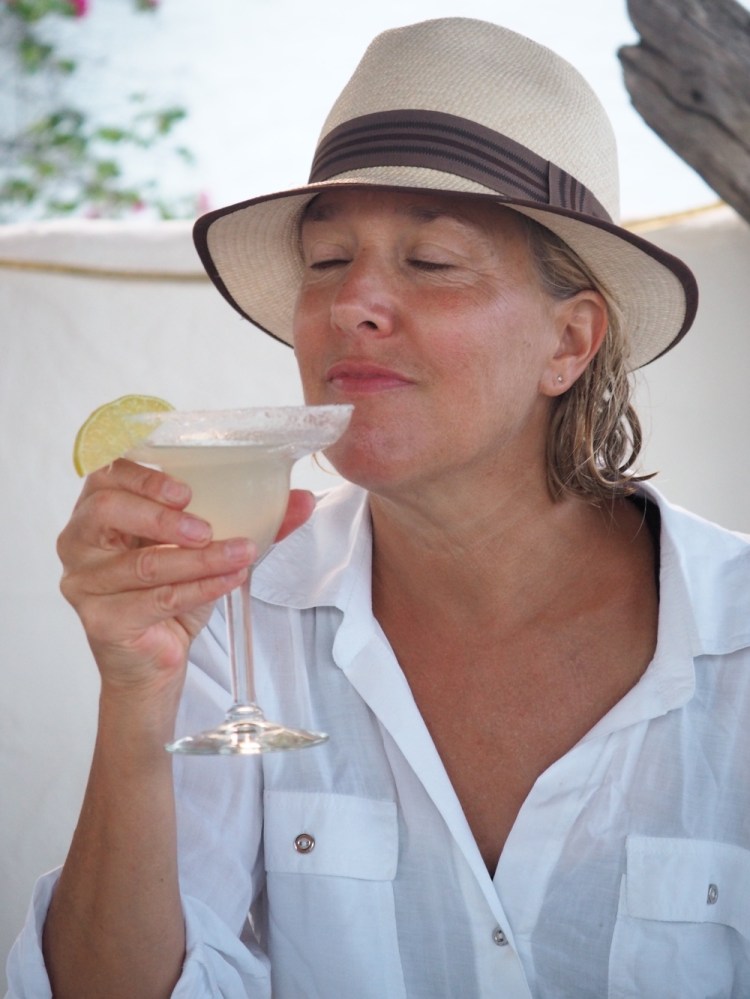
Savouring the moment…
But our favourite beach here by far is Tortuga Bay. We are initially put off by reports of a 45-60 minute walk (depending on who you listen to) across the headland, particularly in the heat of the day. So, despite the cost, we opt for a boat trip around the headland; it’s about a 30 minute ride and on this journey it includes some snorkelling from the boat, just before we arrive at the beach. It’s the first time we’ve done this and to be honest, it’s utter chaos! It’s extremely difficult to help a child put on their mask and snorkel when both of you are out of your depth. And that’s just Jemima and Gabriel – we have Millie too! We eventually get everybody sorted out and manage to see a few fish around the rocks but overall, it’s more stressful than enjoyable and we just put that one down to experience!
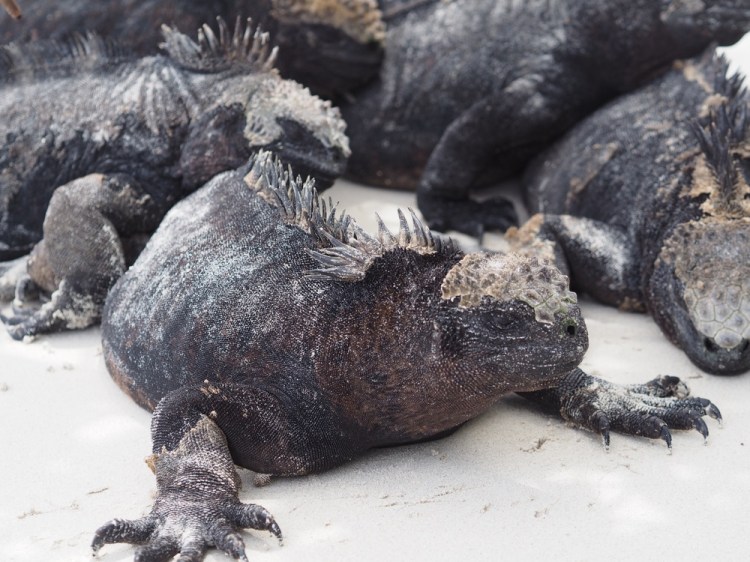
Marine iguanas on the beach at Tortuga Bay
The beach itself however is truly wonderful. Our boat lands on the sheltered side of a small peninsula. The beach is pristine, fine white sand lined with small trees, with a turquoise sea, completely protected from the main ocean. But it gets better. It’s just a short 50m or so walk to the seaward side of the peninsula, were the first thing we see is a group of lava black marine iguanas sunning themselves under a tree. We’re at one end of a 1km long beach; this end is fringed with mangroves and the first 100m is protected behind a rocky reef. At low tide, which it is now, there are bright orange Sally Lightfoot crabs scuttling around among the mangroves. The water behind the rocky reef is completely protected and perfect for the children, including Millie, to snorkel. We see shoals of beautiful tropical fish feeding on the rocks and occasionally the marine iguanas lumber down from the beach and swim off to find food, often swimming right in front of our faces. It’s magical; I could stay here for hours and hours. Along the rest of the beach, its more pristine white sand, this time the turquoise blue sea being punctuated by rolling waves crashing crashing in from the ocean. To top it all off, on the way back we see a few blue-footed boobies, close up on the rocks, with their piercing eyes and ridiculously blue feet!

The magical Tortuga Bay
We come back here couple of times during the course of the week; once by boat and the one third time we brave the walk. Actually, it’s nowhere near as bad as we imagined – it’s about a 30 to 40 minute walk along a perfectly maintained flat path. Even the sun isn’t too bad as we’re sheltered by trees for almost the entire length. The path brings us out at the opposite end of the seaward beach, so we play for a while in the waves before heading on to our favourite snorkelling spot with its iguanas.
We’d intended to take one or two day trips to some of the smaller islands but are shocked at the exorbitant prices. One of the most popular trips is to North Seymour island, which is renowned for its Blue-Footed Booby and Magnificent Frigate Bird populations. But it costs $190 per person, with only a 25% discount for children. For the family, that’s nearly $850 for a day out – as much as we are paying for a week’s accommodation! It seems there is a policy to make the Galapagos more and more exclusive; restricting availability of places on tours and driving up prices. Apparently prices have increased by nearly 50% in just a couple of years. So we decide we will limit ourselves to we can see without splashing out on these excursions.
We take a taxi ride to Santa Rosa in the middle of the island where there is a National Park and a couple of private ranches where there are wild giant tortoises. They’re pretty easy to find, munching away on the grass and wallowing in large puddles. It’s not as though they could run away quickly, even if they wanted to! But unfortunately, we’re all wearing sandals and there are tiny ants that insist on crawling all over our feet. And they itch like mad! Needless to say, the children in particular were keen to get out of there as quickly as possible.

There are several species of tortoises here. Some have evolved to have dome-shaped shells (low at the front) and eat vegetation on the ground; others have saddle-backed shells (high at the front), enabling them to eat leaves from shrubs and low hanging trees.
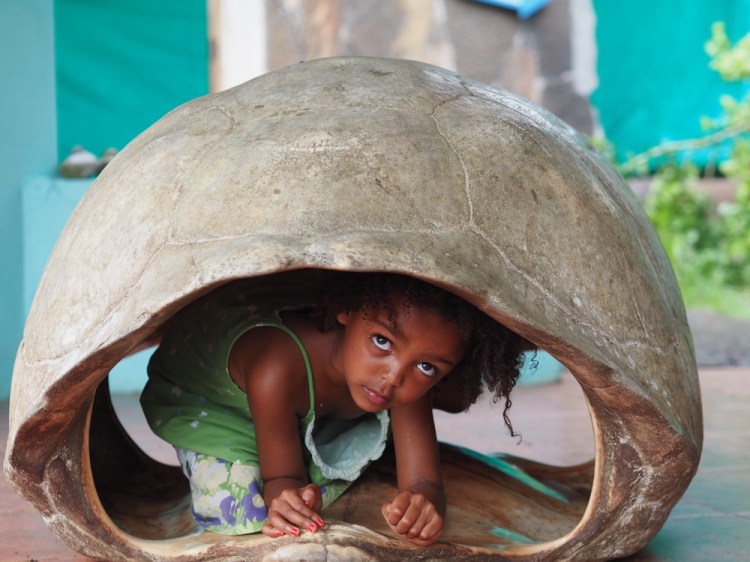
They’ll never find me in here!
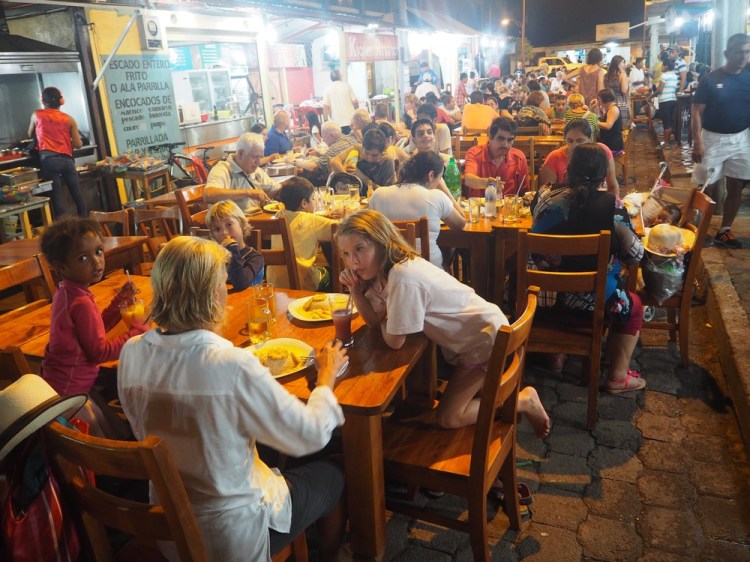
We’d intended to do a lot of self catering while we are here, but have been really surprised at the price of food here, including fruit and veg that have been so cheap and plentiful throughout the rest of Ecuador. Everything has to be brought in from the mainland, including fresh water and fuel, so it’s really expensive. But there’s a street that’s full of simple restaurants that are all very affordable – cheaper than cooking at home in fact. They all do a fixed almuerzo that’s perfectly good: soup and either chicken or fish a la plancha (grilled). It slips down very easily with a cerveza for Fi and me, and fresh lemonade for the children. It’s busier in the evenings – it’s now all à la carte, with every restaurant having the same carte! It’s mainly fish and seafood, a la plancha, with coconut sauce, etc. We’re regulars, eating here at least once a day, switching between a couple of restaurants, and sampling the fish, prawns, langoustines, etc. Life is tough!
And so we come to the end of our fabulous week in Santa Cruz. We didn’t get to see quite as much wildlife as we’d expected, but it has been incredible seeing it at such close quarters. The beaches have been a real highlight, despite the horse flies that are so adept at finding any piece of exposed skin (or T-shirt) that’s not submerged in the water. In fact I think we’d all agree that Tortuga Bay is the best beach we’ve ever been to. So now we’re off to the Island of Isabella, where there are fewer people and hopefully more animals. We’ll see…
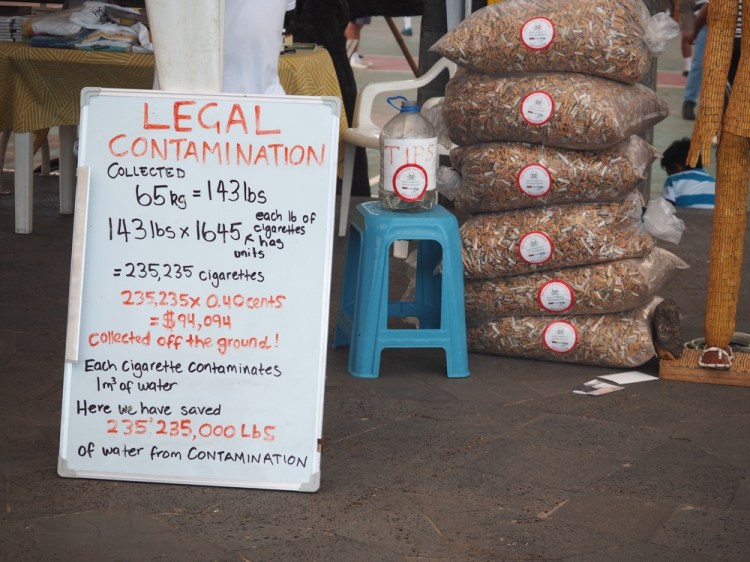
The tobacco-control community has clearly reached the Galapagos – these figures are made entirely of cigarette butts.
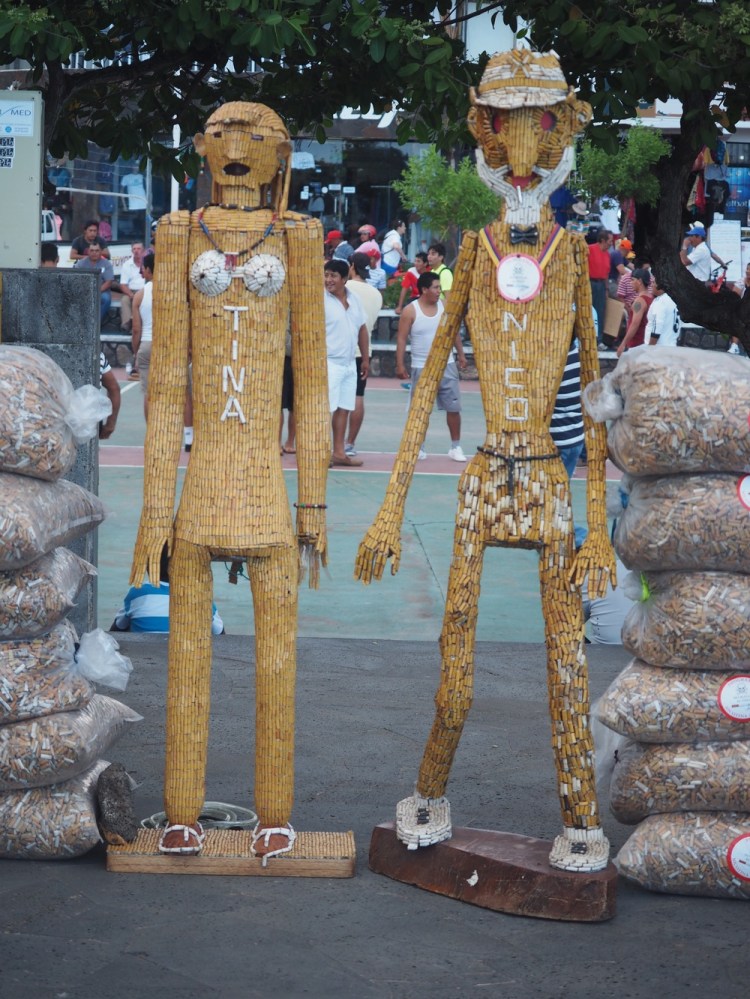
These cigarette butts have been collected just from the small town of Puerto Ayora – it’s food for thought…
 Five Go Round The World