Our lovely time in Cuenca continues, with Jemima, Gabriel and me skipping to Spanish class, Millie going to her school and Fi having some precious time to herself in the mornings. We’ve all changed teachers again as we’ve moved up to 4 hours a day. Jemima and Gabriel now have Juana, who is very into art and brings it into their lessons every day. I have Sandra, who is 50, a little less jovial than Carlos and quite a tough cookie – she doesn’t let me get away with any mistakes and waits patiently as I try to dredge up the correct word or verb ending from the recesses of my addled brain. We’re all sad to have lost our previous teachers who we liked so much, but after a couple of days we warm to our new ones. We meet up for a break at 10.30, when there’s free coffee (the children make themselves a hot chocolate) and snacks – usually little croissants and swirly sweet bread, occasionally a cheese sandwich, or fruit. Once a week the lady who runs the counter makes a large vat of hot chocolate, so the children don’t have to make their own (it tastes better, too).
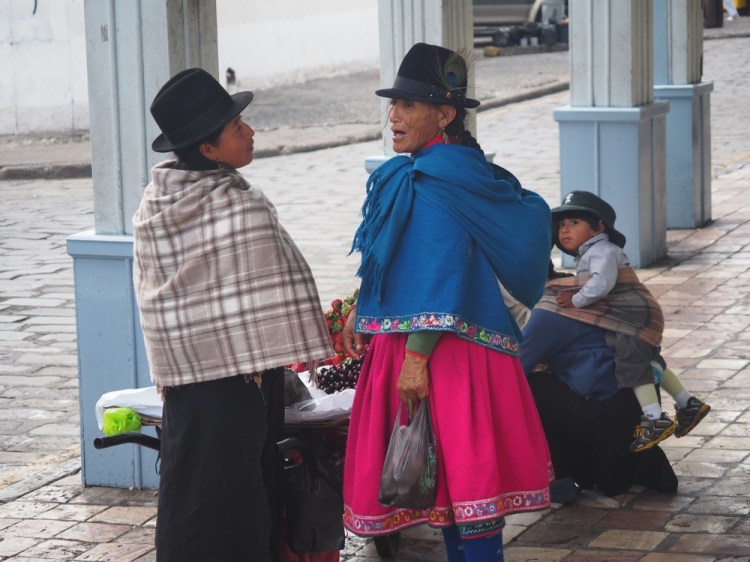
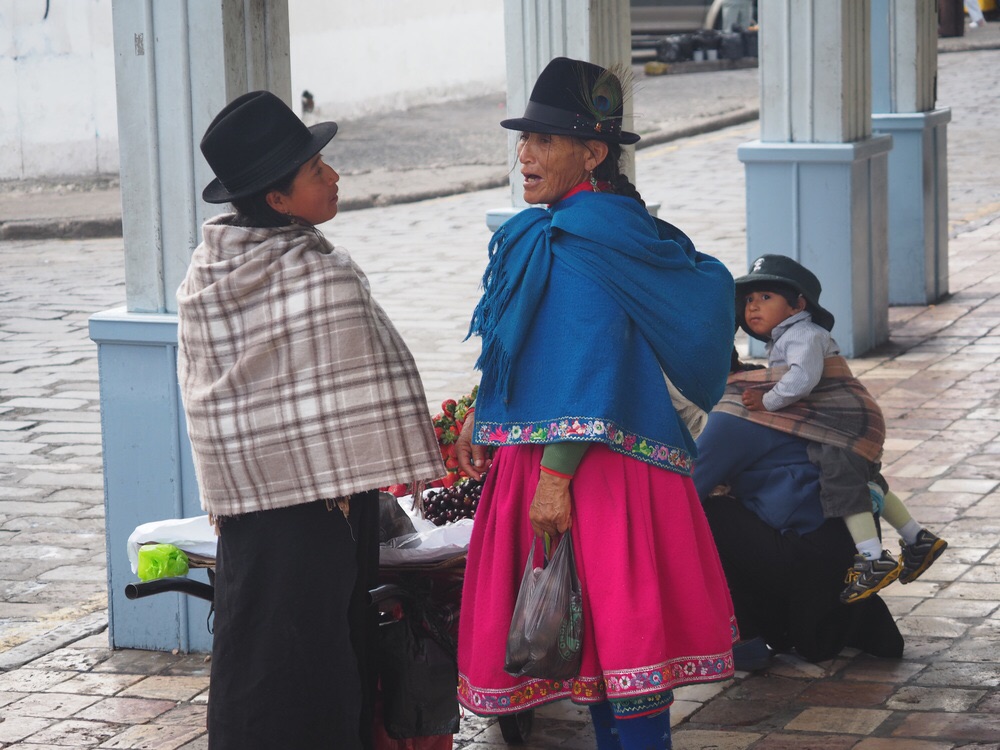
These women sell the most luscious fruit from their barrows

An every day scene, with cobbled streets and a murel on the end of a building.
We decide to get out of town at the weekends, so hire a car for the day from a really small company, Cuenca Car Share. It’s run by Juan (Cuban) and David (American, I think) who appear to live together (we collect the car from their house) and who’ve recently been on holiday together; we can’t quite work out their relationship as David has children, but they’re very friendly and helpful. We head off in our little Chevy Sail south towards Nabón and stop off at a tiny village, Cumbe, hoping to find chanco for lunch. In the tiny plaza there are a couple of places with whole pigs outside, but one in particular looks distinctly undercooked, with blood still oozing from its neck – we quickly lose our appetite! So on we go, but the cloud is thickening as we climb and obscuring most of the views. We decide not to go any higher and turn around, until Fi suggests we take a detour via Jima – it’s a small unpaved road and a long way round, so it’s clearly going to be quite a detour! Its a regular family car (that I’m quite keen not to damage) with fairly low clearance and the road is quite rough, so we’re limited to about 20km/hr. Despite the grey skies, the countryside is really beautiful – green, verdant valleys between the mountains with the occasional tiny hamlet with people (and dogs, chickens, etc) going about their daily business – this is definitely off the regular tourist trail. Fi and I are loving it and keen to make the most of being able to explore but needless to say, our children would rather be anywhere other than in the car!
We go back to Bellavista on a couple of afternoons for horse riding lessons – Fi doesn’t bother as she’s a more experienced rider, which is just as well as Millie also quickly decides she doesn’t want to do it. I’ve been given a fairly spirited but ridiculously small pony – Fi reckons I look like Sancho Panza on his donkey (although wasn’t he quite fat?!). We do a fair bit of trotting and at the end, a brief canter. I try to remember what I was told when I last had a riding lesson about 40 years ago – straight back, heels down and out, hands low. Slowly, slowly, I start to feel a bit less stiff and awkward. It goes without saying that Jemima and Gabriel just got on with it and I know look much better than me! But its very good for all us in terms of giving us a bit more confidence. We meet Sebastian’s parents, who are incredibly friendly – the Hacienda has been in the family for a couple of generations, it’s old money. Sebastian is studying for a degree in engineering and economics, so on one day we’re ‘taught’ by Sargento, who also works here – he used to be high up in the Ecuadorian cavalry, so clearly an extremely skilled and experienced horseman. Unfortunately, however, he doesn’t speak any English and merely waves at us to get us to change direction occasionally! I’m sure his skills were better employed by the people who followed us – practicing jumping on their own large and perfectly turned out horses.
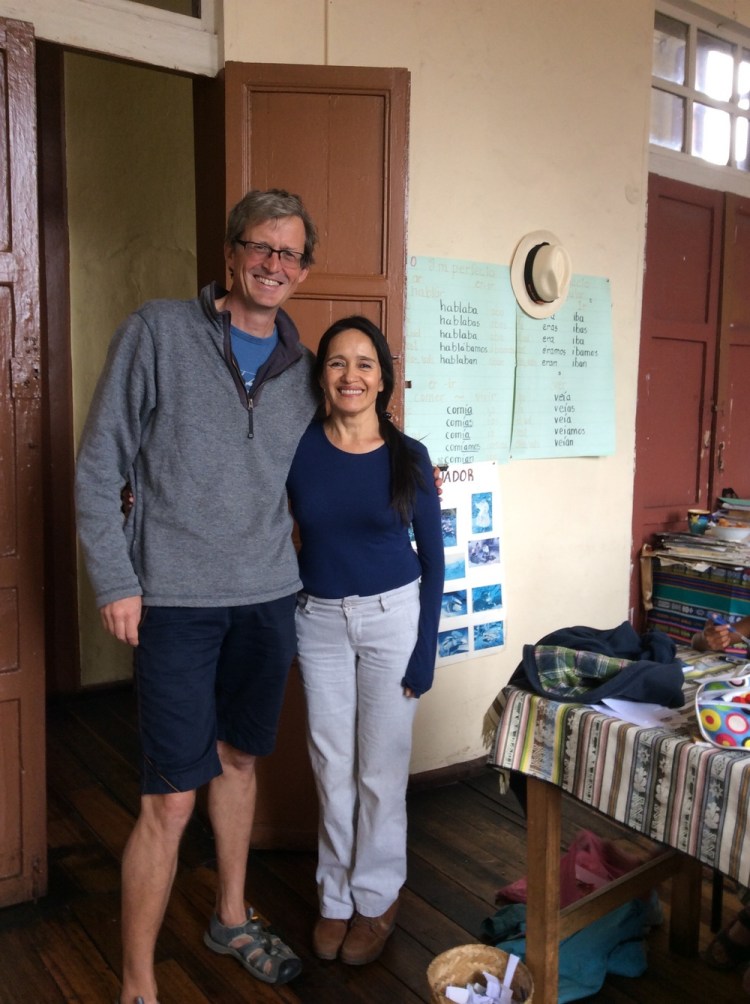
Once again, my lessons with Sandra are an education in history and culture as much as Spanish. She tells me that oil was discovered in Ecuador in the early seventies – before that, it was the archetypal banana republic (actually, cacao was the main export). After a military coup in 1973, there were a series of presidents, but very little of the new found oil wealth made it to the people on the streets. She tells me the the foreign oil companies took about 80% of the revenues and of the remaining 20%, a large proportion went to line the pockets of the various presidents and their cronies. Rafael Correa became Finance Minister in 2005 and vowed to change things, and was elected to President on this platform (and generally championing the poor) a year later. He subsequently changed the ownership laws such that the government now gets nearly 90% of the revenues and he invested enormously in the callateras (trunk roads), in education and in healthcare, which have duly been transformed. (Of course his coming to power coincided with soaring oil prices – the price reaching $135 / barrel in 2008. But since the middle of last year the oil price has collapsed from >€100 to <$50 per barrel, so he can no longer fund this investment from petrodollars.)
Again, she bemoans the conditional loans from China and the tax increases – for example, in March the govt announced it would increase import taxes on many goods by up to 45%! Sandra also tells me that the competence of Ecuadorian agriculture is poor but in an attempt to buy their votes, Correa decided to subsidise the farmers rather than focusing on up-skilling – this not only makes farmers lazy, she says, but creates another financial burden for the government that’s no longer affordable. It reminds me of the British coal mines in the seventies.
We hire a car again from David and Juan at Cuenca Car Share, this time an SUV with a little more road clearance (a Kia Sportage), for the whole weekend. We head up to Cajas national park – it’s a beautiful sunny day ‘down’ in Cuenca but we’re told it’s likely to be wet up in Cajas. Sure enough, as we leave Cuenca at 2,500m altitude and begin the inexorable climb up the valley, the grey clouds appear and it starts to drizzle. The scenery is dramatic, with mountains towering on either side; the trees give way to shrubs and then to moorland – we could be in the highlands of Scotland, apart from the wild llamas that we see grazing by the roadside.
We go for a walk when we get to the visitor centre at 3,600m. Despite the drizzle, we take a picnic that we eat by the lake. My Mum would certainly have approved – I remember many a picnic as a child, eaten on bleak moorland in inclement weather, with my Mum saying “We WILL enjoy ourselves!!” It’s very muddy and slippery underfoot and I’m helping Millie, who’s only got trainers on. We decide to count the number of times she slips and we get to 47! Once again, Millie’s hands are freezing by the time we finish the walk, so it’s hot chocolates all round.
After that, we head to Banos where there are thermal baths – we end up in a fairly upmarket establishment with 7 pools and a steam room. We spend about 3 hours there, playing & relaxing; the children join in with some local children playing Marco Polo – one child has her eyes closed and calls “Marco”; the children all then respond “Polo”; the first child has to catch one of the others without opening her eyes.
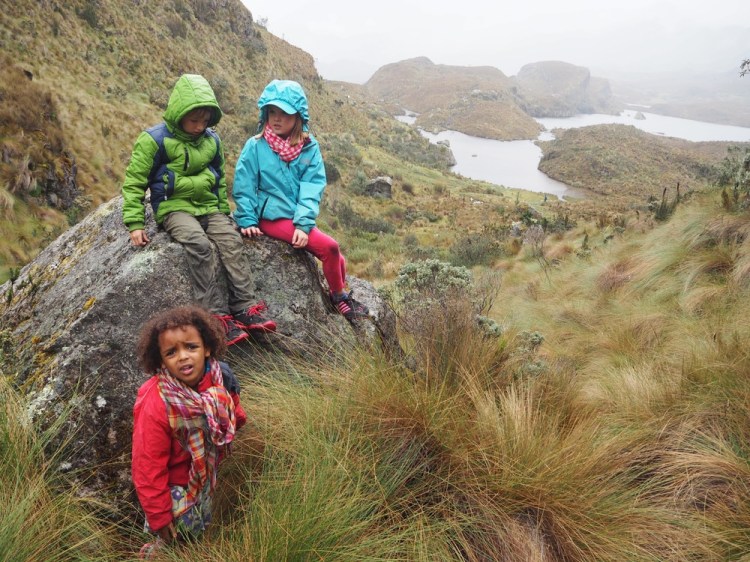
Our walk in Cajas national park – as you can see, Millie is loving it!
On Sunday, we head off again, eager to make use of the car and explore. We head to Cañar, the home of the cañari people, one of the most important pre-Incan cultures in southern Ecuador. The Cañari put up stout defence against the Incas, defending their territory successfully for many years before finally being overcome. They later joined forces with the invading Spanish army against the Incas before the Spanish then inevitably subjugated them along with the rest of the idigenas – some thanks!
Sunday is market day in Cañar, which is why we’re going, although we make a mistake in going to see the regular market first. By the time we get to the animal market, it’s finished. The original market is fascinating and we seem to be the only tourists, which is always a good thing. There are lots of indigenas with their traditional dress, with both men and women wearing the the same white felt hat, decorated with rosettes and tassels; apparently the men wear the tassels at the back, married women at the front and unmarried women to the side. There’s lots going on, including a man grinding flour on the pavement – it smells like maize but the kernels are much smaller; we’re not sure what flour it is.
Sunday is also chancho day and we search some out in market. Talking to the lady running the stall, we discover that a pig costs her $350; if she sells it all she will make $500 (my teacher Sandra tells me later that that the pigs are raised by individual families in the countryside. It’s expensive to feed a pig and a family only has one or two at any one time. The chanco stall owners go into the countryside to buy direct from the families, or from the animal markets in the towns). Its totally free range and absolutely delicious.
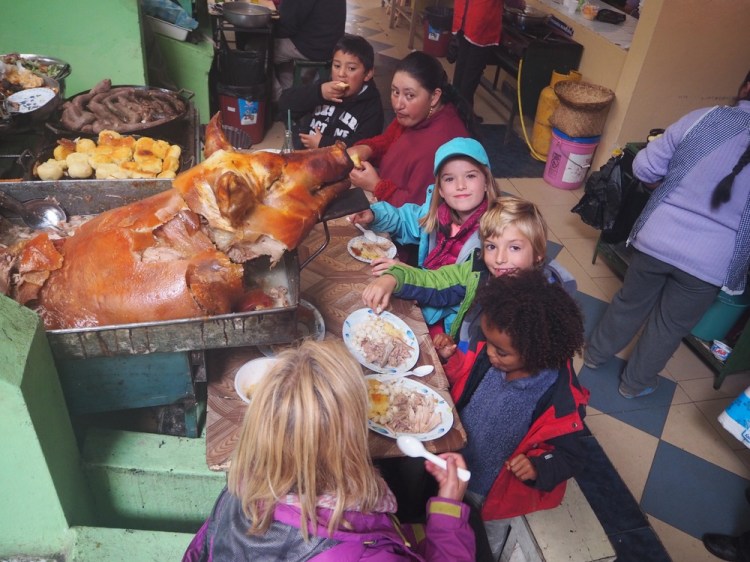
More delicious chanco for lunch. I tried the black sausage you can see at the back – not bad, but I think I’ll stick with the pork!
From here we briefly visit a couple more villages on the way back, including Gualaceo, with its beautiful plaza and church, and Chordeleg, famous for its filigree silver work. By now, the children are clamouring to get home – utterly sick of driving and exploring villages, so we show mercy and it’s only a fleeting visit.
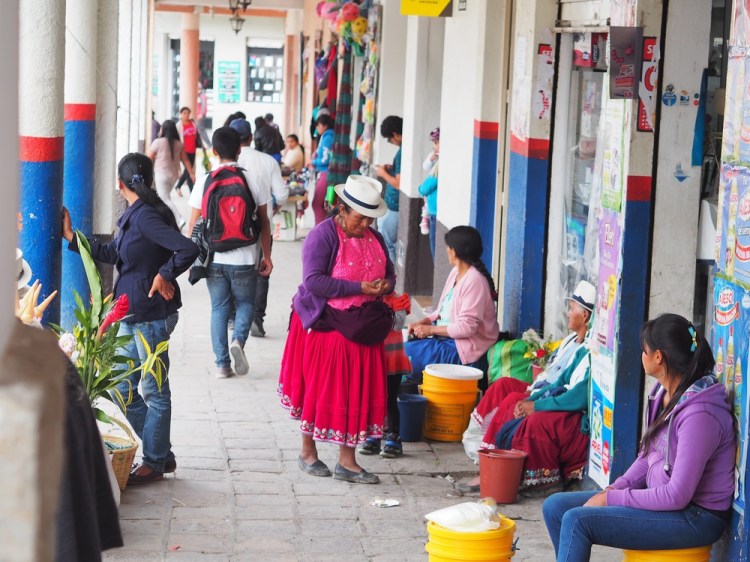
Sunday afternoon in Gualaceo

One of the many fabulous pieces at the modern art museum
Back in Cuenca, we go to the modern art museum, which has a wonderful sculpture exhibition celebrating the lives of people of African origin. The sculptures all portray everyday life of ordinary people – they’re full of character. We meet Anna and her 7-year old daughter Lilly, who’s having lessons at the art school there. Anna and her husband Will are from Hackney – they’ve travelled a lot and have been living on the coast here for the last few years: Will has been training English teachers and Anna’s a translator. They’ve just moved to Cuenca and are dealing with the stresses of moving house as well an changing climates! We arrange to meet up again with Anna and Lilly for a picnic in the park and subsequently invite them to join us for Jemima’s 10th birthday.
Opposite the Museo des Artes Moderno there’s one of the loveliest plazas we’ve come across in Cuenca, with a beautiful white church facing. In the corner, there’s a small bar / restaurant that’s owned by a Belgian couple. We stop to enjoy the ambiance of this square, their home brewed Belgian style beer (hops and barley imported from Belgium) and delicious meatballs. Fi and I relish the moment and the children run off to play in the square.

Making our way to Belgian bar we discovered opposite the Museo des Artes Moderno.
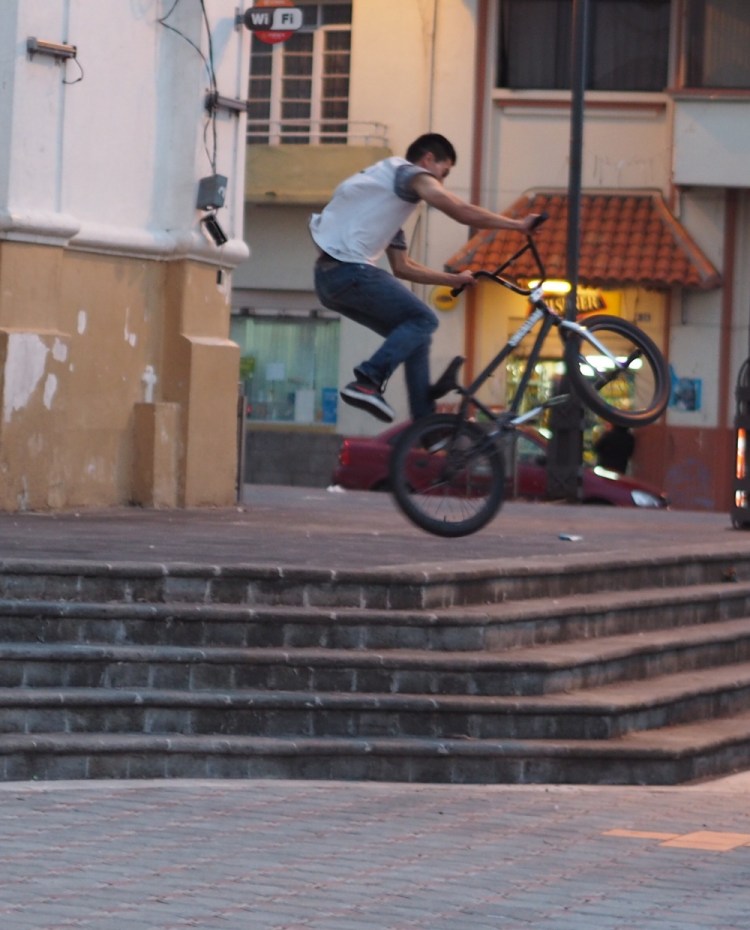
A bit of BMX action in the plaza
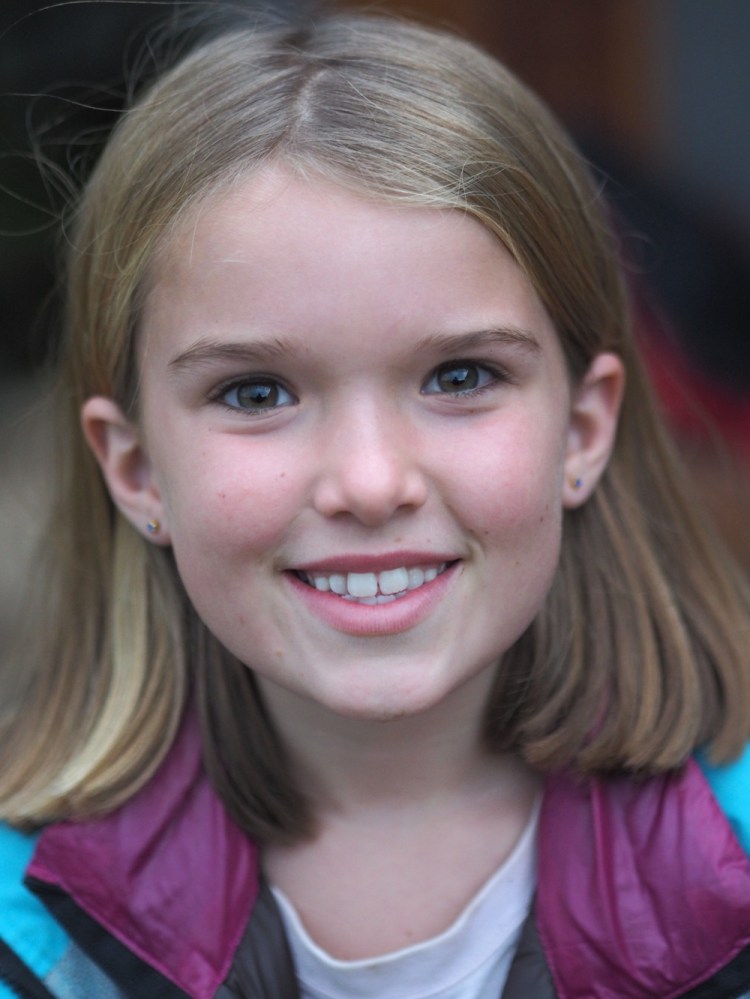
The birthday girl with her newly pierced ears – we been saying for a couple of years that she could have them pierced when she’s 10. Babies here have it done on day 1!

Trekking through the beautiful countryside
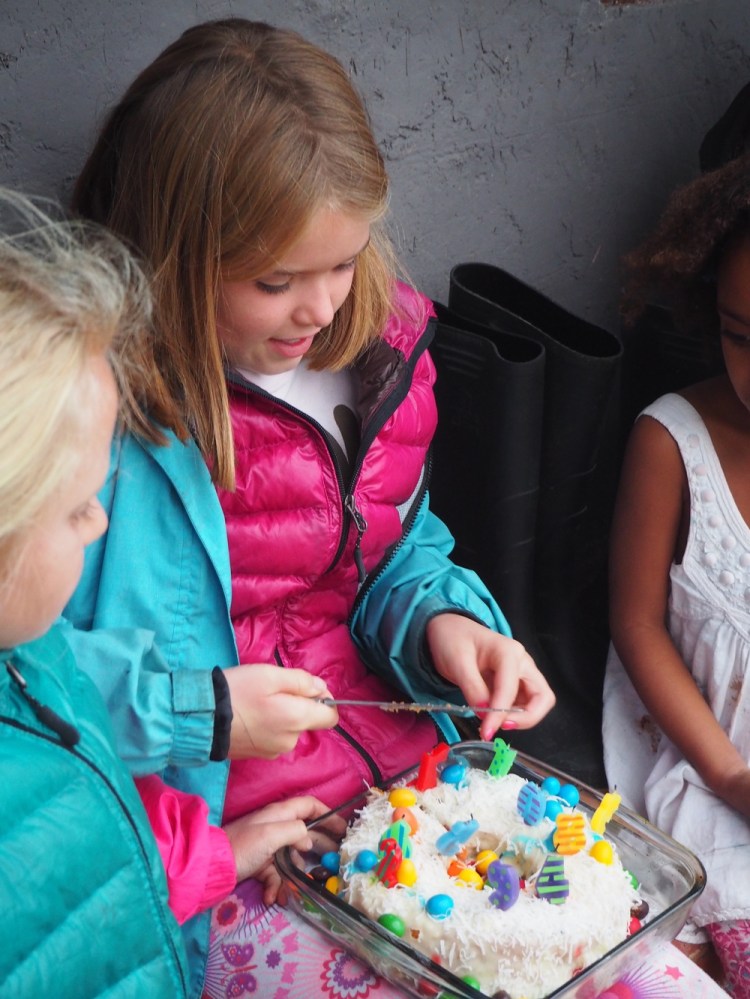
Getting stuck into the birthday cake after r eventful horse riding
Jemima’s birthday is memorable – we open presents in our bed before having French Toast and maple syrup for breakfast (with freshly squeezed orange juice, of course). Its our last day at Spanish school and the teachers all present Jemima with a huge slice of chocolate cake and sing Feliz Cumpleaños. We’ve been told this would happen and so invited Fi and Millie (who finished school yesterday) – it’s great that they’re there to witness this and to meet our teachers. I’ve had lots of very personal conversations with my teacher Sandra over the last 2 weeks and so I’m particularly pleased that Fi gets to meet her.
Anna and Lilly join us for lunch and we all head off to go horse riding – at different hacienda that’s significantly cheaper than Bellavista. Carlos was very friendly and eager to please, but he is completely on his own and has obviously just finished a hack with 4 American women. So he has to saddle up horses for all 7 of us, which takes quite a while. He doesn’t have enough riding hats to fit but we do manage at least to get bike helmets for everyone. The horses here are much bigger than Sebastian’s and more difficult to control, especially for the children. When we eventually set off, we are joined by another 3 year-old horse that seems intent on irritating the others. We re-christen Fi’s horse Moody Margaret as she’s intent on kicking any other horse that comes remotely in range and occasionally gets kicked back in return. Mine is called Volcan, which sounds rather ominous but in fact he’s probably the best natured of the lot. Lilly is a bit nervous on her horse, so after a few permutations we end up with Carlos leading both Millie and Lilly and the rest of us having to fend for ourselves. It all feels slightly risky with just Carlos supervising 7 of us. We go right out into the countryside, which is beautiful but quite steep in parts and boggy in others. At one point we’re traversing quite a steep slope and Millie’s horse loses it’s footing. As it slips sideways, Millie’s pops out of her saddle like a cork out of a bottle – thankfully, Carlos is right there and she lands on his shoulder – phew! Good for Millie – after a quick cry of shock, she gets straight back on her horse and is fine. It seems to have had more of an effect on Jemima than Millie as she suddenly loses all her confidence for the rest of the journey – thankfully we’re nearly back to the ranch. The adults all glance at each other with a sense of relief as we get off our horses and quickly get the birthday cake out!
I’ve really loved our time in Cuenca, despite our house not being as cosy as it could have been. It has a lovely feel to the place; there are a few too many retired Americans here, but it still has the feel of a very real Ecuadorian town with a mix of the amenities and facilities we need, plus the traditional markets and shops. It has a fair proportion of indigenas in their traditional dress; then there’s the mestizos – for whom the compulsory dress for women under 40 (over 40 it’s optional) is super tight figure-hugging leggings or stretch jeans, preferably a size too small, with high heels. Tight tops and bulging cleavage is optional.
There’s the local park with exercise machines and always a bunch of various hippie-type performing artists on the way there, on the steps down to the river – apparently they’re all Argentine. Some of the shops are surprising – for example, there are several that sell both televisions (the enormous, plasma screen variety) and motorbikes. Also, traditional shops that sell wholesale quantities of rice, lentils, cereals, butter (a single block of about 50kg) and raw Ecuadorian chocolate. This is definitely one of the places we’ve visited that I could imagine living in – although chilly, wet weather for 4 months of the year might put me off.
We say farewell and continue our journey south, to Vilcabamba – famous for its wonderful climate and many centenarians…

Spiders here are a bit bigger and hairier that at home!
 Five Go Round The World