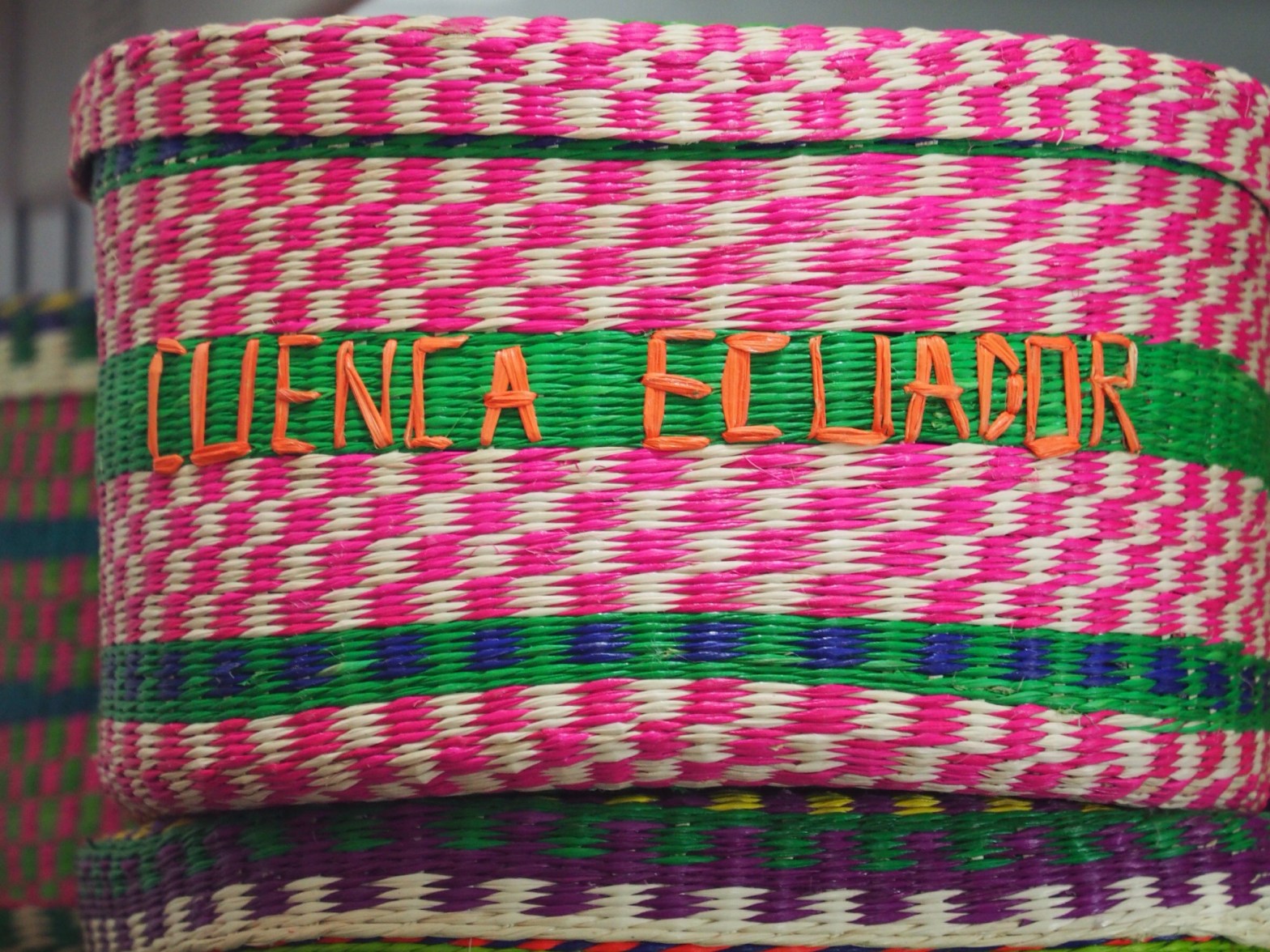
We’re not shirking the difficult journeys – this one’s an overnight bus journey from Otavalo. South – down the spine of the country to Cuenca in the southern highlands. Despite the bus arriving in Otavalo half an hour late, the journey isn’t as bad as I’d imagined. Jemima & Gabriel fall asleep quickly and sleep fairly well through the night. Millie, who’s always the last to fall sleep, watches a film and then eventually curls into a tiny ball like a little dormouse and we don’t hear another peep from her. However, Fi and I don’t get too much sleep – Fi’s shoulder has been getting progressively worse and she’s struggling to get a good night’s sleep at the best of times – so by the time we arrive at about 6am we’re struggling a bit!
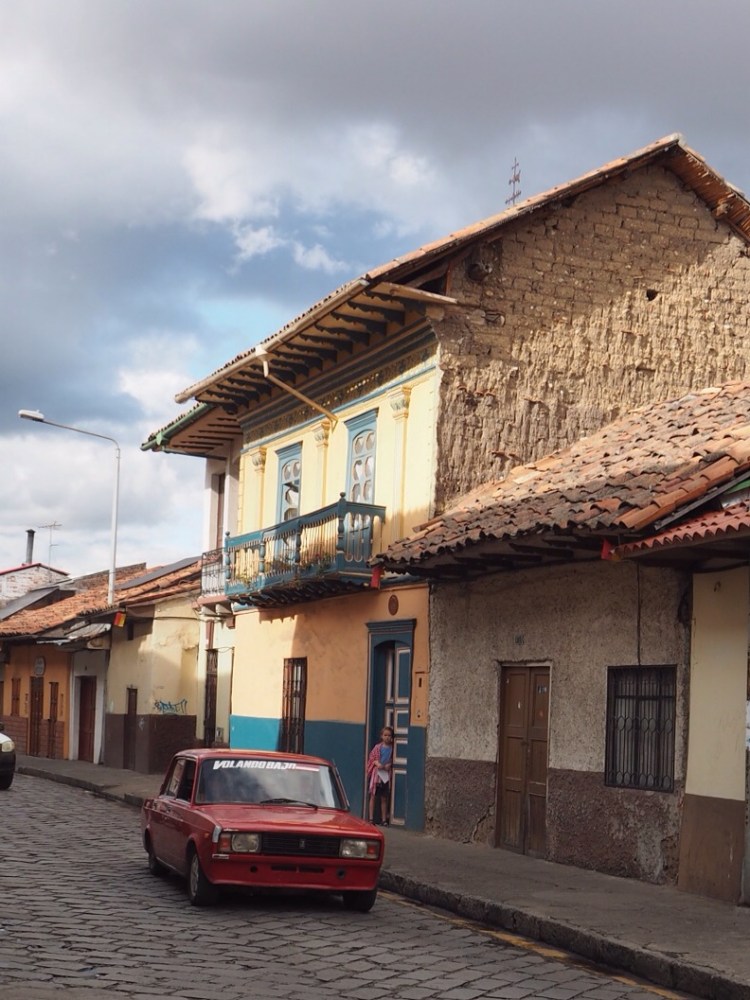
This is our house for the next 3 weeks
We manage to find a restaurant that’s open for breakfast and then go to meet Juan to let us into our house at about 9am. The house is in the old part of the city; it’s nice and big but a bit rough around the edges – I guess that’s what you get when you have a tight budget! It’s an old colonial house; peach and blue on the outside, with blue shutters and a small balcony from the main bedroom that looks right onto the street below. Inside, it’s designed around what obviously used to be an open atrium – now covered by a corrugated plastic roof that keeps out some of the light and most of the rain! The rooms off the atrium (now the dining area) have adobe walls, roughly painted in bright colours; the floors downstairs are terracotta tiles and upstairs rickety oak floorboards. It’s all fine, but not at all cosy – we’re already missing our log fires and lovely Ecuadorian furnishings in Otavalo. The road outside is pretty busy, particularly during rush hour, and cars don’t seem to have any concern about sounding their horn at any time of day or night, so we’re also missing the blissful quiet other than birdsong that we’ve enjoyed for the last couple of weeks.

The flower market by the cathedral
The old town of Cuenca is lovely. We’re right on the corner of Calle Larga, which runs parallel to and immediately north of Rio Tomebamba, one of the 4 rivers that run through the city. The road runs along the edge of the ‘barranco’ (cliff), high above the river; the backs of the 18th and 19th century buildings overlap each other and hang precariously off the cliff face. The churches here are white and striking – one just round the corner from us (and opposite the best coffee shop in town) is particularly beautiful when lit at night. Many of the larger buildings are built with long, narrow bricks – they’re extremely attractive and lend great character to the town. The streets are all cobbled and the pavements have stone flags or tiles. There are also murels painted on the ends of many of the buildings – we saw some of this in Quito and in Otavalo, but not as much as here. There are a couple of supermarkets in the new town, but the fruit and veg is cheaper and better quality from one of the various markets that are here.
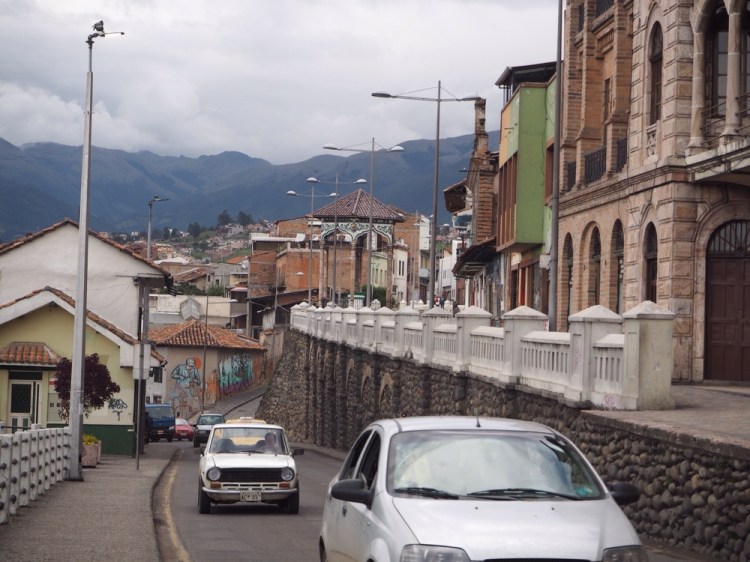
Typical Cuenca architecture, with murels on the buildings and the beautiful mountainous surroundings
Jemima, Gabriel and I start our Spanish lessons at the Simon Bolivar school, about 6 blocks up and 3 across from where we’re staying. It’s an old, rickety building but cheerfully decorated with posters on the inside. Apparently it’s typical of the old buildings here: it’s owned by an elderly couple who have lost a lot of their previous wealth; being an UNESCO World Heritage Site, there are lots of rules regarding what you can do to buildings and they simply can’t afford to renovate it. We do two hours per day for the first week but then decide we can up it to 4 hours per day after that. We’ve decided that paying for Millie to go to Spanish lessons is a waste of money – she’s not getting much from it and inevitably slows Jemima and Gabriel down. Fi has managed to find a private pre-school that we can get Millie into (after a fair bit of beaurocracy), again for 4 hours a day. There is a small handful of American children there and all the teachers speak English, so she soon settles in and makes new friends.

A local indigenous woman who is selling the most wonderful fruit from here barrow.
So once again, we very soon settle into a lovely rhythm: I’m up first at 6.45am to brew the tea (you have to boil the tea bags here for a couple of minutes to get any flavour out – maybe due to the altitude?), squeeze the orange juice and get the porridge on for breakfast (with a handful of chia seeds – one of the various ‘super foods’ grown here in Ecuador). If necessary, Jemima and Gabriel go out to one of the local bakeries (they work their way around them until they find the best) to fetch bread, which is good practice for their Spanish. At 8.15am we all leave the house – Fi takes Millie to her school and Jemima, Gabriel and I skip (literally) to Spanish lessons. I love the journeys to and from school – J&G are always in a good mood on the way there, bouncing along, and afterwards they’re bursting to tell me all they’ve done. There’s a great papeleria opposite the school and several times we stop off to buy bits of art material – they’re really into drawing at the moment, which is lovely. Both have come on in leaps and bounds in terms of their artistic abilities and it’s great to see them so absorbed in their work. While we’re at school, Fi goes to the local park to get some exercise, enjoys a coffee and time to herself in a cafe, and gets lunch for us all on our return.
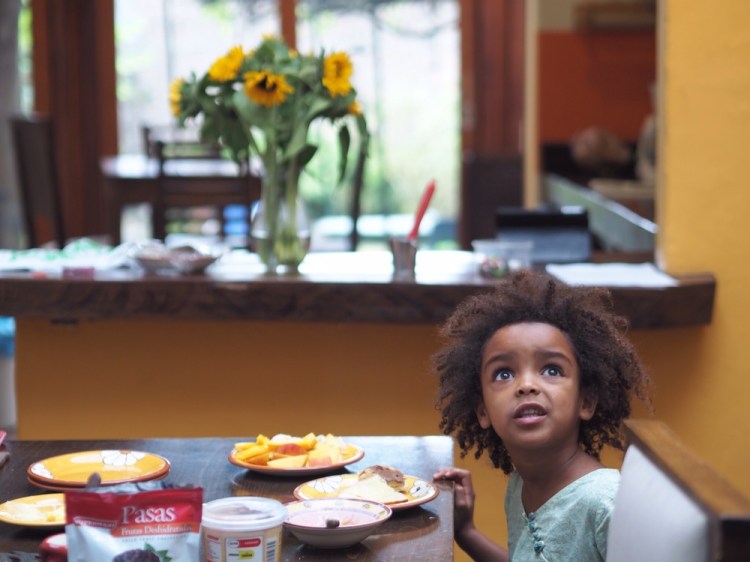
Breakfast!
We quickly realise that the climate here is different to Otavalo. It rains everyday at some point – it can be at any time of day – so we always take raincoats with us. But to be honest, I’m not too bothered – it already feels like we’re living here rather than visiting as tourists and it’s just a fact of life. When the sun is out, it’s fierce but as soon as it goes is the temperature drops markedly and again it gets quite chilly in the evenings (when we miss our log fires!).
My Spanish lessons here are much more conversational than in Otavalo, which is great. I think the combination is a good one: more formal and rules based in Otavalo; with more putting it into practice here. I warm to Carlos, my teacher, immediately. He’s 30, comfortably built with a ponytail and a smile never far from his lips. I’m also learning a fair bit about the history and culture of Ecuador and Cuenca, as well as Spanish. He’s obviously pretty opinionated politically, which makes it all the more interesting. He tells me that Ecuador is a conservative, Catholic country (this has been included in all 20 versions of the constitution since independence in 1830) and Cuenca is a particularly conservative city. For example, it’s unheard of for young people to move out of their parents home until they marry, however old. People living singly (particularly women) are frowned upon – the suspicion is that they must be gay, prostitutes or have committed some similarly heinous crime. Wednesdays are for salsa dancing, Saturdays for friends and Sundays for church and family.
Carlos also has an interesting take on a Ecuadorian history: he tells me that the popular version that’s celebrated is not always consistent with reality. For example, he tells me there’s a statue in the park depicting a young general holding up the Ecuadorian flag in the battlefield where he apparently died heroically fighting the Spanish. The truth (that’s apparently available from books in the central library) is slightly different: yes he was the youngest general ever but came from a very wealthy family and bought the position from Simón Bolivar; he wasn’t so brave and fearless and in fact led his troops from behind rather than from the front; and in reality he died of dysentery several days later rather than fighting heroically on the battle field. And by the way, the flag of Ecuador didn’t exist at the time of the battle in question! It’s a good example of how a single version of history can be misleading!
Carlos also tells me that while we’ve been here, there has been a big public demonstration against President Correa, involving a few thousand people. While in his first term, he was extremely popular as he invested heavily in roads, education and healthcare, but now the people are disenchanted. Taxes are going up massively, there is increasing corruption and after just 8 years in power he’s trying to amend the constitution to remove the limits on how long a president can be in office – a sure sign of megalomania setting in. The government is borrowing huge amounts from China, with lots of conditions attached – for example, the Chinese don’t require visas, allowing the Chinese owned mines to use Chinese rather than local labour. Quite frighteningly, they’ve discovered uranium in the south of the country and the government has effectively sold all the rights to Iran, of all countries.
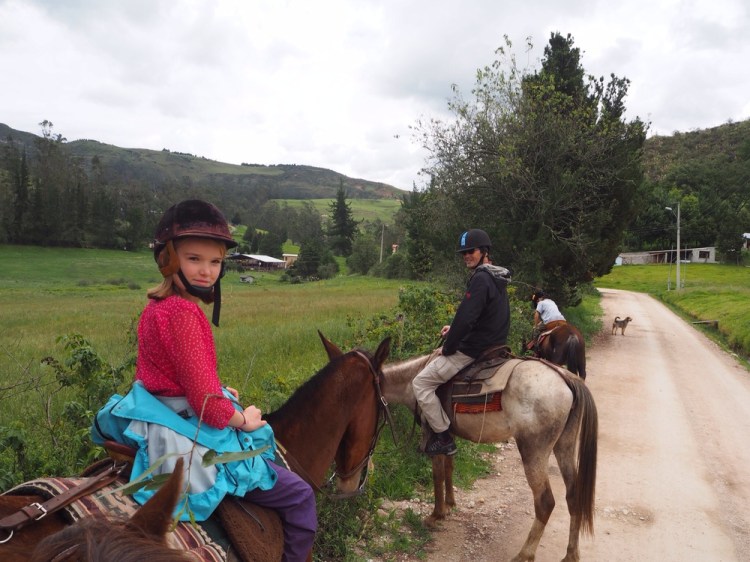
We’ve discovered Bellavista horse riding stables about 8km out of town, so we go for a trek. It’s a fabulous set up run by Sebastian who is extremely friendly and helpful (and who speaks excellent English). He has built a large and beautifully maintained covered manège with a viewing balcony and a large, perfectly manicured grassy area outside for more schooling, including jumps. He has 48 horses here, all clearly very well looked after, some owned by him and some by private individuals who choose to stable their horses here. He chooses ponies of the right size and temperament for each us (although mine’s a bit on the small side!). We have a lovely 2-hour hack through some delightful countryside that everyone thoroughly enjoys. Although the hack was rather pricy, we discover that lessons are only $10 per hour, so we immediately book ourselves back in – if we can focus on Spanish school and horse-riding lessons while we’re here, everyone should be pretty happy!
 Five Go Round The World