
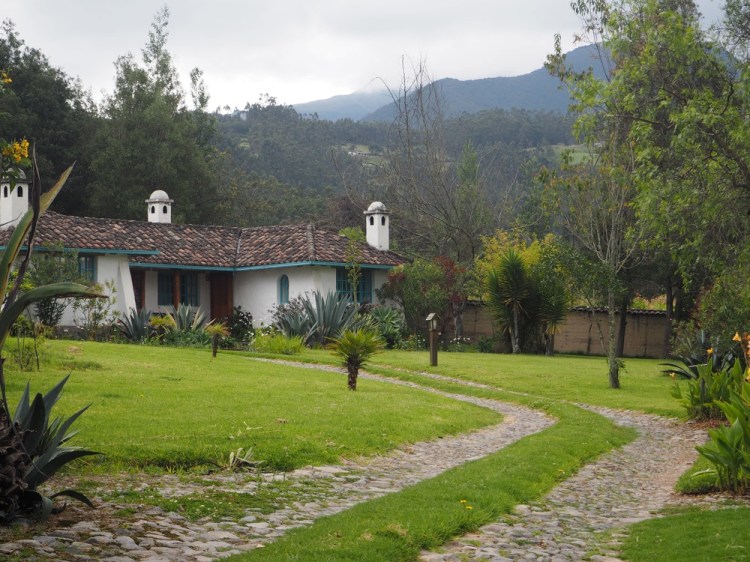
Our beautiful home in Otavalo, from the vegetable garden.
Otavalo is only a couple of hours north of Quito by bus, so a pretty straightforward journey. We’re dropped off next to a main road on a roundabout with no pavement, which seems a little strange! But we manage to get a taxi to take us and all of our luggage to Las Palmeras, a mile or so north of the city. We are staying in a house that’s part of a hotel, so the best of both worlds. Immediately we arrive, we know this is going to be great and we’re already thinking about extending our stay. Our house is perfect: white walls, cornflower blue windows, faded red tiled roof, set a lush green garden and not overlooked. There’s a kitchen/dining/sitting room plus 2 separate bedrooms, each with an ensuite bathroom. What’s more, there are wood fires all three of the rooms, which are lit for us each evening, along with the hot water bottles that are put in our beds (Otavalo is at 2600m altitude, so it gets a little bit chilly in the evenings)! The garden sloping down to the main hotel is laid mainly to lawn, with a few trees and lots of colourful flowers. Immediately we notice the sound of birdsong and see hundreds of butterflies, both of which were so sadly lacking in New Zealand. In the first couple of days we see at least a couple of different species of hummingbirds, iridescent blue and green with one having a beautiful long tail. There’s even a beautifully kept vegetable garden that we are free to use. On day two, I’m startled to see a couple of llamas grazing on the lawn – it turns out they’re their to help keep the grass down!
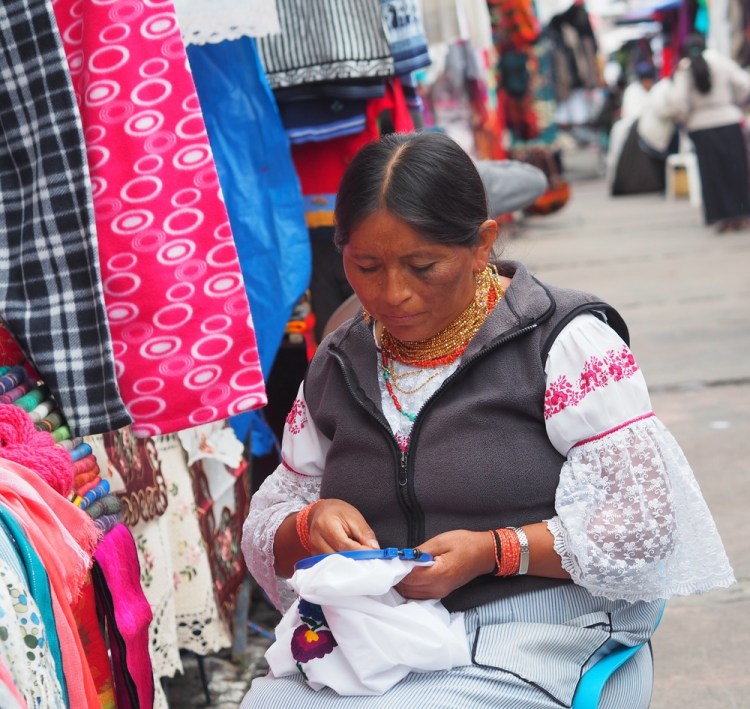
The traditional embroidered blouse, being worn and being made!
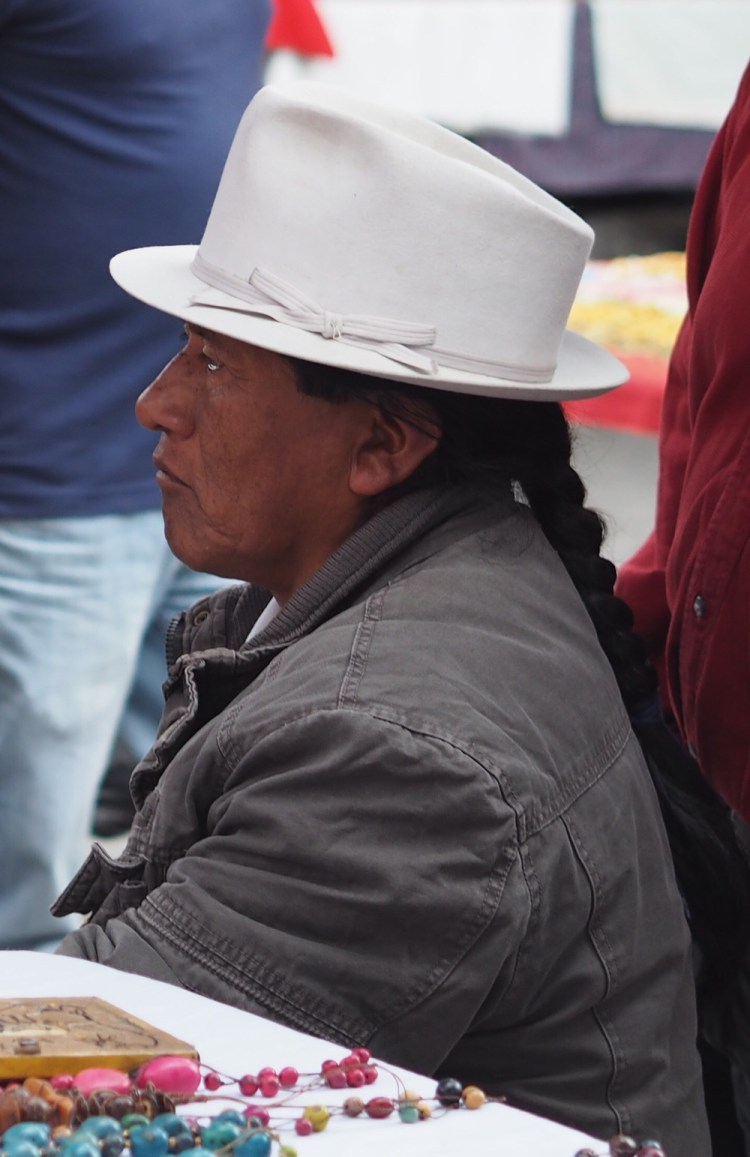
The men also wear their hair long & plaited with a felt hat
Otavalo is set in beautiful countryside between two volcanoes – Imbabura (4,609m) and Cotacachi (4,939m). It’s famous for the number of indigenous people who live here (who are particularly renown for their weaving) and for its incredible market that’s been here since pre-Incan times. It’s a very uninteresting 30-minute walk down into town, or a five minute bus ride. Sure enough, the are lots of indigenous people in town, with everyone over 40 years old wearing traditional dress. The women wear full skirts with beautifully embroidered white blouses. Their long hair is plaited and they wear a dark felt hat. The men (who are generally very short) also wear their hair long in a single plait, also topped with a velvet hat.
The market on Saturday truly lives up to its reputation. The town is bursting with people who have come down from the local villages to buy and sell their wares. The market, which is confined to one square on other days, now spreads out onto all of the surrounding streets. There are all sorts of llama and alpaca woollen products, knitted and woven, including ponchos, jumpers, hats, tapestries, hammocks etc. It’s a riot of colour. Then there is the jewellery, mainly silver and precious stones, and various musical instruments. The children practice their bargaining skills – Jemima gets a hammock for her birthday, and we end up having chanco for lunch at a stall in the market – a pig, roasted whole, with a few local spices added to the juices, served with really large maize kernels and potatoes fried in the pig fat. We sit on a rickety wooden bench at a tiny wooden table and gobble it down – it’s absolutely delicious! The stall is doing a roaring trade and the woman running it is working at an unbelievable pace, serving out (with her hands!) plate after plate to tourists and locals alike. We then load up with super-fresh and super-cheap vegetables and fruit before heading back home for a relaxing afternoon.
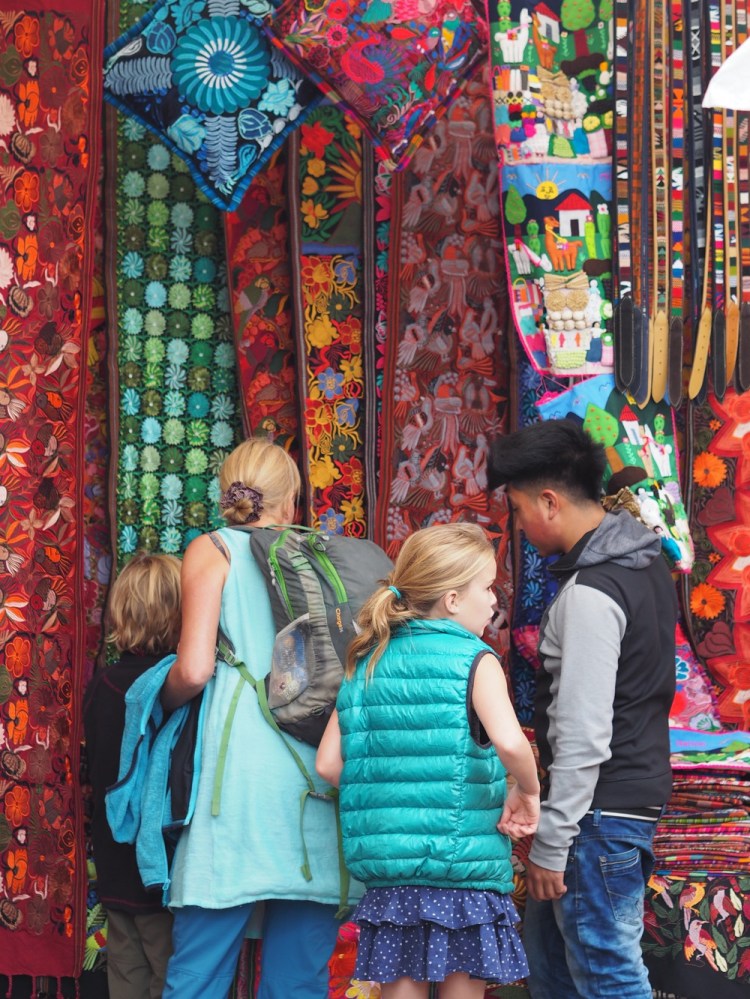
Browsing Otavalo market

Gabriel y el chanco!
On our first Monday, the children and I start Spanish lessons for two hours each afternoon. Our teachers have agreed to come up to our house rather than us having to go down to the school; all we have to do is pay their taxi fare. The children have Myra and I’m having 1:1 lessons with Juan. Millie joins Jemima & Gabriel for the first hour and then gets to watch a video for the second hour. Halfway through, Jemima plays waitress and delivers a homemade juice / smoothie and snacks – very civilised! The children’s lessons are fun and play–based, while mine are surprisingly formal. On day one, Juan goes through in detail when to use the verb ser (to be) and estar (to be). It’s much more about learning the rules and exceptions than learning through conversation – certainly to start with. Everything is “muy importante” and there’s a lot of “necesita memorizar y practicar”! On some days I feel that I’m making real progress and on others it feels like my head is going to explode as I search for the right words – particularly when we move onto the past tense with a new set of verb endings and a completely new set of irregular verbs! Most importantly, Jemima and Gabriel are really enjoying it and we settle into the rhythm really well. We’re even managing to do a bit of maths or writing each morning and they’re reading their kindles in front of the fire each evening. Routine is good!
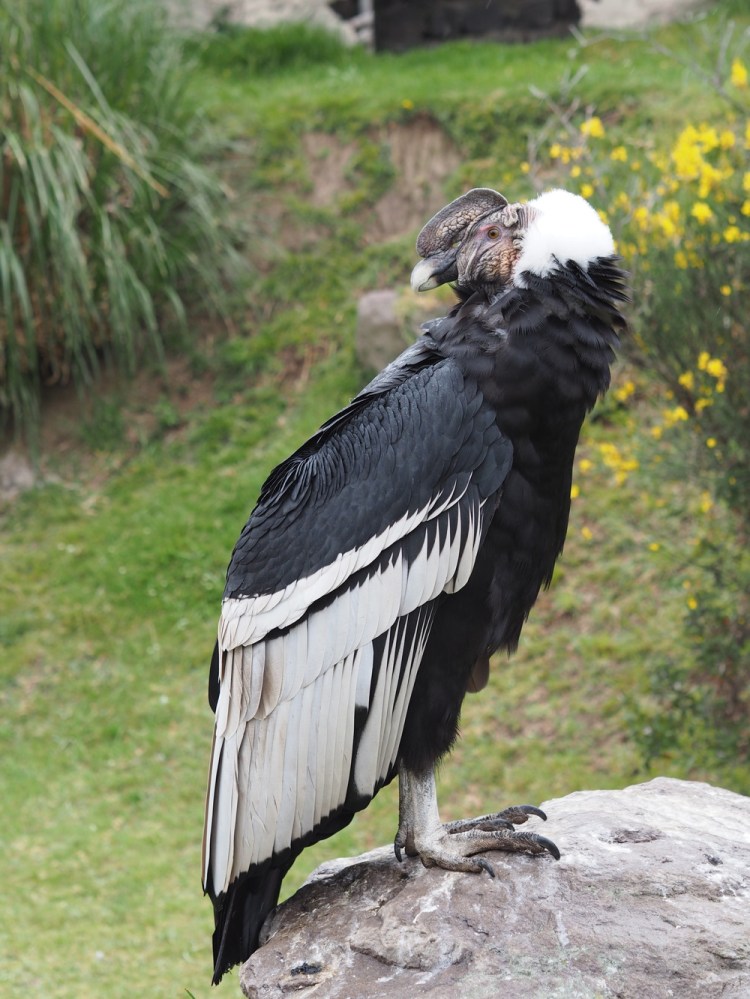
The condor is an impressive bird – this guy is about as tall as MIllie!
We take a taxi to visit the Parque Cóndor, a Dutch run bird of prey centre that rehabilitates birds. It’s set in a magnificent location, high in the hills overlooking Otavalo. There are lots of native birds of prey here and we get to see a fabulous flying demonstration – it takes place in a stone amphitheatre perched on a precipice overlooking the town and surrounding countryside. I can’t imagine a better location and I’ve never seen a better demonstration. They fly a kestrel, an owl, a couple of hawks and a baldheaded eagle that is absolutely magnificent. It’s fabulous to see them soaring up on the thermals over an adjacent hill. They have a condor, but apparently they’re not allowed to fly it as its deemed to be too dangerous. However, we do get to see it being fed and it does fly for a few metres in its enclosure – a truly impressive sight and sound!
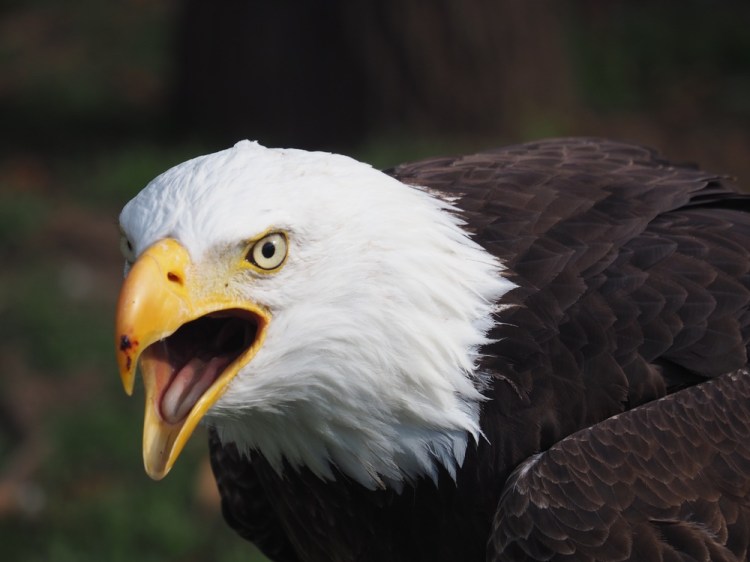
The equally impressive American bald-headed eagle
Fi’s old nanny Adella &her husband Jorge, Lupe & her husband Edison and their 4 children drive up from Quito for Sunday lunch. It’s lovely that they all made the trip and an indication of the depth of their relationship with the Dalrymple family – and good practice for me since none of them speak any English! Fi encourages me to go for a quick walk with Jorge to get some beers from the corner shop; but it’s Sunday and they’re closed. So it becomes a much longer walk to the next village and back, but we manage to maintain a conversation all the way there and back – these lessons must be doing some good! I’m also quite flattered by the fact that Edison makes no allowance and chats to me as if I’m a native speaker. Thankfully he naturally speaks very clearly and again I’m pleasantly surprised at how much I understand!

A lovely father and son moment between Edison and one of the twins
We’re loving our routine after a complete lack of one for several months. Between our maths / writing in the morning and Spanish lessons at 3pm, we’re having short trips to see some of the local villages:
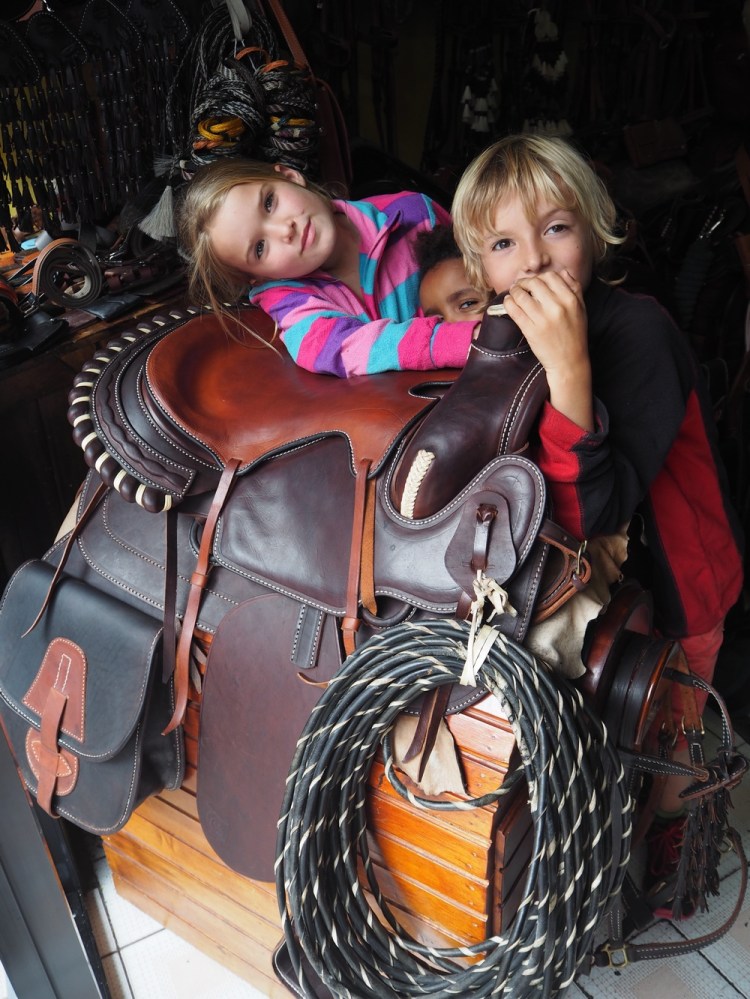
Check out the extraordinary workmanship on this saddle at one of the myriad leather shops in Cotacachi
Cotacachi is a small town famous for its leatherwork. The main street is lined on both sides with shops selling the most exquisite leather products. It’s fabulous quality and at an extremely good price. Fiona and I both succumb to temptation and buy a leather jacket each. We also stumble across a shop selling leather horse saddles (western style); the quality and workmanship is absolutely extraordinary.
Peguche is a tiny village famous for its weaving. We see a couple of weaving demonstrations and buy a couple of tapestries to hang on our walls whe we get home. There’s also a famous musical instrument maker here, but apparenty one of his relations is getting married and so he’s been taken out of circulation for a few days!
On our second Saturday here, we drag the children moaning and groaning out of their beds early to see the animal market. Apparently they’ve only recently introduced any sort of demarcation at the market but at least now the cattle are separated from the pigs and other animals. As we approach, we have have to carefully pick our way between squealing pigs that are being driven / pulled / cajoled / beaten by men, women and surprisingly small children. The sound of pigs screaming always reminds me of one of my first European Ultimate Frisbee Championships in Obertraun, Austria (1985, I think), when we stayed in a hostel right next to an abattoir, where we frequently heard the sound of pigs being slaughtered. The trading system at the market seems pretty simple – you turn up with the animals you want to sell, find a spot and hang around until someone makes you an offer. Apart from the obvious, there are chickens (and chicks), turkeys, guinea pigs, rabbits and puppies, to name but a few. When we’ve seen enough, we head down to the main market and have an early lunch – chancho again, of course!
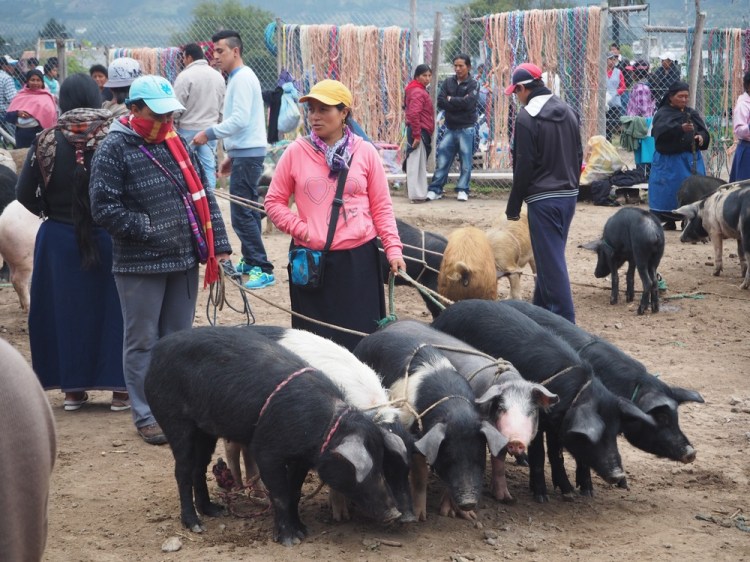
“Will someone please make me an offer for these pigs?!”
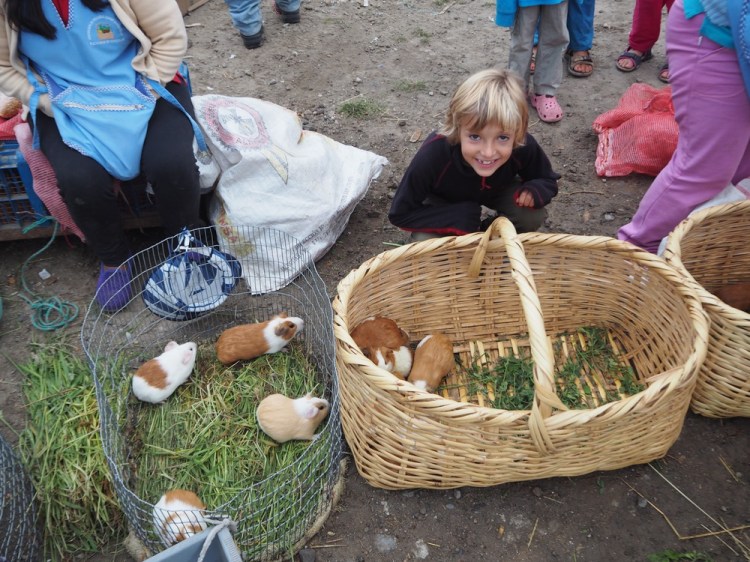
Gabriel, blissfully unaware that these are also destined for the grill!
Our neighbours at Las Palmeras are an incredibly friendly American couple, Malkum and Marcie Gibson. In many ways, they’re complete opposites – Malkum is a very extrovert blues singer and producer who had his own first single produced by none other than B.B. King! He has a recording studio in their house with an extensive collection of accordions and harmonicas, along with various other instruments he’s collected over the years. He also happens to have a very impressive waxed and curled moustache that I struggle to take my eyes off. Marcie, on the other hand, is a retired IT project manager who has worked with several global corporations such as P&G. They come over for dinner one evening and bring home smoked trout plus some delicious home-made schnapps (Malkum has built his own smoker on their roof and he also brings us THE most tasty smoked bacon). Unfortunately Marcie gets a very nasty infection while we’re there and is laid low for a few days. But Malkum kindly drives us to Chichimbiro thermal pools where we lounge for a few hours – it’s an incredible set up in the middle of nowhere, with about 9 different pools of different temperatures and water slides for the kids. Then, of course, it’s back home for Spanish!
We go for a couple of walks – on one, we go part way round the crater lake of Cuichocha (‘guinea pig lake’ – named after the two islands in the lake that apparently look like guinea pigs). It’s hot and pretty steep – Gabriel is on fine form and runs on ahead like a mountain goat but unfortunately both Jemima and Millie have left their walking legs at home and it’s a real battle to drag them up. The second walk is to the Lagunas de Mojanda – a taxi ride up a steep, steep cobbled road to an altitude of 3,700m. Given the state of the road, I’m glad it wasn’t my car! It’s chilly and cloudy, so the lakes aren’t the beautiful turquoise colour as billed in the Lonely Planet, but impressive and enjoyable nonetheless. (It strikes me again just how lucky we were with the weather in New Zealand). By the end of our walk, poor little Millie’s hands are like blocks of ice, so we stop for hot chocolates to warm up at the Casa Mojanda, which enjoys a stunning location looking out over the valley. As we leave, the weather starts to change and the drive back down is wonderfully dramatic – it looks like we could reach up and touch the dark, leaden ceiling of cloud immediately above us, and then in the distance the sun cuts through the blanket of cloud, bathing the other side of the valley in golden evening light.
We visit the parent hacienda of Las Palmeras, Hacienda Cusin, for a horse ride followed by lunch. The ride was only an hour but to be honest, for our tender and inexperienced derrières it was probably enough. We’ve been promising the children throughout our time in NZ that we’ll go horse riding in Ecuador where it will be much cheaper. So this is a fulfilment of that promise and an appetiser for more to come, hopefully. It’s certainly a lovely way to see the countryside. The hacienda itself is a large and rambling 17th century estate, with an adjacent monastery – owned by a Brit for the last 20 years or so. It turns out that Malkum and Marcie are having lunch with the owner from whom they bought their house – it seems that extensive and rigorous vetting process he insisted on has turned into a long lasting friendship. The Hacienda has been beautifully restored and as we chat to ??? It’s obvious he has a keen interest in it’s history, which he’s traced back to around 1600. In fact, he’s really interested to get copies of photos of Ecuador from when Fi’s parents lived here. He tells us that upkeep is a challenge – for example, there are 60 fires to light and tend to each day!!
We would love to stay longer in our idyllic casita at Las Palmeras and settle into even more of a rhythm, but unfortunately they’re booked up and we have to move on. So we say goodbye to our Spanish teachers, our lovely neighbours Malkum and Marcie, to the crazy puppy Omero and head to Cuenca in the southern highlands.
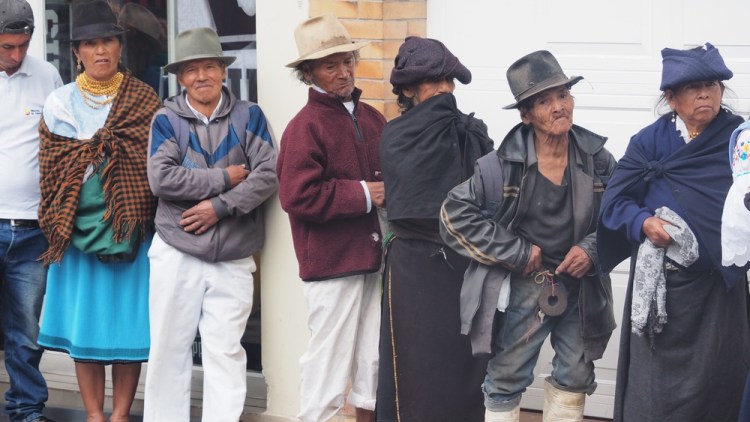
The queue for some government office in downtown Otavalo
 Five Go Round The World