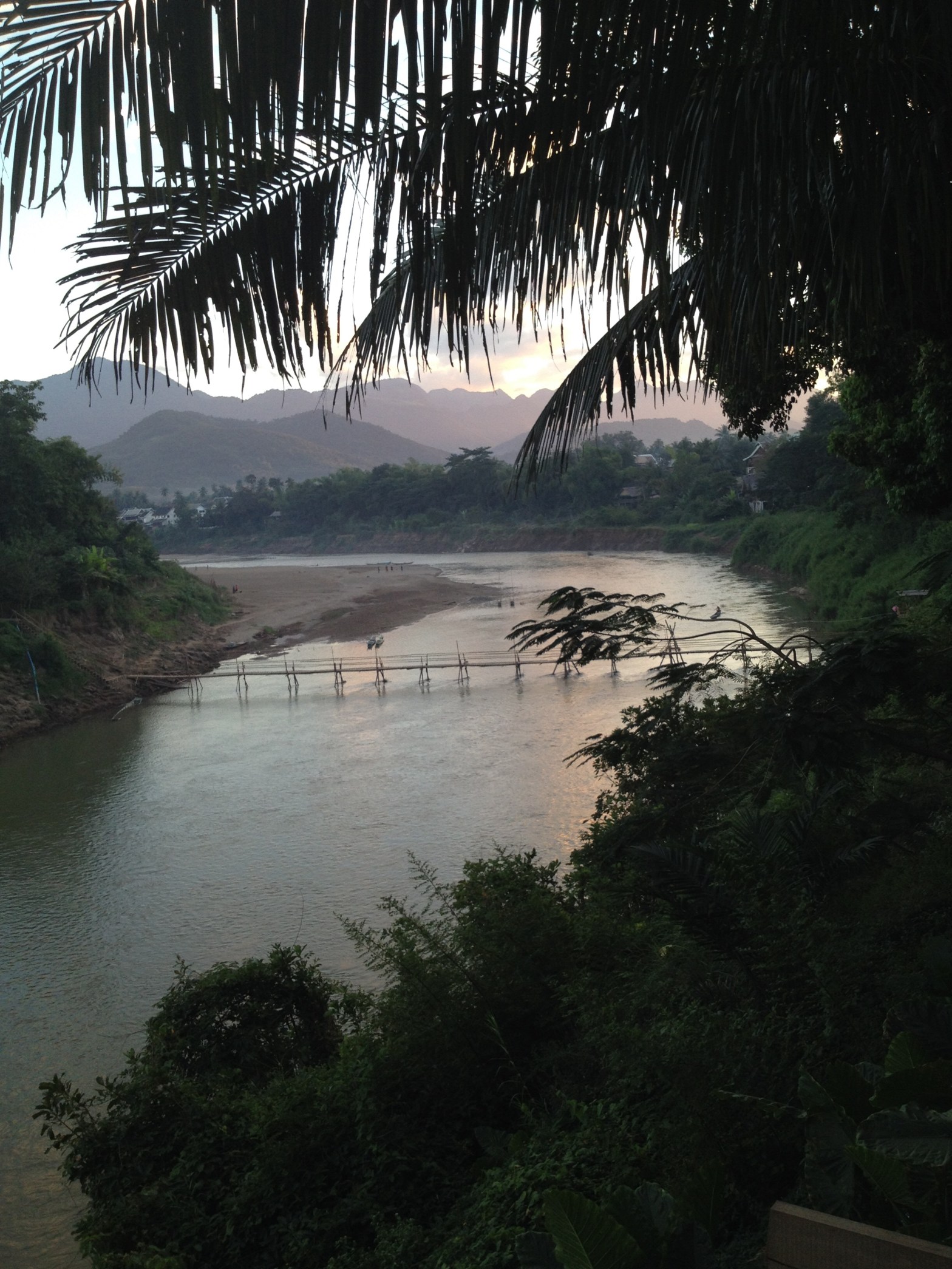
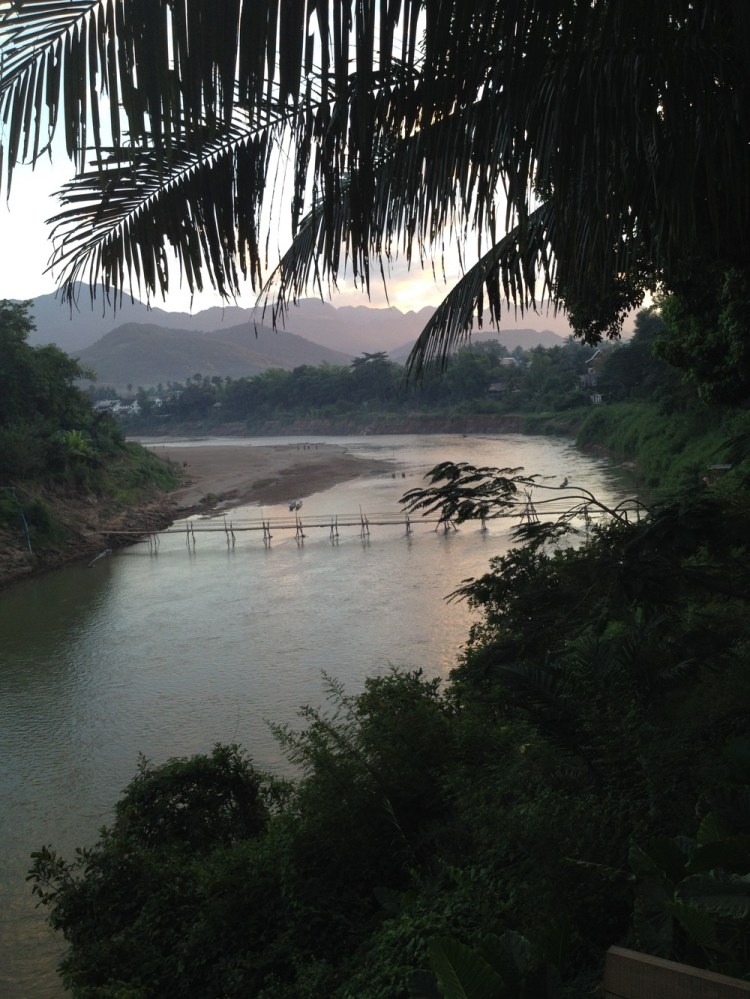
The view up the Nam Khan river from our revised hotel choice
After the adventures of Vang Vieng, we were intrigued to find out what Luang Prabang had in store, which is much more on the tourist trail and a ‘must see’ destination in Laos. We had booked a hotel with a pool for the children, but unfortunately it was out of town, rather quiet and somewhat lacking in character. They had free bikes to use, but no kids sizes, so only Jemima could manage them – she was continuously zooming backwards and forwards with either Gabriel or Millie perched on the back! But after two nights we moved to a much simpler but way more characterful hotel right on the peninsula in the heart of town, looking out onto the Nam Khan river (the smaller of the two rivers that form this Peninsula, the other being the mighty Mekong).
On the first evening, we venture into town to discover the fabulous night market that takes over the main street every evening. It’s packed with the most beautiful handicrafts – thank goodness we’re restricted in terms of what we can carry, otherwise Fi would have spent an absolute fortune in there, particularly as it’s the run up to Christmas! There are exquisitely woven fabrics and wall hangings, clothes, jewellery, ornaments – some made of recycled bombs, some sadly made of ivory. It’s all really beautiful and the colours so vibrant. We go down one side alley, discovering that’s it’s lined wall to wall with street food, the length of a whole block. There’s everything here – fried fish, a hundred different varieties of chicken and pork, buffet style stalls with salads, Pad Thai noodles etc, plus a few less appealing (to us tourists) offerings, such as fried chickens feet, various forms of offal and sausages made of entrails, etc. we pick a selection (it’s not as cheap as you might think), find a trestle table next to a stall of fried fish and tuck in – yum!
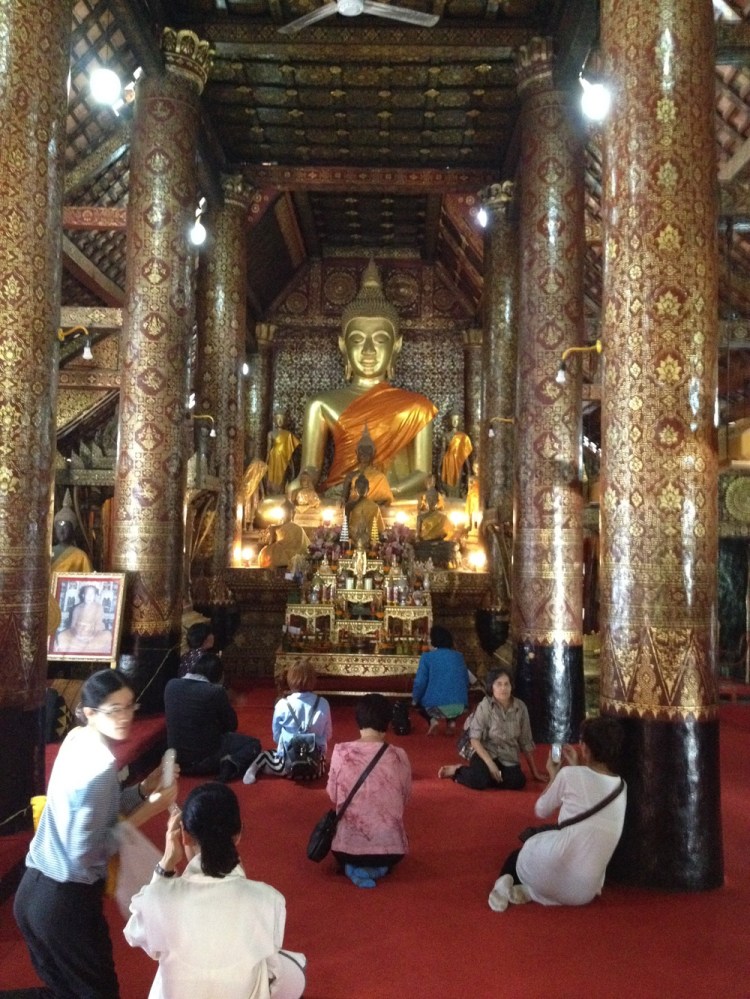
Luang Prabang is a historic capital city, so is rich with Bhuddist temples. But what is really striking is the French influence – it is a wonderful fusion of Asian and French cultures and architecture that has a gorgeous feel to it. There are numerous cafés and bistros which would not look at all out of place on a Parisian street corner, with their window shutters, signage, interior decor and great coffee. There’s clearly plenty of tourist money here – there are lots of chic places and boutique hotels – it would be perfectly easy to find a stylish but not opulent double room here for $120+ per night. And a number of restaurants run cookery courses during the day, but their restaurant prices are not too far off what we’d be paying at home. Our new hotel is lovely and characterful, with it’s woven bamboo wall coverings and wooden ceilings – unfortunately I see more more of it than I’d like as Jemima is sick for 3 days, for two of which she was confined to barracks.
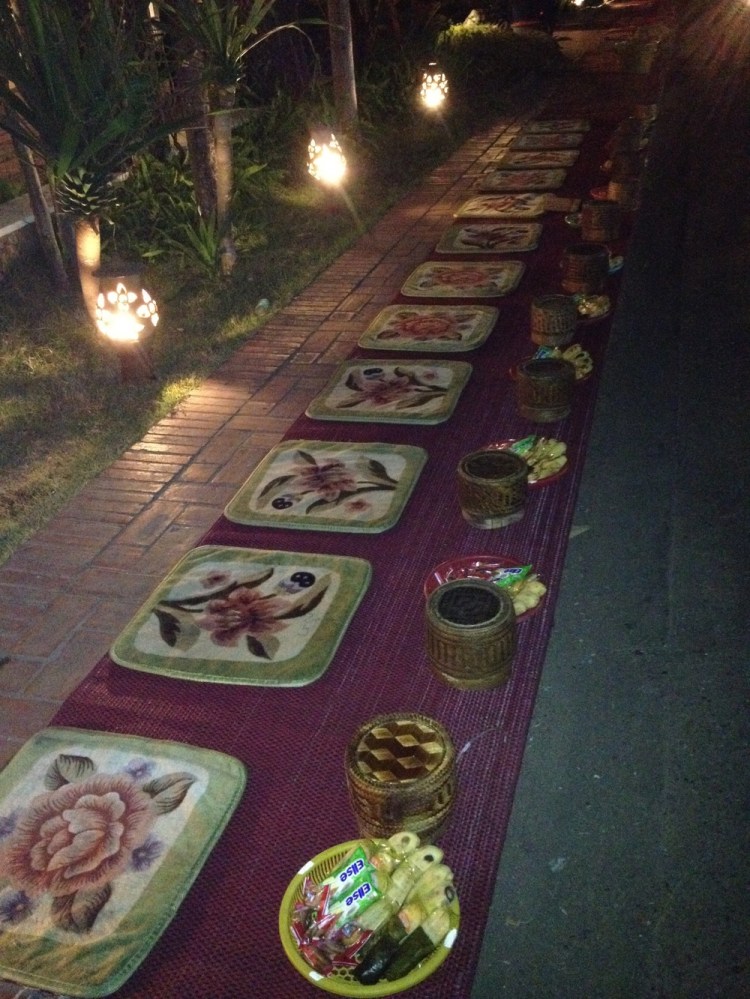
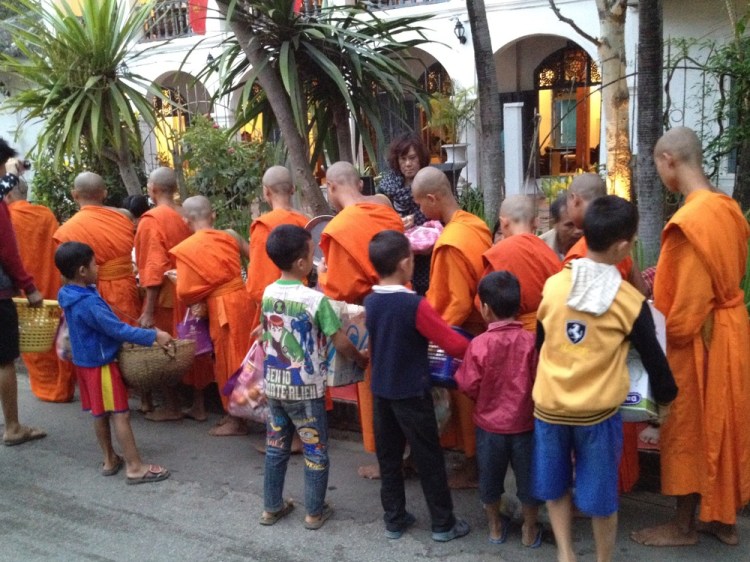
One morning I decide to get up early to watch the alms giving to the local apprentice Monks. I’ve heard that it starts at 6am, so I get up early and head down there by about 5.45am. All is fairly quiet, but hundreds of small baskets and plates of bananas & biscuits sitting in front of squares of carpet have been laid out, side by side, along the whole length of the route. Nothing much happens for the next half hour or so – it seems like I’ve had a dodgy brief in terms of the start time, so I settle down at a roadside restaurant and order a coffee and wait… Eventually, at around 6.45am, lots of minibuses start arriving and park along the opposite side of the street. Their passengers spill out and start to fill the seats on the carpet squares – many bless the food in front of them with a short prayer. And at 7am I see a line of orange-clad monks slowly making their way along the line. As they approach, I see that they are each carrying a basket and they stop briefly in front of each person in the line. That person they takes a small ball of sticky rice out of their basket and puts it in the monk’s. Nothing is said – there are no thankyous or acknowledgement of the donation. Needless to say, before long the monks’ basket is full of well-fingered sticky rice (with accompanying bacteria) and snacks. I then notice the small boys behind each of the monks, each carrying a large basket or cardboard box – every now and then, the monk takes a large handful of the food in his basket and dumps it into the box/basket behind him, thereby stopping his basket from overflowing. What happens to the food the boys collect, I don’t know – presumably it’s taken back to the rest of the monks at the temple? I’m struck by just how much sticky rice is being given – the processional route goes all the way around a couple of blocks, with each mat taken less than 1m of pavement space. And this happens every day. Apparently it’s all the apprentice monks have to eat, and while there does seem to be enough to feed an army, it doesn’t look like a terribly balanced diet!
Later in the week, Sarah and her family again catch us up (they stayed in Vang Vieng longer than us). We go with them to a very cool chill-out bar called Utopia. Here there are unexploded bombs among the furniture as decoration – one is simply sticking out of the ground at an angle, presumably how many of them landed – it’s another poignant reminder of this country’s violent recent past.
Fi and I have both been reading a book called ‘The Ravens: Pilots of the Secret War of Laos’ by Christopher Robbins. It gives a great insight into the ‘secret war’ waged between the US and the North Vietnamese in Laos – neither the Americans nor the Vietnamese emerge with any credit whatsoever and one’s sympathies are left clearly with the Lao people – roped into a war based on America’s paranoia about communism and Vietnam’s expansionist ambition; and then completely abandoned by the Americans when they’d had enough and pulled out. I didn’t know to much about this war previously and am surprised to read that Laos is the most bombed country on earth – and one of the most heavily land-mined:
“The minefield into which they had crashed had originally been laid by the French in the 1930s, reseeded by the Japanese in the 40s, mined again by the French in the 50s, and mined yet again by the Americans in the 60s”
On a lighter note, we also take a tuk-tuk with our Aussie friends to the Tat Kuang Si waterfalls – they are a bit touristy, but incredibly beautiful. The first sight we get through the forest is of a 2-3 metre waterfall cascading into a jade green pool, just made for swimming. But as we wander further up the path, we realise that this is just the last of a dozen or so similar falls and pools, each more beautiful than the last. We pick one with a tree with a good overhanging branch and all have a go at jumping into the (refreshingly chilly!) water. At the top of the path we discover the first and by far and away the biggest fall in the series – the water emerging from between the trees and tumbling down for maybe 100m over the limestone cliffs into the pools below.

Reluctantly we say our farewells to Sarah and her family and prepare to leave this gorgeous country. A couple of weeks has been nowhere near long enough to do it justice – we wish we’d had longer to explore more, get further away from the tourist trail and absorb it all a bit more deeply. I’ll remember with great fondness the beauty of the landscape (both natural and domesticated), the friendliness of the people, the kindness of the people and the gentleness of the pace of life – not to mention the food. It’s another country to add to the list of ‘must come again’.
But for now, it’s time to fly south to neighbouring Cambodia….
 Five Go Round The World