We’ve seen Karma’s village of Syafru from several vantage points throughout our trek. However, it’s only when we arrive that we can appreciate its unique situation, perched along a sharp ridge with views on one side to the Ganesh Himal (elephant) range and the Langtang peaks on the other. Straight down the valley, we can even see some snow-covered peaks in Tibet.
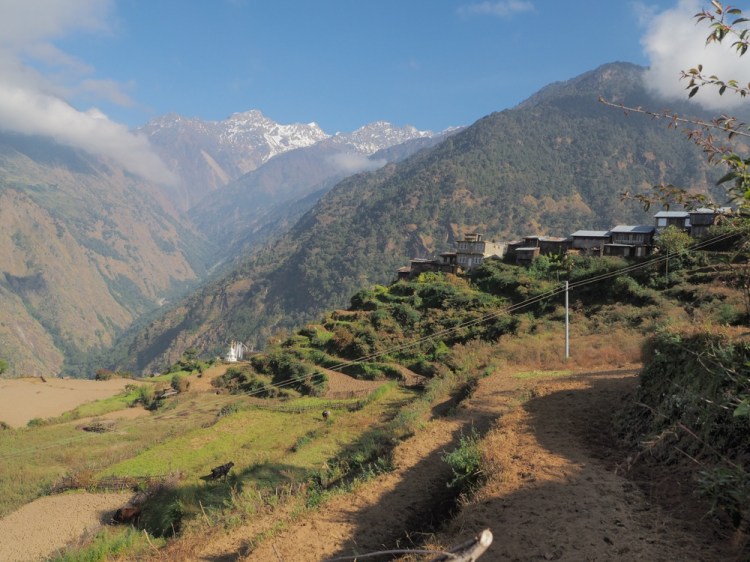
The view back to Syabru from our walk down
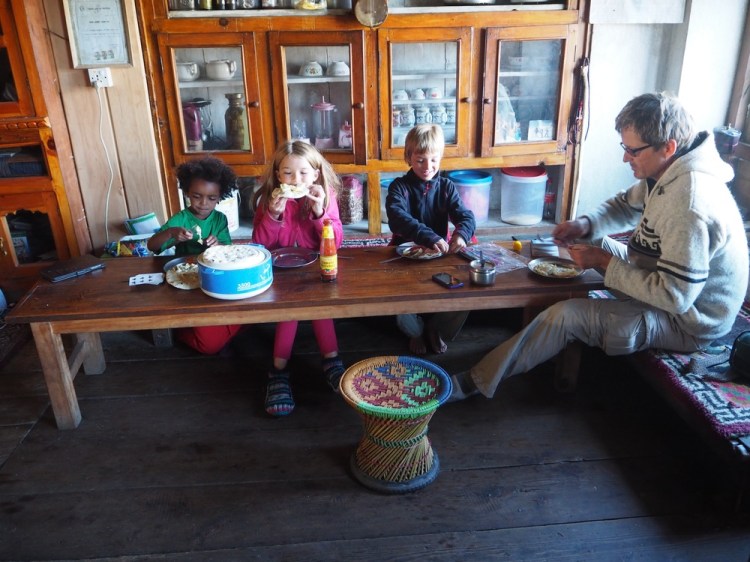
Breakfast in the kitchen / dining / living / bedroom
We are invited to Karma’s home where his mother immediately puts the kettle on to make a cup of chai. In contrast to the many of the larger hotels that seem to have sprung up in the village over the years, this is a real traditional homestay. Everything happens in the main room of the house. It’s the kitchen, dining / living room and also Karma’s parents’ bedroom. All the cooking is done on a low level burning stove. Food preparation and other jobs are done sitting cross-legged on the floor.
We do a huge wash out on the terrace while watching neighbours shelling beans and drying various vegetables and pulses on their terraces. The children start playing all sorts of games with the water; Jemima decides to set up a foot wash and massage service for the weary travellers trudging up the hill through the village. Sadly, the only customers she gets are Fi and I – still, good on her for trying!
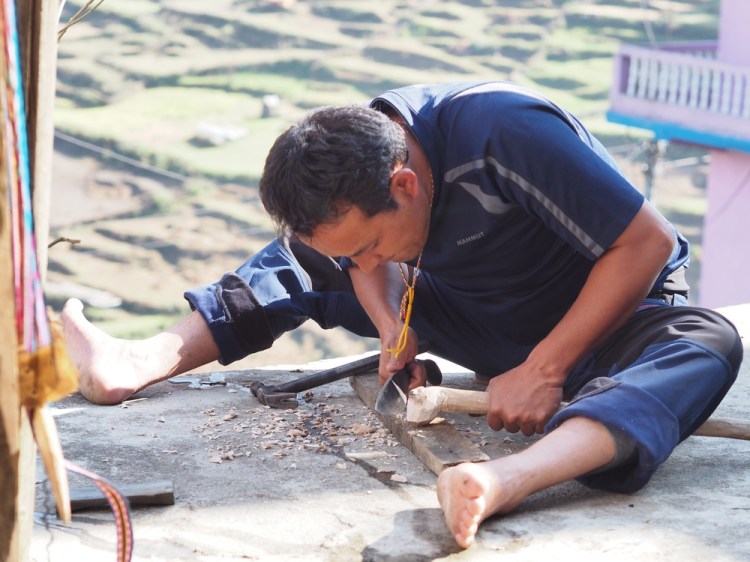
Karma now has the tools at his disposal to complete the bear’s head on the top of his stick! The khukuri knife is generally the tool of choice for most jobs.
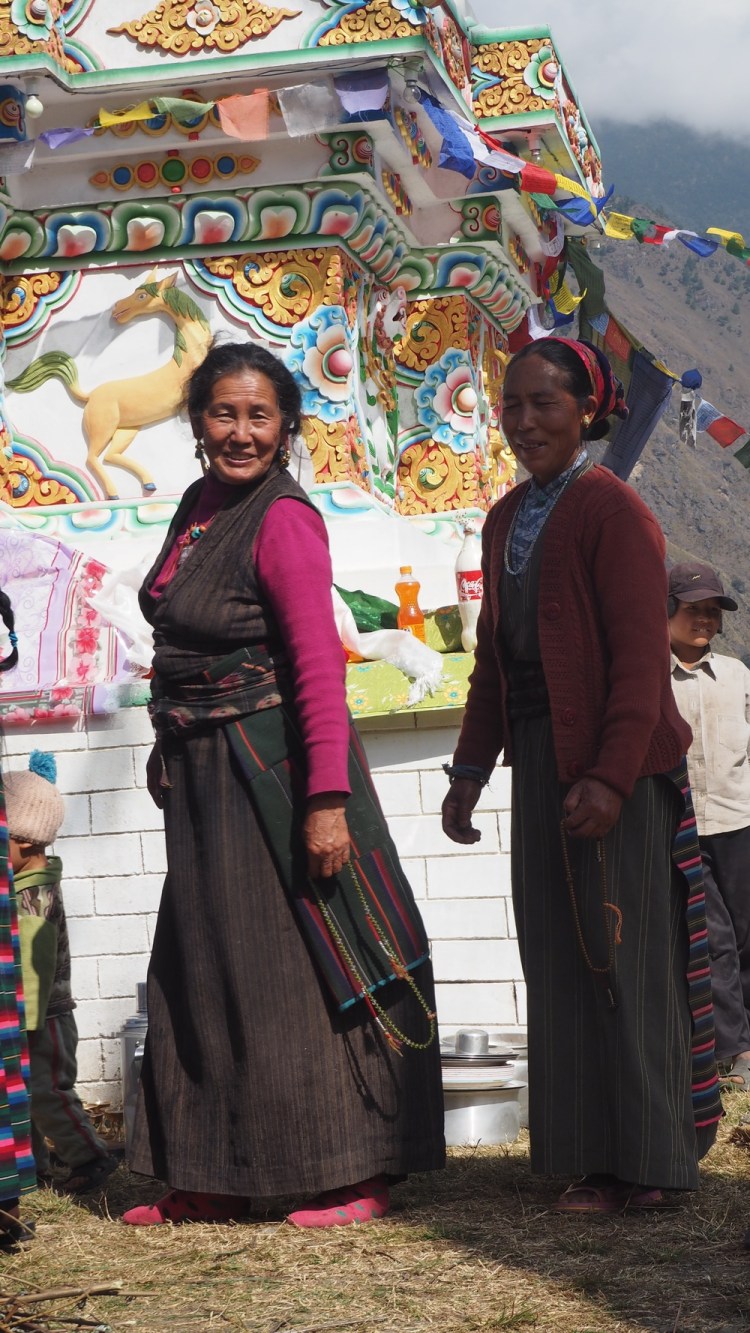
Karma’s mum at the stupa
Karma is in and out of the house, meeting various friends he hasn’t seen for some time and attending to various demands on him. He now has access to a decent khukuri knife and various other tools of his father, so he can put the finishing touches to the tiger’s head on Gabriel’s stick. He also quickly produces a bear’s head on the top of his!
Karma is the second ranking Lama in the village and is at the heart of many community activities and projects. He tells us that not many people in the village have studied Buddhism and are therefore vulnerable to the handful of evangelising Christians who, according to him, spend most of their time criticising other religions. In response, once a month he holds sessions at the local stupa, educating village members more about buddhism. When we arrive, it’s full moon and the next day, Karma disappears for several hours to officiate in a ceremony at the stupa and also deliver some of this teaching. Fi and I go down to the bottom of the village to take a look – we are immediately invited in and offered a cup of tea. The three lamas are sat behind a low bench, chanting from their holy books to the accompaniment of cymbals, bells and a drum. This is such an open religion; Karma invites me to come and sit right next to him behind the ‘altar’. After the chanting, food (ie lunch) is blessed and passed around. Of course, we’re offered some. Now it’s more chanting, cymbals and bells, while some of the men quickly erect a wind break, behind which lots of oil candles are lit. The whole thing is so atmospheric and it feels a real privilege to be invited into the heart of it.

Local village women with prayer wheels and beads at the ceremony at the stupa
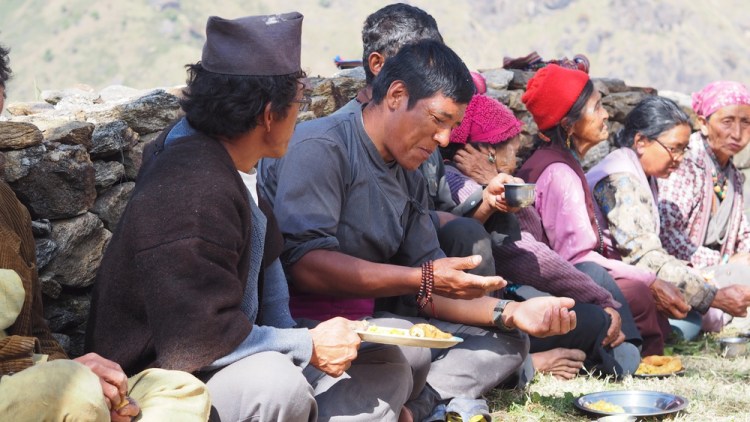
Lunch is served part way through the ceremonies

The local blacksmith making Gabriel’s knife
Having seen so many khukuri knives on our trek, I had decided to get one for Gabriel as a surprise. Traditionally, there is a big knife with too much smaller knives in a single sheath. Karma told me that while it’s relatively easy to buy the bigger knife, the smaller ones need to be ordered. I’d asked him to do that and so we take Gabriel to see the local blacksmith making the knives. It is fascinating to watch him at work. In total, Gabriel and I sit watching him work for 2-3 hours, forging the blade, carving the handle, attaching the two together and finally grinding the blade. It’s great father and son bonding time watching this craftsman at work! In the end, the knives turn out to be much larger than we’d intended, so Gabriel ends up having just one of these knives rather than the full set of three. Actually, while less authentic, it’s probably much more practical, so a good outcome – and Gabriel loves his new knife to the extent that he slept with it under his pillow the first night after we got it!

A typically splendid cockerel – we saw so many during our trek that I thought I needed a picture of one. They’re kept to sell for meat for the tourists – the price is more than the fanciest butcher in London, about £20 per bird!
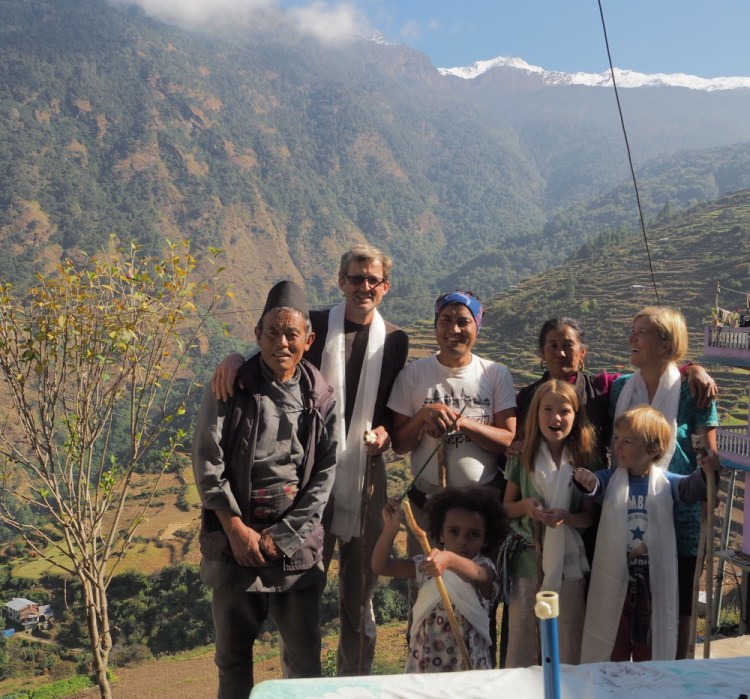
So, after a lovely few days staying with Karma and his parents, we say our thanks and farewells and with heavy hearts head back to Syafru Bensi. It’s about a two hour walk downhill and again Millie makes it all the way unassisted. This time there’s no excitement in arriving in this town that is so completely heaving with western tourists. We’ve had such a wonderful time in the mountains that none of us want it to end.
The drive back to Kathmandu is of course just as beautiful as on the way up but it feels different when you’re leaving the mountains and heading back to the dirty air of the city. But we only stay for one day in Kathmandu and then take a tourist bus to Pokhara. We’re delighted that Karma and Karmu have decided to join us on this trip as a holiday for them. The 6-hour drive is beautiful, for much of the way following a stunning mountain river as it weaves down the valley. And as we approach our destination the backdrop of the Annapurna range looks as though it’s been painted onto the skyline.
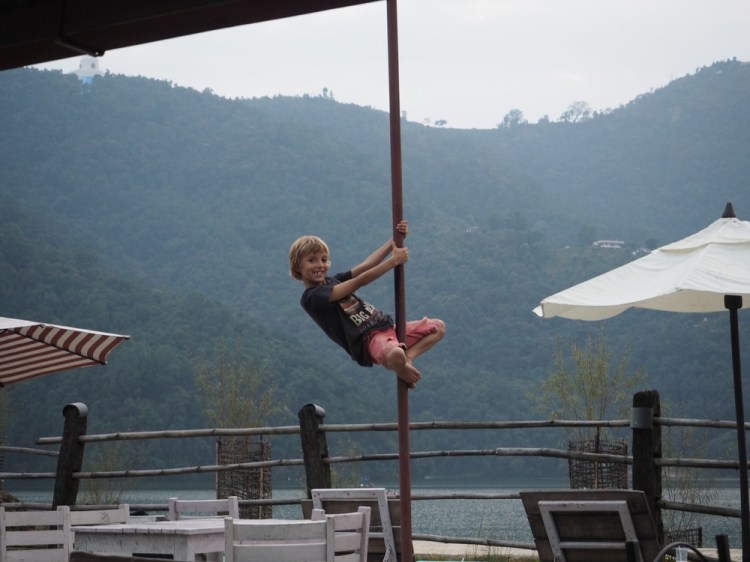
Gabriel looking for coconuts!
Pokhara is the third largest city in Nepal but feels a lot airier and cleaner than Kathmandu. On the first evening we take a walk down by the lake and decide to stop for a drink in what we name the Bob Marley bar, as No Woman No Cry wafts out to greet us. We heard his music in Ethiopia, in India and now in Nepal! This becomes our regular evening haunt, with the adults enjoying a beer while the children play in the gravel and Gabriel climbs higher and higher each evening up a lamp post.
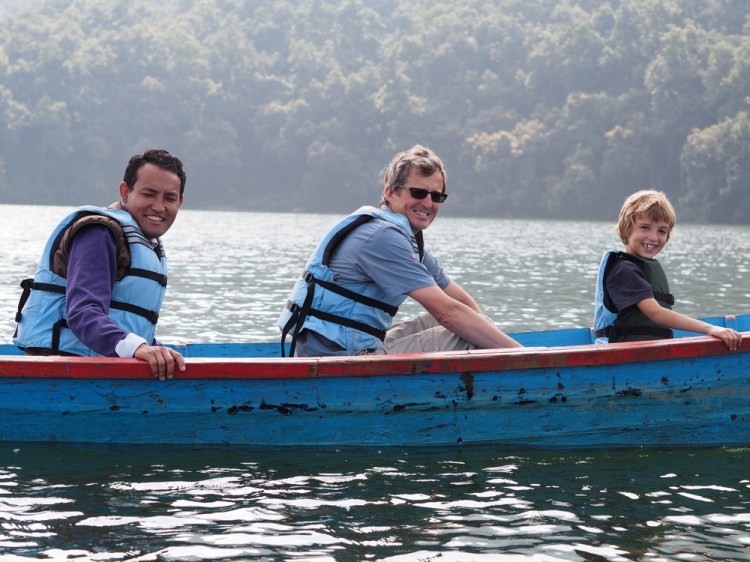
It was boys vs. girls in the boat race across the lake. I don’t need to tell you who won!
Our 3-4 days here are very relaxing. We take a boat across the lake, walk up to the world peace stupa at the top of the hill and then down through the forest on the other side. We get a few cries of “Please, no more trekking!” but before long the children are into their stride and we enjoy a lovely 3-4 hour walk. We also go and see some traditional Nepalese dancing which Jemima and Millie particularly enjoyed.
The only disappointment of this trip was that the weather was generally overcast and one of the main attractions of Pokhara is the stunning views of the Annapurna range, especially at sunrise. I guess the good news is that we didn’t have to get up at 5am! Still, it was a shame to be heading back for Kathmandu without having witnessed it.
 Five Go Round The World