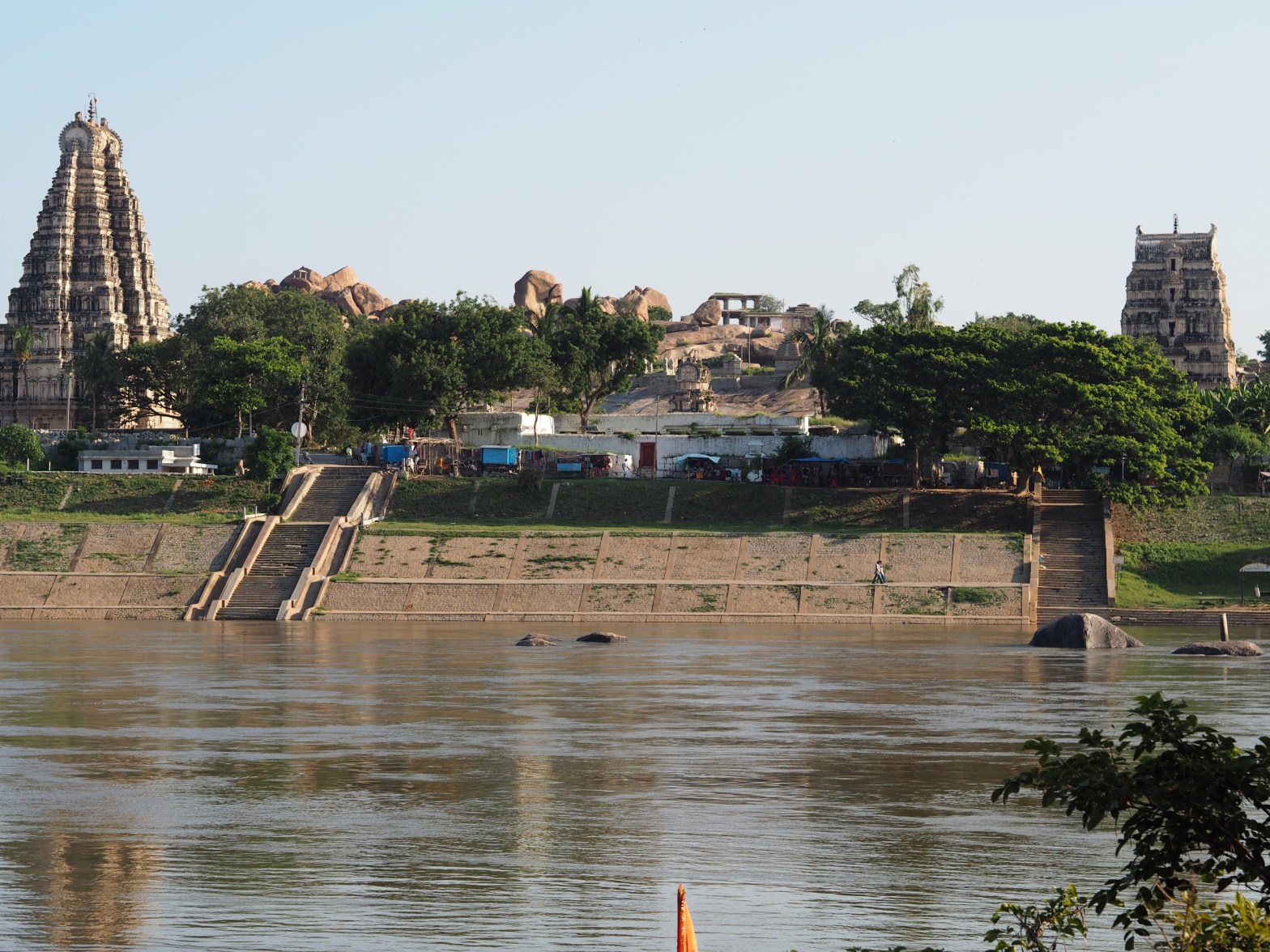
Our plans here in India keep changing. We were still planning to go down to Kerala, but Carole at Casa Susegad questioned why we were going so far, to beaches when we’re not really beach people and to the backwaters that the kids would find boring. It’s a very fair point, so we take her advice and head off to Hampi, which is due east, by train. I love changing plans to follow local people’s advice – from my limited travelling experience it generally results in a more interesting journey that’s more off the beaten track.
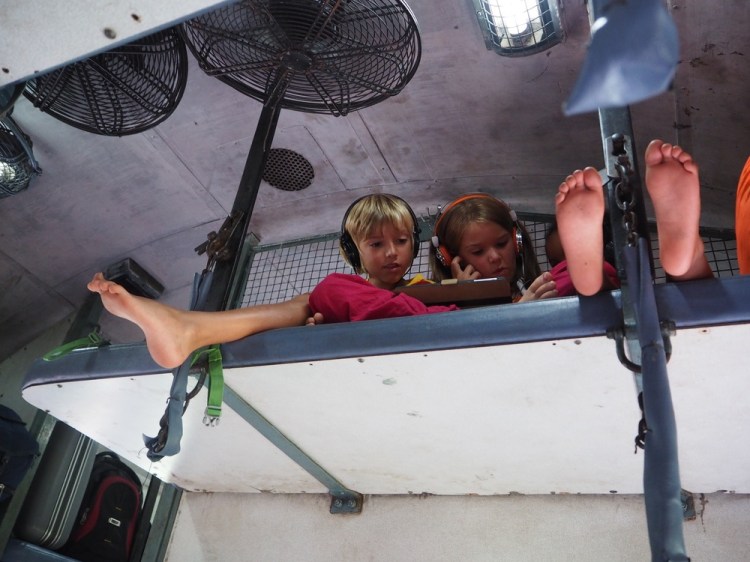
Killing time on a long train journey
This time it’s a day train, but the carriages are just the same, with the seats that convert to beds and the bunks up top. Needless to say, the children clamber up onto the bunks, which is just as well, as half way through the journey a couple of Indian families with mountains of luggage cram into our little compartment. Thank goodness for iPads, films and headphones! On the way, the train passes right next to a spectacular waterfall but after the that the scenery is less spectacular.
We’ve read about the terrain surrounding Hampi and it’s obvious when we’re getting close. It’s extraordinary – over millions of years, the granite rock has split with the changes of temperature and the rain has then worn away at the cracks. The result is enormous boulders, piled up high as though the stone giants have been playing some form of Jenga!
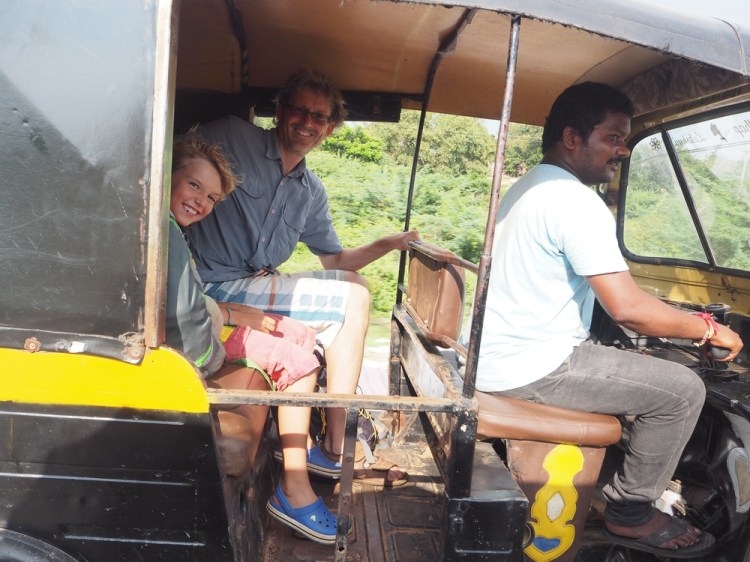
The great tuk-tuk race!
The nearest station is Hospet – the train only stops here for a couple of minutes, so it was a scramble and then a physical battle to get our luggage out against the flow of passengers getting on the train. After some debate, we opted for a couple of tuk-tuks to take us to Hampi – it’s amazing how much luggage they hold! It was girls vs. boys, but needless to say it was Gabriel & I in Lightening McQueen that won the race!
There are two options in Hampi: stay in the village itself, right next to all the temples; or take a ferry across the river and stay in an adjacent village that’s apparently calmer and airier. We’re booked into Mowgli Guesthouse across the river but the tuk-tuk driver, who obviously had a vested interest, warns us us that the ferry has only just re-opened after the monsoon rains and if the level of the river rises, we could get stranded on the other side. We look at a couple of guest houses on the Hampi side but the tiny streets are crammed together and stiflingly hot. We take a vote, I lose and we opt to go across to the other side (no doubt not the last time I’ll be talked into a better decision).
Indeed it is much more chilled on the other side, to the extent that we feel we should all have long hair and flowers in our hair. We have two little huts at the Mowgli, with swing seats overlooking a paddy field that’s punctuated by elegant palm trees and behind it, the river. The restaurants on this side of the river follow a common template: low tables with mattresses for seats and bolster cushions; low lighting in the evenings with psychedelic paintings on the walls and late 60s / early 70s music playing (Pink Floyds Dark Side of the Moon springs to mind). The Indian food is invariably delicious – I’m loving eating it twice a day at least. There was a couple we kept coming across in our favourite restaurant that were entering fully into this relaxed atmosphere – they became known to us as ‘the snoggers’.
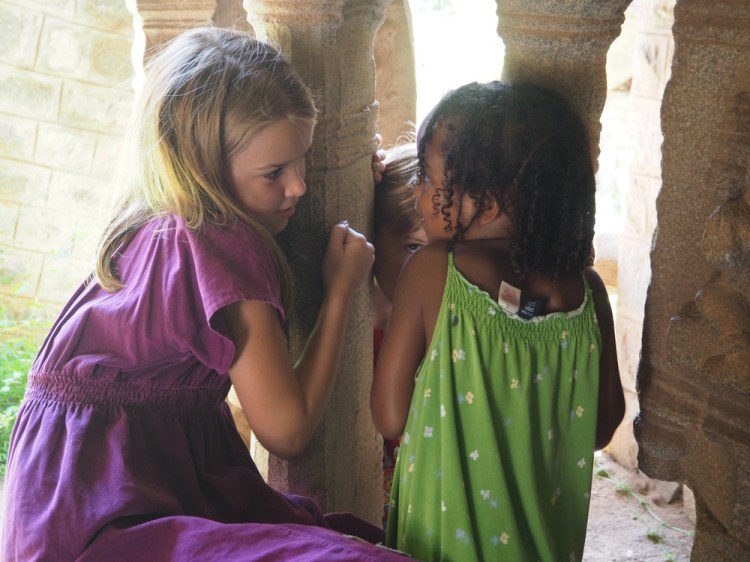
Listening to the amazing musical pillars in an Ancient Hampi temple
The ferry is still running the next morning (it’s a little further than the St Margarets to Ham ferry and the river running a little more briskly) so we go to see a few of the sites that Hampi is famous for. Between the mid-1300s and 1565 (when it was razed to the ground by Muslims from the north), Hampi was a the centre of a huge Hindu empire covering most of South India. There are the remains of numerous temples and bazaars, scattered among the unfeasible piles of massive boulders. The most impressive feature we saw was an extensive palace with ‘musical pillars’. Solid granite pillars were worked by architects and musicians in partnership. The weight of the granite above, the thickness of the pillar and the distance from the wall behind dictate the pitch and tone of the note when struck by a sandalwood hammer (or today by our guide’s thumbs). The result was an enormous musical instrument that could be heard over half a kilometre away. Each pillar had multiple faces, each producing a different tone. It’s extraordinary that a solid granite pillar can sound as if it is hollow. Again, we followed what’s turning out to be a successful approach – take a guide and spend some time at the first site, then just skimming a couple more (elephant stables and Queen’s bath. This was hopefully another valuable lesson for the children (including learning a bit more about Hinduism).

Quite a large millipede that Gabriel & I came across on the way down from Monkey Temple
Having done the history / culture bit, we spent the next few days just chilling. This was made easier by the fact that the water level in the river did indeed rise and we were stranded on the hippy side. Gabriel and I got up at 5.15am one morning to see the sunrise over Monkey Temple – I was impressed and pleased that he volunteered to get up at that time and come with me. Fi & Jemima did the same the next morning – it was a great view and well worth it.
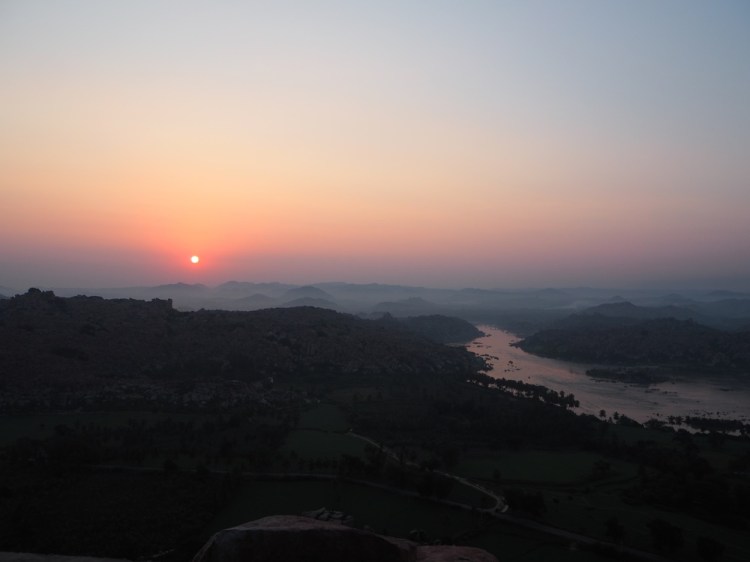
Sunrise from Monkey temple – well worth the early start!

The only available transport across the river when the motor boat isn’t running! These boys are stronger than they look
On our last day’ we were keen to visit some off the shops & stalls on the Hampi side but again the motor boat ferry wasn’t running. Surprisingly, a couple of small, wiry Indians with their coracle were, so we somewhat nervously clambered in with another family (10 of us in total) and the two paddlers, perched on broken coke crates, paddled absolutely flat out to get us across the now very significant current that was running. By the time we made it to the other side they were absolutely gasping for air and fit for nothing. I certainly didn’t resent them the somewhat steep fare!
So after a chilled out time at Casa Susegad in Goa and now something similar but different in Hampi (so different to our time in Ethiopia) it’s time to move on again, this time South to Mysore, just in time to catch the end of a huge Hindu festival….
 Five Go Round The World