(Be warned, this is a bit of a long one…)
Having seen a fair bit of the south of the country, with its beautiful countryside and fascinating cultures, it’s now time to embark on an 8-day tour of the north, the more classic ‘historical’ tourist route (after a very brief 4 days in Addis to recover from the last trip and to plan this one!)
The first stop is Bahrdar, on Lake Tana. We did consider taking a bus, which would have saved us a chunk of money, but that was scheduled to have taken about 8 hours and goodness knows how long it would actually have taken – see later. But we thought the children had done enough long car journeys and so opted for the one-hour flight. We also felt that we needed a bit of luxury in terms of accommodation and so splashed out on the gorgeous Kuriftu resort on the lake (we’d stayed at the sister resort on Lake Langano 3 years ago, so knew what pampering was in store!)

Home made paints on the way up to the monstery
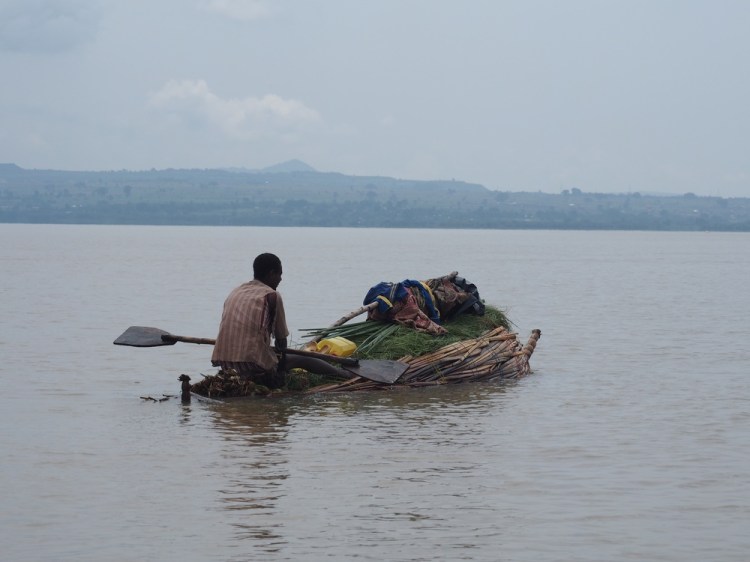
Between the lovely food, the swimming pool and the massages(!) we did manage to squeeze in a boat trip to see the monasteries on the islands of Lake Tana. We saw fishermen paddling their papyrus boats on the way out (a 6-hour paddle from the islands to shore) and the occasional pelican. We were wondering how to keep the children entertained, but got them to write their journals so that worked out (Millie played with her Barbie doll!).
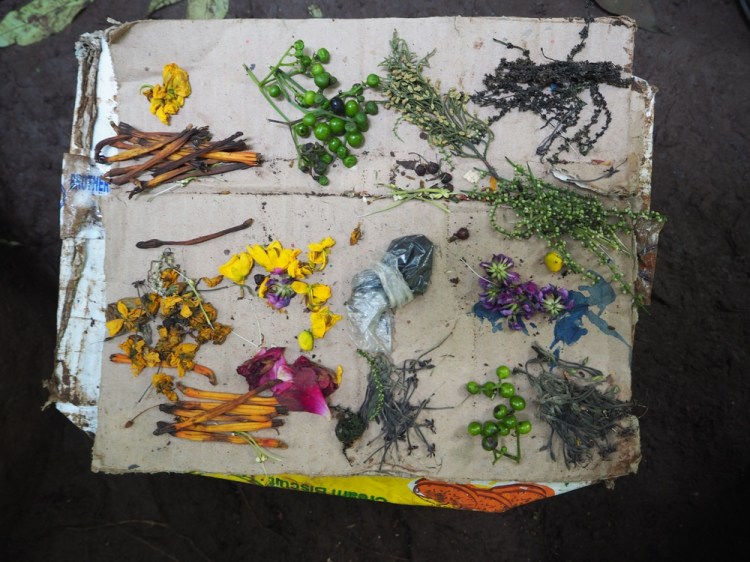
The ingredients for the paints
After we put ashore on the island we had a half-mile walk up a hill, the path lined (even in off-season) by people selling little papyrus boats, various jewellery, crosses, religious paintings, etc. I wonder which is the most profitable pitch? I reckon either 2nd or 3rd in from the bottom or the top. On the way, we saw a man painting copies of images in the monastery using homemade paints made from natural plants, earth and charcoal.
The round monastery followed a standard format with three main areas: a general place for prayer; an area for chanting (with a couple of quite impressive drums that the children particularly liked) and in inner sanctum (‘holy of holies’) that only the priests can enter. All around the inner walls were vibrant paintings of scenes from the New Testament and various saints – with literacy being low, this is how the stories were taught and learned over the ages. There seemed to be 3 levels of character within the paintings: 1) halos indicatings member of Jesus’ family, angels, etc; 2) both eyes showing indicating believers / good people; 3) only one eye visible, symbolising non-believers / bad people. We were amazed at how many of the biblical stories that Gabriel knew and was happy to recite (although he has read his copy of a children’s bible from cover to cover!) – we were there for probably an hour and a half and the children retained their interest throughout, which was an unexpected bonus! However, we decided not to push our luck and opted for just one more brief visit to another temple on the way back.
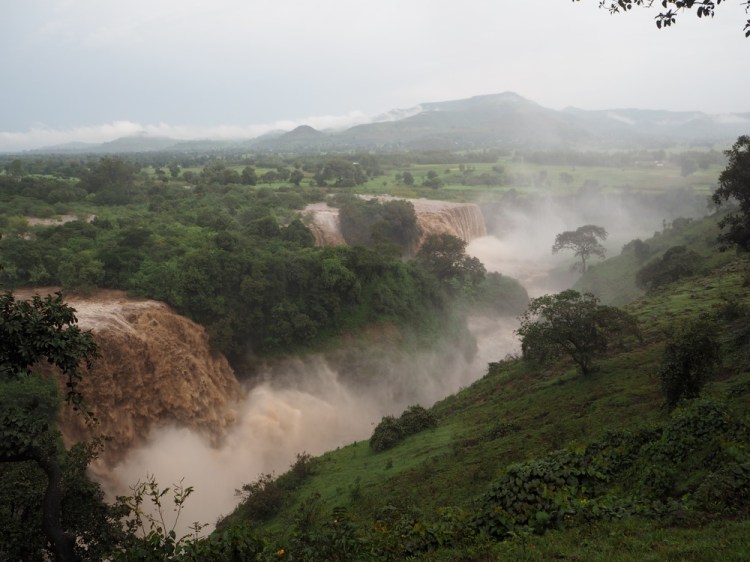
Lake Tana is the source of the Blue Nile and just a few kilometres into its 6,000km journey to the Med is the second largest waterfall in Africa. We’d been advised by our previous guide Bek not to bother visiting due to: lengthy car journey on very bumpy roads, cost of journey & entry fee; risk of there not being much water, even during the rainy season. However, Fi was at her persuasive best(!), so we got up at 5.30am to make the trip before breakfast. Sure enough, it was a VERY bumpy road in a minibus BUT it had rained torrentially in the night and we knew from previous experience what a rapid and dramatic effect that could have on river levels. As we arrived, the rain subsided and we had a lovely 30 minute walk to the falls, with locals volunteering to carry Millie (for a fee, of course) on the steep and tricky bits. I’d been inclined to go with Bek’s advice (we’d ignored it twice before and regretted it) but had to eat my words and admit that Fi had been right to drag us out of bed in the middle of the night. The falls were truly impressive, with a huge volume of water coming over. On the way back, the rain had caused the road to flood and for the second time we had to wait for the flood waters to subside.
From Bahrdar, it was then up to Gondar by public bus, which we were told would take about 2.5 hours. We were collected from the hotel and then went to the central bus station where chaos reigned. Our driver got out and effectively wandered around hawking seats until he’d filled the bus. He tried to charge us for 2 benches of 3 seats – we refused but he pointed out that someone would sit in the spare seat. In the end, we were squeezed into just 3 seats!
Before we’d left the town, we stopped for about 20 minutes to let one of the passengers out to apparently do her weekly supermarket shop – either that or she’d gone home to pack all her stuff for her weekend trip – she returned absolutey laden with carrier bags! The countryside was again beautiful, with ‘fields’ of different crops (there were no apparent boundaries separating them), creating a patchwork of different coloured polygons. Here the rice was ready to be harvested, so the shades of green were broken by patches of gold. The road was lined by beautiful yellow flowers that only come out at this time of year. It’s New Year’s Eve here and most of the passengers were travelling home for family celebrations. The tradition is that boys and men give these flowers to their mother for New Year – we stopped several times en route for the men to get out and pick large bunches, including our driver! So we eventually arrived in Gondar at 5.30pm, the journey have taken more than twice as long as scheduled and too late to visit the famous palace. Never mind, we can see it on Saturday when we get back from our camping trip to the Simien mountains.

Supper, reluctantly joining our crew
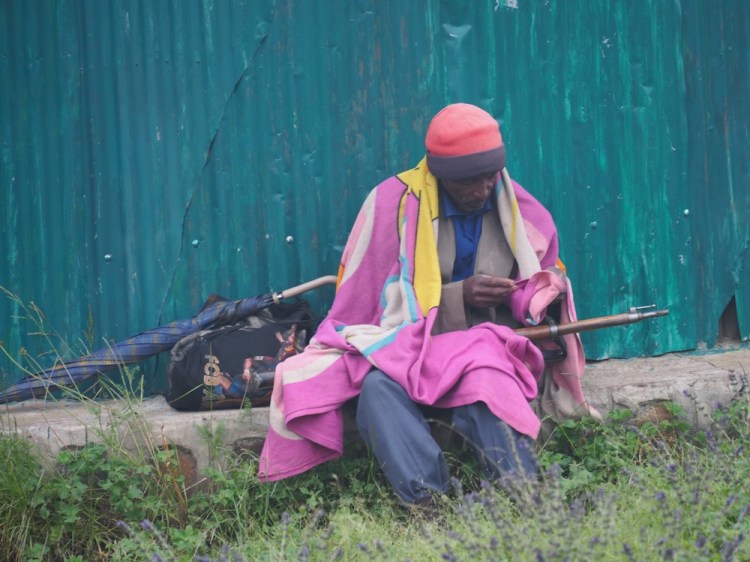
Our scout, fully kitted out with brolly, rifle and Barcelona FC bag!
The next morning we’re met nice and early by our guide Malese – it feels so great to be back in a Landcruiser, even though it’s an older model than the last one. We drive for a couple of hours to a small town just outside the national park to pick up a few provisions: tents, sleeping bags, food (including a scrawny looking chicken), etc. I was just about to seruptitiously take a photo of a craggy-faced character with an umbrella, a rifle and a Barcelona FC duffle bag over his shoulder when Malese introduced him to me as our scout! So into our trusty Landcruiser he hopped, with assistant chef Fanta and one more crew. So we now have all of our kit, the camping kit, 10 people (one or two of whom could have benefited from deodorant) and a chicken in, or on, our car.
Off we drive for another hour or so, (punctuated by the occasional urgent stop for Jemima, as it happens, to hop behind a bush. I now hold the ‘cast iron stomach’ record for only having been sick once on the trip!) into the national park. The plan was to drop us off and for us to walk the rest of the way along a ridge to Sankaber camp but the weather was closing in, so we drove all the way to the camp and pottered around there, stopping off along the way to investigate a group of Gelada baboons wandering in a meadow of wild thyme.
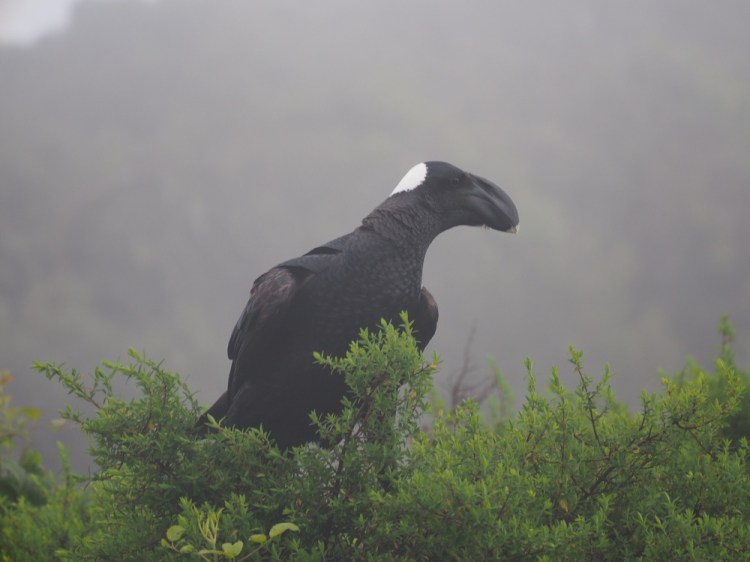
Thick-billed raven
I’m going to run out of superlatives talking about the Simien mountains, but the views down the valley from a view point at the back of the campsite were stunning. The clouds were blowing in and out, changing the light every couple of minutes and creating a wonderful atmospheric feel. While we were getting a feel for the lie of the land, the crew set up camp, discretely dispatched our feathered guest and set about creating an extravagant meal in the kitchen hut. The meal was delicious, although the chicken, despite some considerable time in a pressure cooker, was completely unchewable – too many stress hormones, among other things! We also had the company of a couple of huge, noisy (and very bold) thick-billed ravens hanging around looking for any leftovers. They were particularly grateful to Millie for scattering her food liberally at mealtimes!
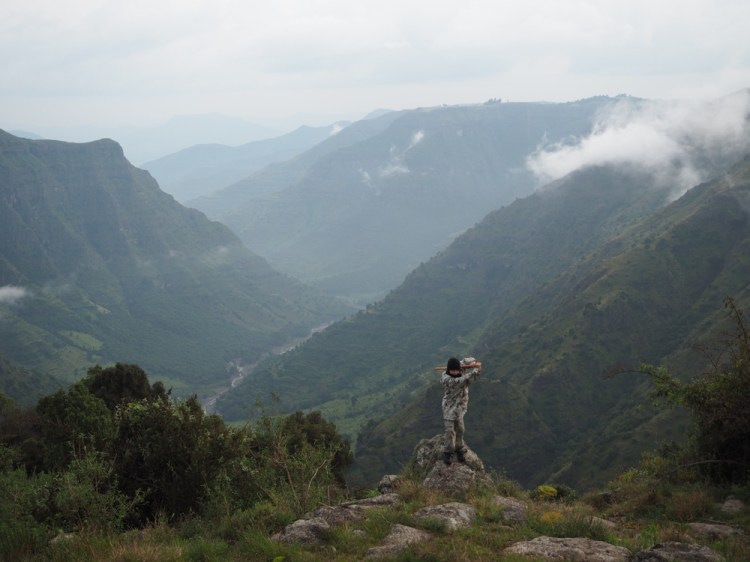
The view one way down the valley (with Ninja warrior)
We had been warned that it gets very cold at night in the Simien mountains – our campsite was at 3,200m – and they were right. We wrapped up in as many warm clothes as we had and huddled down. I discovered the next day (needless to say there were a couple of children sleeping between us) that Fi had slept in 2 T-shirts, 2 jumpers, a fleece, her waterproof jacket and a balaclava – well, she does feel the cold a bit!
I woke at 6am, considered turning over and going back to sleep but thought better of it and decided to get up and watch the sun rise over the valley. What a good decision! It was incredible, with the sky constantly changing colour and the rising sun catching different edges of the white clouds as they blew across, before suddenly cutting through like a projectioner’s light in a cinema and eventually lighting the mountains on the other side of the valley.

Breakfast at our campsite – what a way to start a day!
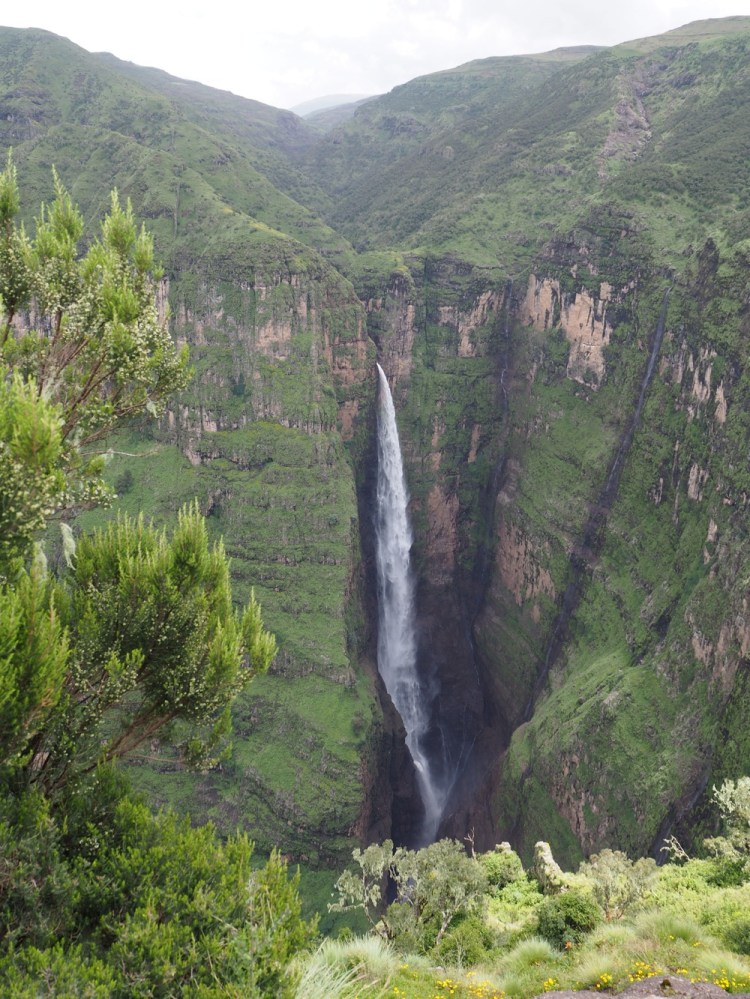
I didn’t dare get closer to the edge to get the full height of the waterfall!
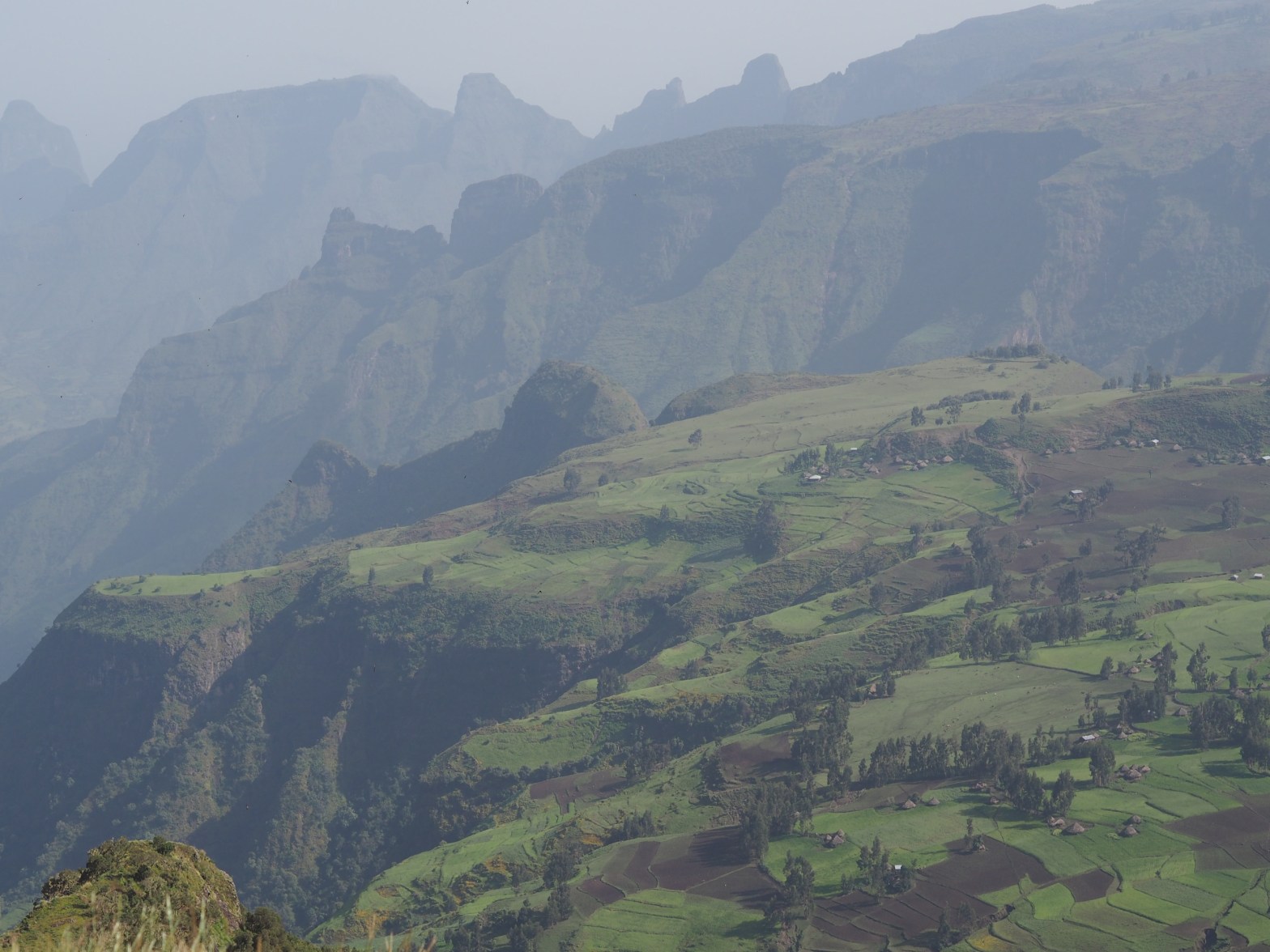
After breakfast, we set off on a hike to a waterfall. It was a beautiful day, even though it’s rather hazy at this time of year. The views were absolutely spectacular – the Simien mountains are characterised by high plateaus at 3,000 – 3,500m, on which farmers graze sheep and goats and grow barley. All the ploughing is done by hand, including on some unfeasible slopes. This is offset by dramatic cliffs, up to 1km high. We are at the end of the rainy season so wild flowers are abundant and the scent of wild herbs is intoxicating.
Getting to to the viewing point for the waterfall involved crossing a short but nerve wracking ridge, with sheer drops off each side (of course in reality it was plenty wide enough). Jemima and Gabriel are like mountain goats and took it in their stride; I however, carried Millie across rather tentatively! The waterfall was worth it, over 500m high, with our small viewing peninsula again surrounded by sheer cliffs.

You can see how even at these altitudes, the plateaus are being cultivated.
The children (including Millie) did really well with the trekking – we walked for at least 3 hours, admittedly at a pretty gentle pace, but very few complaints along the way. This bodes well for Nepal!

An adult male Gelada baboon – really beautiful creatures, they have a tail like a lion and a golden mane the ripples magnificently when they run
We then drove to Chenek camp at 3,600m, which if anything was even more beautiful than Sankaber. There was a troup of Gelada baboons near the camp that we hung out with for a while, watching them going through their evening grooming rituals. At one point, Gabriel called me out of the kitchen hut to see some baboons close by. Fi was in the tent as about 150 baboons ran right past it. I called to her to come out to look; when she did Malese immediately called “don’t look at the baboons, look at the wolf!” They had all gathered together to escape an Abyssinian wolf (like a large red-brown dog) that was stalking them!

Another fabulous breakfast!
After another cold night and great breakfast in the sunshine, Gabriel & Jemima both collected charcoal from the previous night’ scamp far and set about making their own paint, inspired by the painter at the monastery! We then set off for another walk on which we managed to spot a Walia Ibex (another species endemic to Ethiopia), albeit at a considerable distance. We then reluctantly said farewell to the Simien mountains and returned to Gondar – this has been a real highlight of our trip so far, I’m just sorry we only had 2 nights.

Typical Simien mountain scenery
On the way back, the car developed a very nasty screeching sound and we had to stop to get it fixed. The good news was it coincided exactly with Arsenal vs. Manchester City, which we watched in a local bar. The bad news was that it meant we were late into Gondar and again missed the Palace – oh well, we’ll have to come back to see it next time!
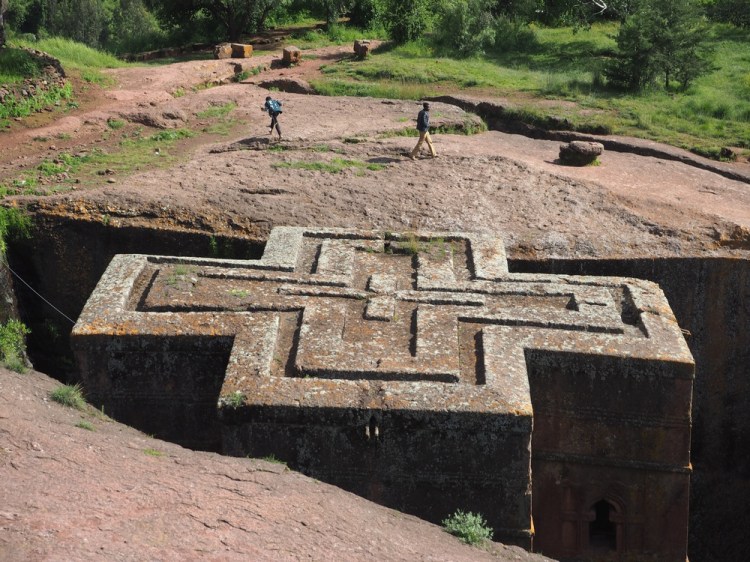
The next day we hopped on a short flight to Lalibela, the holiest city in Ethiopia, famous for its rock-hewn sunken churches. We decided to visit just 3 of the 11 – it was pretty awe-inspiring to be inside a church in which all the open space has been carved out of rock, but when you’ve seen three…
We did go to an amazing restaurant, the Ben Ababa, owned by a Scottish woman and her Ethiopian husband. It overlooks the Rift Valley and has an extraordinary structure with a series of small individual viewing points on different levels.
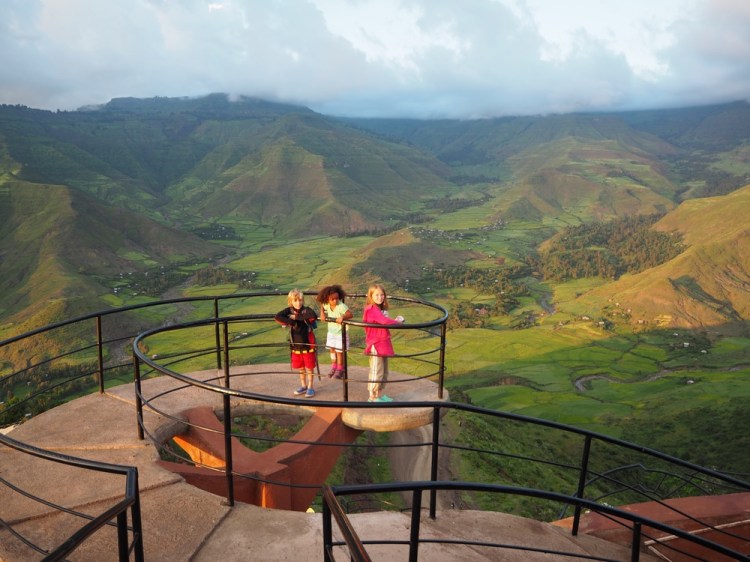
The Ben Ababa restaurant in Lalibela, overlooking the Rift Valley
Although Lalibela is probably the most famous tourist destination in Ethiopia and as I said, being inside a rock-hewn church is pretty mind-blowing, the town is nothing particular to write home about and I’m not sure it was worth the cost of the flight there, plus $125 of entrance fees. Still we’ve seen it now and know for next time.
 Five Go Round The World